
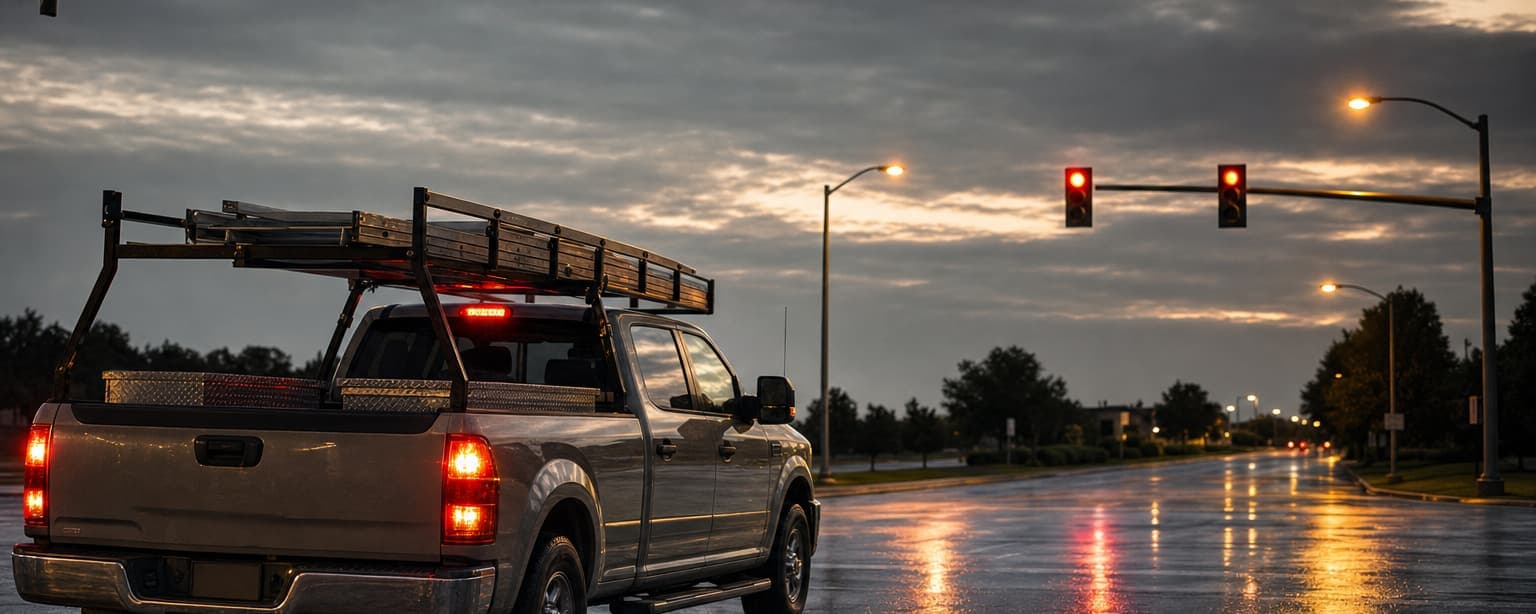
Your personal auto policy will decline the claim the moment it learns the trip was work.
Commercial auto covers vehicles the business owns and the people who drive them for work: liability for the harm they cause, and physical damage to the vehicles themselves.
Tell us the situation.
One licensed human replies the same business day — not five agents, not an auto-responder. If the policy you have is already the right one, we will tell you.
We use this to quote and service your insurance, and we do not sell it or pass it to lead networks. Privacy policy.
Send us what you have. We’ll tell you if it’s right.
Your current policy paperwork, a renewal notice, or nothing at all. A licensed agent reads it and replies the same business day.
What commercial auto actually covers.
Liability
Injury and damage your vehicle causes to other people and their property.
Without it — An at-fault accident in a work vehicle becomes a personal judgment against the business.
Physical damage
Collision and comprehensive coverage for the vehicles you own.
Without it — A written-off van is replaced out of cash flow, with the finance still owing.
Hired and non-owned
Rentals, and employees driving their own cars for work.
Without it — An employee’s personal policy declines a business trip and the business is named anyway.
Uninsured motorist
Injury to your driver caused by someone with no insurance or not enough.
Without it — A driver hurt by an uninsured motorist has no recovery beyond that person’s empty pockets.
Where commercial auto shows up.
- Contractor
A truck accident on the way to a job is a personal claim your employee’s insurer will decline the moment they learn it was work.
- Landscaping & Grounds Maintenance
Trucks towing loaded trailers all day are the largest severity exposure on the account, and personal auto declines the moment it learns the trip was work.
- Tree Service & Arborist
Chip trucks, bucket trucks and loaded chippers are heavy, frequently in traffic, and rated as such.
- Snow & Ice Management
A plow blade is an attachment your auto policy has to know about, and damage caused while plowing is auto exposure rather than general liability.
- Pesticide & Herbicide Application
Spray rigs and tanks on the road are business use and carry the chemical with them.
- Irrigation & Sprinkler Contractors
Trucks and towed equipment are on the road between sites every day.
- Trucking
The gap between those two numbers is the difference between legal and hireable, and plenty of new authorities buy the first and find out about the second from a broker who will not load them.
- Auto Services & Garages
Shop trucks, loaners and test drives are all uninsured business use.
- Janitorial & Cleaning
Crews driving between sites all day are uninsured for work use without it.
- Film & Entertainment
Production vehicles, cube trucks and picture cars are all business use.
- Directional Boring
Trucks, trailers and equipment transport are constant and all business use.
- Pet Services & Veterinary
Mobile grooming and transport put the animals and the vehicle on the road together.
- Tow Truck & Recovery
The wrecker itself is a heavy vehicle in traffic, often on a shoulder at night, which is where this trade’s worst losses happen.
- Tanker & Hazmat
The filing that keeps your authority active, at the higher minimum your commodity requires rather than the general freight figure.
- Refrigerated Freight
The filing and the primary liability that keeps the authority live.
- Livestock Hauling
Primary liability and the filing behind your authority.
- Farm Truck
A truck registered to the farm and hauling its own crop, livestock, machinery or supplies is a private carrier. It needs commercial auto liability, and a farm plate does not change that.
- Auto Transport
Primary liability and the filing that keeps the authority active.
- Hot Shot Trucking
Operating under your own authority means the same federal filing as a tractor-trailer, whatever the truck looks like.
- Box Truck & Straight Truck
The filing applies to the freight and the authority, not to whether the vehicle needs a CDL to drive.
- Last Mile & Delivery Contractors
A fleet of vans making hundreds of stops a day is the highest-frequency auto exposure in transport.
- Dump Truck & Aggregate Hauling
Loaded dump trucks are top-heavy and the overturn exposure is unlike anything in general freight.
- Local & Short-Haul Trucking
Frequent stops in congested areas is a high-frequency exposure, and it is rated very differently from highway miles.
- Regional & Intermediate Radius
Regional running combines real highway severity with frequent stops, and the filing has to match where you actually go.
- Long Haul Trucking
Highway speeds and long hours produce the largest verdicts in transport, and the federal filing is what keeps the authority live.
- Freight Brokers
Contingent auto liability sits behind the carrier’s policy for the moment a plaintiff argues the load was really yours.
- Freight Forwarders
Any drayage or final-mile leg you run yourself is your auto exposure, whatever the rest of the chain looks like.
- Single Truck & Owner-Operator
The federal filing is the same on one truck as on fifty, and it is what keeps the authority active.
- Fleet
Fleet liability and the federal filing, at the limit that keeps every unit’s authority active.
- Commercial truck
The liability the FMCSA filing is written against — no filing, no active authority, no load.
- UIIA & Intermodal
Auto liability at the limit the agreement specifies, with the filing that keeps your authority live.
- Public Auto & Passenger Transport
Passenger carriers have their own federal minimums, set by seating capacity rather than by what is in the back.
- Bus, Limo & Charter
The federal minimum for a passenger carrier is set by seating capacity, and crossing sixteen seats changes the number substantially.
- Non-Emergency Medical Transport
Wheelchair-equipped vehicles carrying non-ambulatory passengers are the highest-rated units in public auto.
- Taxi & Rideshare Fleets
High-mileage urban driving with continuous passenger pick-up is the highest-frequency exposure in public auto.
- Limousine Service
A personal auto policy excludes a vehicle carrying people for a fee, and a commercial policy written below the filed limit leaves the operator holding the difference after a serious loss.
- Party Bus Operators
A policy written at the limousine band because the vehicle was described as a limo bus is under-filed, and an under-filed carrier is out of service before it is out of money.
- Black Car & Chauffeur Service
The personal auto policy on the same sedan excludes public or livery use. The first paid ride voids the coverage you thought you had.
- Charter Bus & Motorcoach
A coach without the filing and the endorsement is not authorized to carry passengers across a state line, and a coach insured below the band is out of service on inspection.
- Regional Center Vendors
Transporting consumers brings vehicle requirements of its own, and they are checked.
- Glass Contractors & Glaziers
Racked glass on a truck is fragile cargo and a load shift is a total loss.
- Carpentry & Framing Contractors
Crews, lumber and equipment move between sites daily.
- Hardscape & Retaining Walls
Material deliveries and towed equipment are constant and all business use.
- Pressure & Soft Washing
The truck and the trailer are on the road daily and towing is constant.
- Mobile Mechanics & Heavy Truck Repair
Service trucks are on the road constantly and frequently stopping on shoulders, which is the worst place a vehicle can be.
- Roofing Contractors
Loaded trucks, trailers, tear-off debris and material deliveries run all day.
- Electrical Contractors
A van full of material on the way to a call is a work trip, and a personal auto insurer will decline it once they learn that.
- Plumbing Contractors
Service vans run all day between calls, and the mileage is the exposure as much as the driving.
- HVAC Contractors
Service trucks carrying cylinders and recovery equipment are on the road all day, and the cargo changes the conversation after a collision.
- Painting Contractors
Crews travel between sites daily with material aboard, and solvent in a van changes what a fire looks like.
- Concrete Contractors
Mixers and pump trucks are heavy vehicles on public roads, and a loss involving one is rarely small.
- Crane & Rigging Contractors
A boom truck is a vehicle when it is driving and a machine when it is lifting, and the two are not covered by the same thing.
- Excavation & Grading Contractors
Haul trucks and lowboys move heavy plant on public roads, and an overturned load is a road closure as well as a claim.
- Drywall & Interior Finish Contractors
Crews and board move between sites daily, and a loaded truck handles differently from the one on the personal policy.
- Moving & Storage Companies
Loaded trucks in residential streets and loading docks are the exposure the business runs on every working day.
- Masonry Contractors
Loaded flatbeds carrying units and scaffold are heavy vehicles, and a shifted load is a road incident.
- Flooring Contractors
Vans and box trucks run loaded between the warehouse and occupied buildings every working day.
- Welding & Fabrication
A mobile rig is a truck carrying compressed gas, which changes what an accident looks like.
- Handyman & Property Maintenance
A loaded van going between calls all day is a business use a personal policy will decline once it understands it.
- Security Guard Companies
Patrol vehicles cover a lot of miles at night between sites, which is the highest-risk driving profile there is.
- Staffing & Temporary Employment Agencies
Where placed workers drive, whose policy responds is decided by contract long before it is decided by an adjuster.
- Staging & Rigging Companies
Trucks move heavy gear between venues on a schedule that does not forgive delay.
- Television Production
Unit moves, picture vehicles and a fleet that runs for months rather than weeks.
- Loan-Out Companies
Driving to and between engagements on business is not what a personal auto policy was rated for.
- Touring Artists & Bands
A van and trailer crossing state lines on a schedule is a commercial use whatever the vehicle looks like.
- Equipment Rental Companies
Deliveries, collections and trucks moving high-value loads on a schedule.
- Production Vendors
Vehicles moving between locations with equipment, people or food aboard.
- Music Video Production
Unit moves and picture vehicles on a one or two day schedule are still commercial use.
- Auto Body & Collision Shops
Tow-ins you move yourself, the parts runner and road tests after a repair. An employee driving a customer car is an auto exposure, and general liability excludes autos.
- Auto Detailing, Ceramic Coating & Tint
The van or truck you detail from. Personal auto policies commonly exclude a vehicle used mainly for business, and a loaded rig is a business vehicle.
- Tire Shops
Service trucks for road calls and fleet work, and road tests in customer vehicles.
- Heavy Truck & Diesel Repair Shops
Service trucks, the wrecker if you have one, and road tests. Trucks you drive on a customer’s behalf need auto coverage that names that exposure.
- Event Vendors & Concessionaires
Getting to the show with the stock aboard is business use whatever the vehicle is.
- Youth Sports & Leagues
Volunteers driving teams in their own vehicles is the gap nobody has looked at.
- Sports Camps & Clinics
Transporting campers, whether in hired vehicles or staff cars.
- Food Trucks
A personal auto policy excludes business use, and this is unambiguously business use.
- Daycare & Childcare
Transporting children is the single highest-severity thing a center does.
- Florists
Personal auto excludes business use, and delivery is the business.
- Private Schools
Transporting children is the highest-severity thing a school does.
- Funeral Homes
Processions run on public roads with unusual driving patterns.
- Auto Dealers
A customer crashing on a test drive is your liability, not theirs.
- Couriers & Last-Mile Delivery
A delivery claim on a personal policy is a denial, not a dispute.
- Dispensaries
A vehicle carrying cash and product is a distinct target.
- Party, Event & Bounce House Rentals
Personal auto excludes business use, and delivery is the business.
- Summer Camps
Transporting children is the highest-severity thing a camp does, and every field trip is a full bus of them.
- Group Homes
Transporting residents is the highest-severity thing a group home does every day.
- Adult Day Care
Transport is the highest-severity thing a day program does, and it does it twice a day.
- Medicaid Waiver Providers
Virginia and New Jersey both require vehicle liability in their rules, and a personal auto policy on an agency van is not it.
- Land Trusts and Conservation Organizations
A personal auto policy on a staff member’s truck rarely answers when it is used for land trust work.
- Homeless Shelters and Transitional Housing
A van full of guests is the highest-severity thing most shelters do every day.
- Community Action Agencies, Head Start and Weatherization
A bus of preschoolers is the highest-severity exposure an agency has, and federal rules require monitors and licensed drivers on it.
- Youth Centers, Clubs and Y’s
Pickup runs happen every day, and a crash with children aboard is the most severe claim a youth program faces.
- Private Colleges and Universities
15-passenger vans and student drivers are the auto risks underwriters ask about first.
- GEICO Commercial
Competitive on small fleets and single units, particularly where the driving records are clean.
- Berkshire Hathaway Homestate
A market that will underwrite a fleet rather than rate it, which cuts both ways depending on your records.
- Auto Repair Shops
Shop trucks, the parts runner and road tests. An employee test-driving a customer’s car is operating a non-owned vehicle on your business.
What clients with commercial auto ask us.
My van is in my own name. Does my personal policy cover it?
Almost certainly not once the use is commercial, and this is the single most common uninsured exposure in small business. Personal auto policies exclude business use beyond commuting. The insurer does not have to prove much — a signwritten vehicle, tools in the back, or a delivery on the trip is usually enough — and the discovery happens at claim time.
What is a symbol on a commercial auto policy?
Symbols define which vehicles a coverage applies to: owned, hired, non-owned, or any auto. They matter more than the limits in one specific way: a policy written for owned autos only gives you nothing when an employee crashes their own car on a work errand. Check the symbols, not just the number.
I was non-renewed and my policy lapses this week. Can a fleet be placed that fast?
Often, if the file is complete on day one. A non-renewal is not a decline from the whole market, it is one carrier deciding the account no longer fits its book, and growth is a common reason. We placed a California electrical contractor whose fleet had outgrown its carrier the next business day after it called us, 24 hours before the lapse. What makes that possible is having the schedule, the drivers, the loss runs and the non-renewal notice ready to send, so the first conversation with a new market is an application rather than a request for one.
Guides on commercial auto.
- Does general liability cover vehicles?General liability excludes vehicles by name. Commercial auto covers the vehicles the business owns, hired and non-owned auto covers the ones it borrows or rents, and the two policies sit side by side.
- CSL vs Split LimitsOne pot versus three caps: why a single seriously injured claimant is the case where split limits fail, and why filings ask for a CSL.
Commercial insurance is 96% of what we do — it is not a department here, it is the whole business. Not ready to talk? The guides answer the questions this page raises in more depth. Already insured with us and need a certificate or a policy change? Ask the service team rather than starting a quote — it is faster and it goes to the people whose job it is. We also write home and auto, which is usually cheaper alongside the business policy than apart from it.
Handed a lease, a vendor packet or a client contract with insurance requirements? Paste it into the COI Requirements Decoder to see what each one means for your business, or read what the requirements mean.