
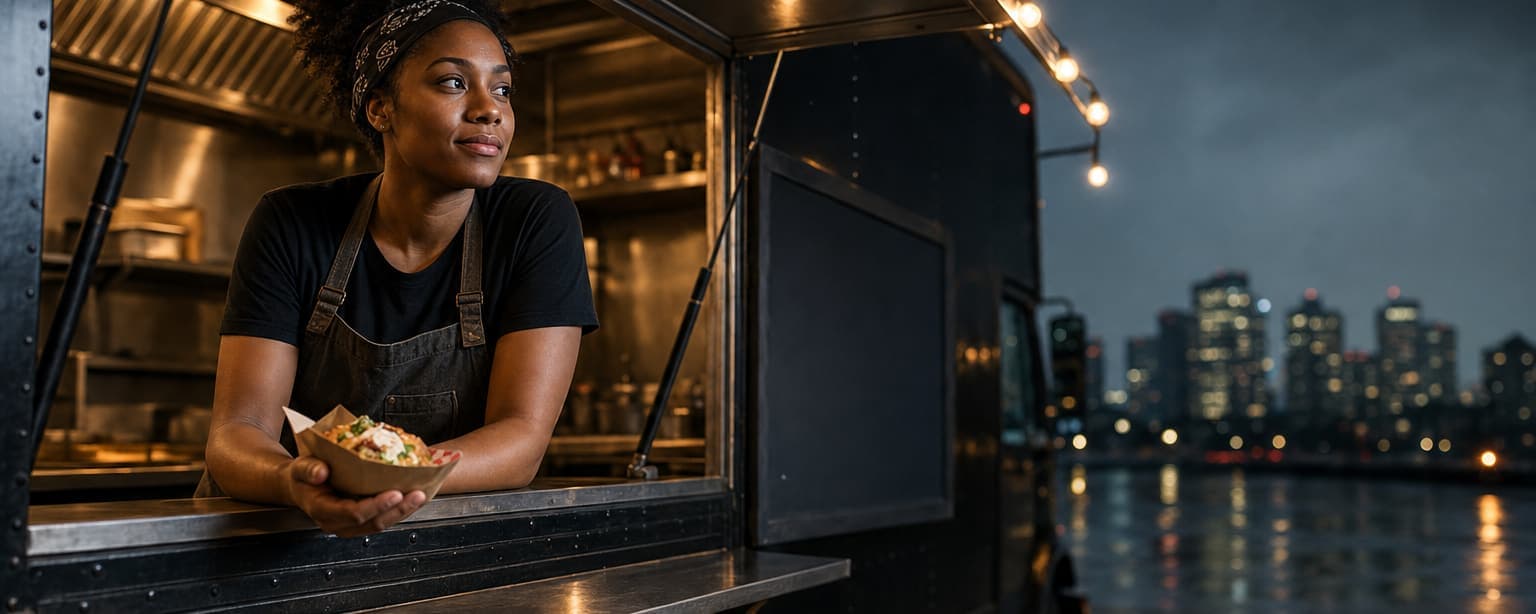
It is a commercial kitchen and a commercial vehicle, and it needs to be insured as both.
We cover mobile food businesses for the auto, the general liability, the cooking equipment, and the certificates every event and commissary asks for.
Tell us the situation.
One licensed human replies the same business day — not five agents, not an auto-responder. If the policy you have is already the right one, we will tell you.
We use this to quote and service your insurance, and we do not sell it or pass it to lead networks. Privacy policy.
Send us what you have. We’ll tell you if it’s right.
Your current policy paperwork, a renewal notice, or nothing at all. A licensed agent reads it and replies the same business day.
What food truck businesses actually need.
Commercial auto
The truck or the tow vehicle and trailer, on the road.
Without it — A personal auto policy excludes business use, and this is unambiguously business use.
General liability
Customer injury, and foodborne illness claims.
Without it — No event, festival or commissary will let you operate without it.
Equipment and contents
Griddles, fryers, refrigeration, generator and the build-out itself.
Without it — The fit-out is often worth more than the vehicle it sits in.
Spoilage and breakdown
Stock lost when refrigeration or the generator fails.
Without it — A failed fridge overnight is a write-off and a lost trading day.
Business interruption
Income while the truck is off the road after a covered loss.
Without it — One vehicle is the whole business; there is no second location.
Crime and social engineering
A cash-heavy till with one person on it, and a commissary payment sent somewhere it should not go.
Without it — A caller claiming to be the commissary asks for a card number to hold your slot. Nothing was taken from the truck, so property coverage does not respond. Social engineering is bought separately, and it has to be asked for.
Group health and benefits
The two or three people who can actually run your window at lunch rush.
Without it — A truck runs on a tiny crew, so one person leaving is a third of your labor. Benefits are cheap next to a closed service.
Businesses like this one, with their own page.
Every one of these is written for that specific operation — the coverages it needs, the questions underwriters ask it, and what it usually gets wrong.
- Food Vendors and Concessions
A food vendor sells at events, markets, fairs and stadiums under a permit from someone else, and every one of those someones asks for general liability with themselves named, usually a week before the event. That certificate is the first reason vendors buy the policy; the second is the claim the certificate is for, which is a customer made ill by what you served or hurt by the setup you brought. We place annual policies for vendors who work a season of events, per-event certificates for the occasional one, and the trailer, the equipment and the truck for those who own them.
What our food truck clients ask us.
Why do I need two kinds of liability?
Because the truck causes two different kinds of harm. Commercial auto answers what happens while it is being driven, such as a collision on the way to a pitch. General liability answers what happens while it is being operated as a food business: a customer burned at the window, an illness from the food, someone tripping on your generator lead. Insurers treat parked-and-serving and driving as separate exposures, and a policy covering only one leaves an obvious hole.
What do events and commissaries actually require?
Usually a $1,000,000 general liability limit, the event or commissary named as an additional insured, and sometimes a waiver of subrogation and proof of workers comp. Large festivals and municipalities can ask for more, and city permit offices frequently require to be named too. Ask for the exact wording weeks ahead: the common failure is a vendor who has coverage but cannot produce a certificate in the right form by the deadline and loses the pitch.
Is the build-out covered by the auto policy?
Only partly, and this is where trucks are badly underinsured. Auto physical damage covers the vehicle, generally at its value as a vehicle. The kitchen inside it — the hood, suppression system, fryers, refrigeration, custom fabrication — is often worth as much again and needs scheduling specifically. Get the build-out valued and listed rather than assuming the truck limit stretches over it.
What do underwriters ask about fire?
The suppression system and the propane. Deep frying in a confined space with LPG on board is a serious fire load, so expect questions about the hood suppression system, when it was last serviced and certified, how many propane cylinders you carry and how they are secured, and whether you have current fire extinguisher inspections. A current suppression certificate is often a condition of coverage rather than a discount.
Also in this family
Commercial insurance is 96% of what we do — it is not a department here, it is the whole business. Not ready to talk? The guides answer the questions this page raises in more depth. Already insured with us and need a certificate or a policy change? Ask the service team rather than starting a quote — it is faster and it goes to the people whose job it is. We also write home and auto, which is usually cheaper alongside the business policy than apart from it.
Handed a lease, a vendor packet or a client contract with insurance requirements? Paste it into the COI Requirements Decoder to see what each one means for your business, or read what the requirements mean.