
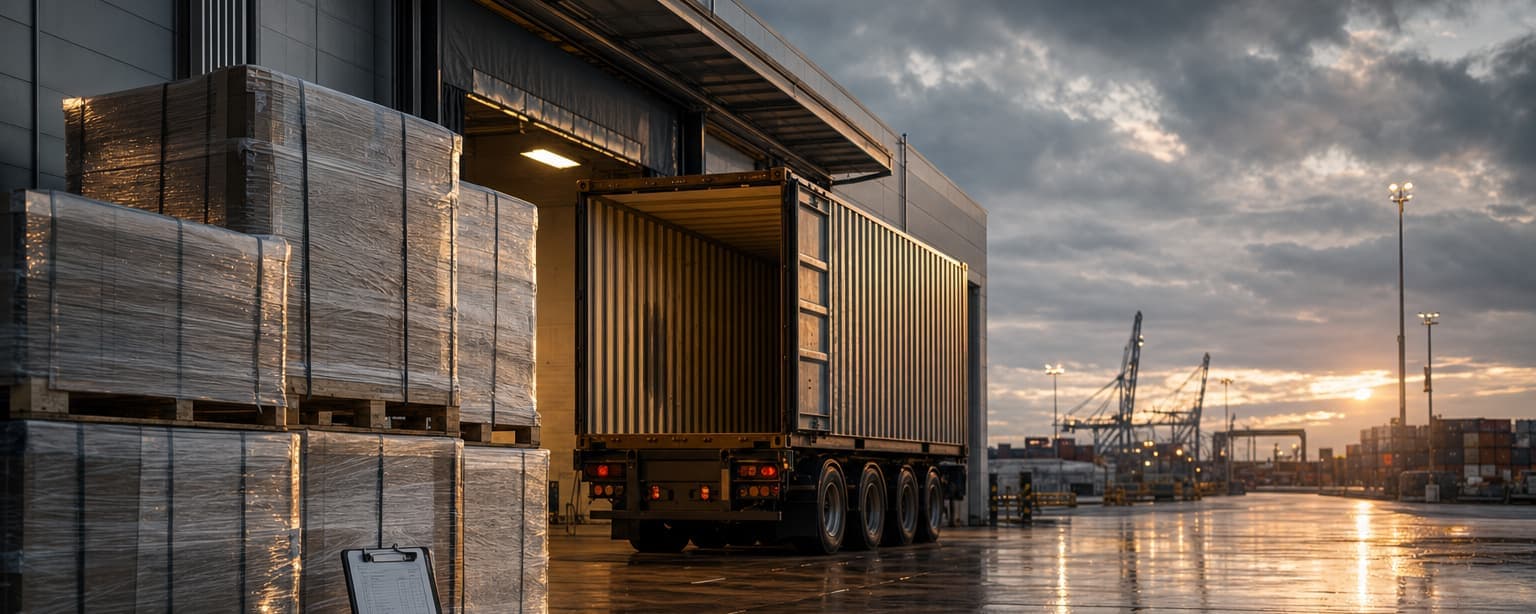
You took possession. That changes which policy answers.
A forwarder assumes carrier liability rather than arranging somebody else’s, which makes contingent coverage the wrong answer. We write forwarders and NVOCCs on the right one.
Tell us the situation.
One licensed human replies the same business day — not five agents, not an auto-responder. If the policy you have is already the right one, we will tell you.
We use this to quote and service your insurance, and we do not sell it or pass it to lead networks. Privacy policy.
Send us what you have. We’ll tell you if it’s right.
Your current policy paperwork, a renewal notice, or nothing at all. A licensed agent reads it and replies the same business day.
What freight forwarding businesses actually need.
Motor truck cargo
The freight itself while you are hauling it. Separate from the liability on the truck.
Without it — A forwarder issues its own bill of lading and takes on the goods, so this is primary coverage rather than the contingent kind a broker buys.
Inland marine & equipment
Tools, equipment and property in transit. It picks up exactly where commercial property stops, which is the moment the item leaves the building.
Without it — Freight sitting in your facility between legs is property in your care, custody and control, which general liability excludes outright. Warehouse legal liability is written here.
Professional liability
Covers the advice, the drawing, the diagnosis. The work itself, rather than someone getting hurt on your premises.
Without it — Misdescription, a missed customs deadline or the wrong routing is an error rather than an accident, and the loss is purely financial.
General liability
Third-party bodily injury and property damage. It is the line nearly every contract names by default.
Without it — Docks, forklifts and visiting drivers are ordinary premises exposure and the most frequent injury claim in the operation.
Commercial auto
Vehicles the business owns and the people who drive them for work.
Without it — Any drayage or final-mile leg you run yourself is your auto exposure, whatever the rest of the chain looks like.
Cyber & tech E&O
Breach response, ransomware and the notification costs that follow. Technology errors and omissions sits on the same policy and covers the software or service itself failing a client, which is the half most tech companies find out about too late.
Without it — Routing instructions and payment details move by email, which is exactly where the diversion fraud in this trade happens.
Umbrella & excess liability
Extra limit stacked above general liability, auto and employers liability. Usually the cheapest million dollars on the policy.
Without it — International contracts routinely specify limits above primary before they will award the work.
Surety bonds
License, bid and performance bonds. A bond guarantees you will finish the job. It protects the other party, not you, which is the part most people get wrong.
Without it — An OTI license requires a bond with the Federal Maritime Commission, and customs work brings its own.

Lori Adams, TRS
Commercial Trucking Insurance Advisor
Twenty-five years in trucking insurance. Knows the filings, the radius rules and the carriers that will actually take the risk.
Transportation Risk Specialist (TRS)
What our freight forwarding clients ask us.
What is the real difference between a broker and a forwarder?
Possession, and everything follows from it. A broker arranges transport between a shipper and a motor carrier and never takes the goods. Their exposure is the choice they made. A forwarder takes the freight, usually issues its own bill of lading, often consolidates it with other shipments, and is liable as a carrier for what happens to it. A forwarder therefore needs real cargo coverage rather than contingent, and buying a broker’s program because it looked similar leaves the main exposure uninsured.
Do I need warehouse legal liability if I only hold freight briefly?
If it is ever under your roof or in your yard, yes. General liability excludes damage to property in your care, custody and control, and freight waiting for its next leg is exactly that. Duration does not change the exclusion: a pallet destroyed by a sprinkler failure overnight is the same uncovered loss as one stored for a month.
We are an NVOCC. Does that change the program?
It adds to it. Operating as a non-vessel-operating common carrier means an OTI license from the Federal Maritime Commission and a bond with it, and it means you are issuing your own bills of lading on the ocean leg with the liability that carries. The domestic pieces stay the same; what changes is that the cargo coverage has to be written knowing you are the contracting carrier rather than an intermediary.
Is customs brokerage covered by the same policy?
Not automatically, and it is the gap we see most on combined operations. Customs work is a professional service with its own errors — a misclassification, a missed filing, a duty exposure — and it needs to be named in the professional liability rather than assumed to fall inside a forwarding policy. If you hold both licenses, say so at application; the two are rated differently.
Commercial insurance is 96% of what we do — it is not a department here, it is the whole business. Not ready to talk? The guides answer the questions this page raises in more depth. Already insured with us and need a certificate or a policy change? Ask the service team rather than starting a quote — it is faster and it goes to the people whose job it is. We also write home and auto, which is usually cheaper alongside the business policy than apart from it.
Handed a lease, a vendor packet or a client contract with insurance requirements? Paste it into the COI Requirements Decoder to see what each one means for your business, or read what the requirements mean.