
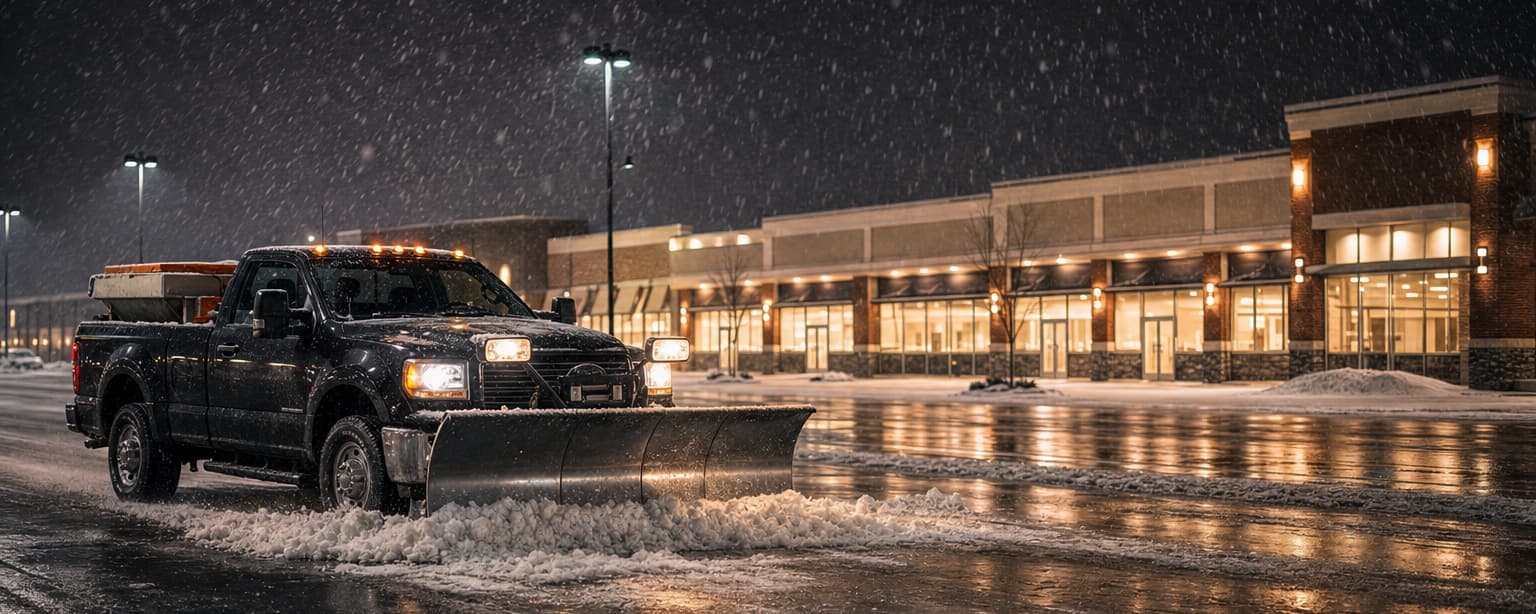
An unendorsed policy does not respond to a slip on a lot you cleared.
Commercial insurance for snow plowing and ice management, including the general liability and commercial auto endorsements a standard landscaping policy leaves off.
Tell us the situation.
One licensed human replies the same business day — not five agents, not an auto-responder. If the policy you have is already the right one, we will tell you.
We use this to quote and service your insurance, and we do not sell it or pass it to lead networks. Privacy policy.
Send us what you have. We’ll tell you if it’s right.
Your current policy paperwork, a renewal notice, or nothing at all. A licensed agent reads it and replies the same business day.
What snow and ice management businesses actually need.
General liability
Third-party bodily injury and property damage. It is the line nearly every contract names by default.
Without it — A slip-and-fall on a lot you cleared is the claim, and without a snow and ice endorsement the policy simply does not answer it.
Commercial auto
Vehicles the business owns and the people who drive them for work.
Without it — A plow blade is an attachment your auto policy has to know about, and damage caused while plowing is auto exposure rather than general liability.
Umbrella & excess liability
Extra limit stacked above general liability, auto and employers liability. Usually the cheapest million dollars on the policy.
Without it — Commercial lots and property management contracts routinely require limits above primary, and a bad ice event produces several claims at once.
Inland marine & equipment
Tools, equipment and property in transit. It picks up exactly where commercial property stops, which is the moment the item leaves the building.
Without it — Plows, spreaders and blades are seasonal equipment worth stealing and expensive to replace mid-storm.
Workers compensation
Required in almost every state the moment you have employees. Priced on payroll and class code, which is why the class code is worth arguing about.
Without it — Night work, ice underfoot and long shifts in the cold are exactly when injuries happen.

Joe Gorman
Co-Founder | President of Commercial Lines
Came up in construction, on site and in the office, then moved into sales. Went out on a limb to become Boring’s first dedicated salesperson when the agency had no sales team at all, and now leads it. Landscaping is the class he writes most: grounds maintenance, tree work, irrigation and the spray operations that push an account out of preferred appetite.
The Grounds Guys — Franchise owners are referred to us by their corporate office. We are not affiliated with, or endorsed by, The Grounds Guys.
Five endorsements, and a certificate is none of them.
A certificate is evidence a policy existed the day it was printed — it says so on its own face. The coverage a contract is really asking for lives on the policy as named endorsements, and this is the list they come from.
- Additional insured — ongoing operationsCG 20 10Covers the general contractor for claims arising from your work while the job is in progress.Without it: They fund their own defense on a claim your work caused, then look to you for it.
- Additional insured — completed operationsCG 20 37Extends that coverage to claims arising after your work is finished.Without it: The claim arrives years later, when the policy that should have carried it has renewed several times. Cheaper policies often exclude this or do not offer it.
- Primary and non-contributoryCG 20 01Puts your policy first and stops your insurer demanding a contribution from theirs.Without it: Two insurers argue about who pays while the defense waits.
- Waiver of subrogationCG 24 04Stops your insurer recovering from the party you agreed in writing to protect.Without it: Your insurer pays, then sues your customer, which ends the relationship.
- Per-project aggregateCG 25 03Gives each job its own general aggregate instead of sharing one across the year.Without it: Another project’s claims quietly spend the limit that was meant to cover this one.
Tract, condominium and apartment work is the exception that undoes all five — an exclusion for multi-unit residential removes the coverage before any endorsement can apply. What national homebuilders require covers that in full — D.R. Horton, Pulte Group, Blackrock Homes and the rest of the national builders set the strictest terms a sub will see, and they do not negotiate them.
Contracts ask for more than these five. Every contract insurance requirement, explained, or paste your exhibit into the Contract Insurance Decoder to see the endorsement behind each clause.
How high do you work?
Third floor and above is a different account. The exposure is not only the fall — it is what gets dropped, who is underneath, and how far a tool travels before it lands. Carriers ask for a height limit and many stop at two or three stories, so work you take on because it was offered can quietly put a renewal into a market you were not in last year. Tell us the tallest job you do, not the usual one.
Residential or commercial?
Underwriters treat these as separate trades even when the work is identical. Residential carries construction-defect exposure that follows the job for years and a homeowner who sues; commercial carries bigger limits, tighter contracts and a general contractor who enforces them. A book that is mostly one prices very differently from a book that is evenly split, and the mix is usually the second question on the application.
“They stay on top of our rates and premiums. They notify us of any potential increase and automatically shop all options to ensure we get the best possible rates. When we initially switched to them they literally cut our premiums in half for both of our companies…”
What the insurance company will ask about your snow and ice management business
We read 2 applications the markets use for this kind of business and pulled out what they actually ask. Have these answers ready and a quote takes a day instead of a week, because nobody has to come back to you for the missing piece.
About the business
- How many years have you been doing snow removal work?
- What's your business structure (sole proprietor, corporation, partnership, or LLC)?
- Do you have a website address?
- What types of customers do you work for (single-family homes, businesses, municipalities, etc.) and what percentage of your work does each type represent?
How you operate
- What equipment do you use for snow and ice removal (plows, shovels, salt spreaders, snow blowers, sweeper brooms, or other)?
- How do you perform your work, including what chemicals, salts, or other methods you use?
- Do your contracts specify where snow should be stored after the job is done?
- Do you work any snow removal jobs in New York, and if so, what percentage of your work is there?
- Do you keep a log book of your work, and if so, what information does it capture?
Your workforce
- How many owners or principals work on the jobs, what do they do, and what's your payroll for them?
- How many full-time employees do you have, what work do they do, and what's your payroll for them?
- How many part-time or seasonal employees do you have, what work do they do, and what's your payroll for them?
- Do you hire casual or day laborers, and if so, how many?
Subcontractors and contracts
- Do you use any subcontractors who don't have their own insurance?
- What percentage of your receipts come from subcontracting costs?
- Do you enter into snow removal contracts written by property owners or other third parties, and if so, what percentage of your work do these represent?
- Do your contracts specify response times for snow and ice removal?
Safety and controls
- Do you provide certificates of insurance to all your customers?
- Do you carry commercial auto insurance, and if so, what limit?
Have these ready
- Your receipts or income statements from your snow removal work
- Your last three to five years of claims history (called loss runs) from your current or prior insurance company
- Copies of all your snow removal contracts with customers, showing who the customer is, what work you perform, and what percentage of your receipts each contract represents
- Copies of your employee payroll records
- A sample page from your work log book if you keep one
You answer what you can; a licensed agent fills the rest with you.
What our snow and ice management clients ask us.
My landscaping policy is in force. Am I covered for plowing?
Probably not, and this is the most consequential misunderstanding in the trade. Snow and ice operations generally have to be added to the general liability policy explicitly, as an endorsement or a class code, and to the commercial auto policy separately because a plow is an attachment the vehicle rating has to account for. Two policies in force and neither one endorsed is a common way to discover a gap in February.
The property manager wants to be indemnified. Should I sign?
Read the clause and check the state before you do. Several states have passed statutes making indemnity and hold-harmless provisions in snow removal contracts void as against public policy — Illinois has had one since 2016 — precisely because contractors were being asked to accept liability for the property owner’s own negligence. Where no such statute exists, that clause transfers real money, and your policy needs to be built to accept it.
Do I need coverage if I only plow for existing landscaping customers?
Yes. The exposure attaches to the work, not to whether the customer is new. A long-standing maintenance client whose parking lot you clear is exactly as capable of producing a slip-and-fall claim as a new one, and the endorsement question is identical.
What records matter after a storm?
Time-stamped service logs, what was applied and when, and the weather at the time. Slip-and-fall claims are often filed weeks or months later, and the defense is almost always the log. Contractors who keep them win claims that contractors who do not, settle.
What does a snow and ice management insurance application ask for?
The applications for snow and ice management businesses ask about 4 things above all: how many years have you been doing snow removal work; what equipment do you use for snow and ice removal (plows, shovels, salt spreaders, snow blowers, sweeper brooms, or other); how many owners or principals work on the jobs, what do they do, and what's your payroll for them; do you use any subcontractors who don't have their own insurance. Have your receipts or income statements from your snow removal work and your last three to five years of claims history (called loss runs) from your current or prior insurance company ready and a quote takes a day instead of a week.
Commercial insurance is 96% of what we do — it is not a department here, it is the whole business. Not ready to talk? The guides answer the questions this page raises in more depth. Already insured with us and need a certificate or a policy change? Ask the service team rather than starting a quote — it is faster and it goes to the people whose job it is. We also write home and auto, which is usually cheaper alongside the business policy than apart from it.