
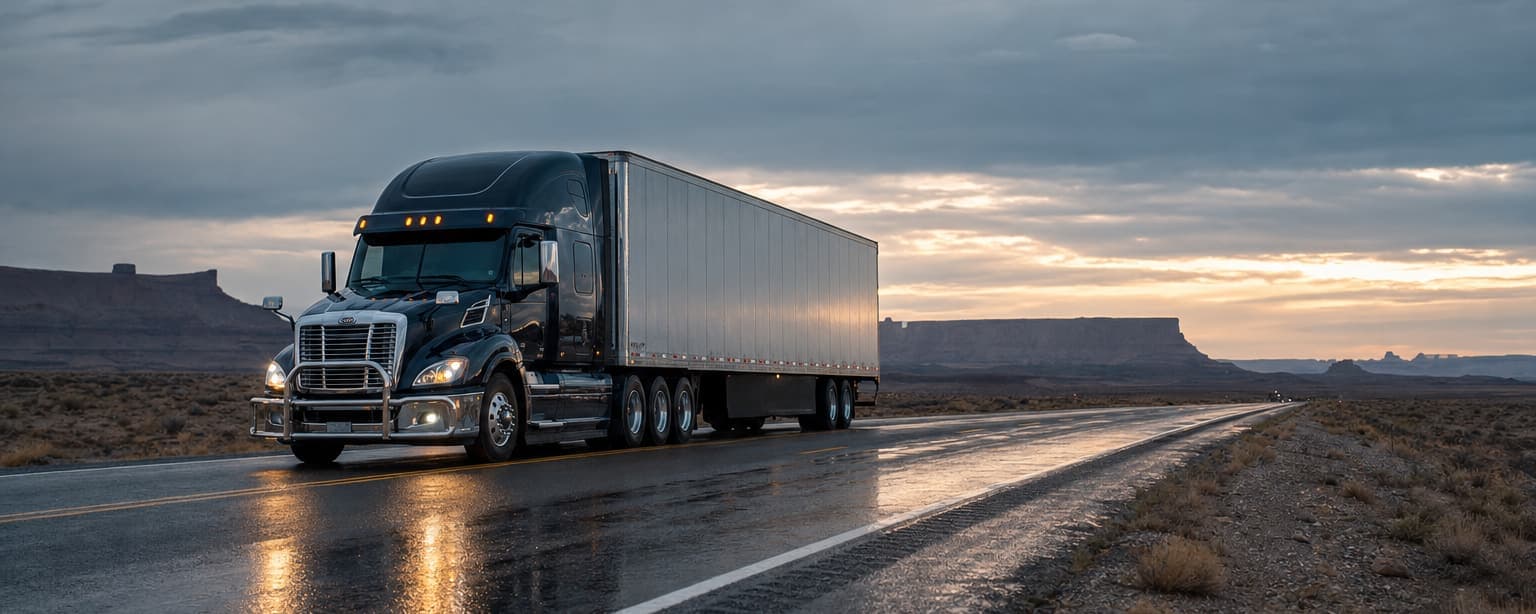
Every state you cross is another chance to be inspected.
We insure long haul and over-the-road carriers, where federal filings and inspection exposure across jurisdictions sit alongside the severity that prices the class.
Tell us the situation.
One licensed human replies the same business day — not five agents, not an auto-responder. If the policy you have is already the right one, we will tell you.
We use this to quote and service your insurance, and we do not sell it or pass it to lead networks. Privacy policy.
Send us what you have. We’ll tell you if it’s right.
Your current policy paperwork, a renewal notice, or nothing at all. A licensed agent reads it and replies the same business day.
What long haul trucking businesses actually need.
Commercial auto
Vehicles the business owns and the people who drive them for work.
Without it — Highway speeds and long hours produce the largest verdicts in transport, and the federal filing is what keeps the authority live.
Motor truck cargo
The freight itself while you are hauling it. Separate from the liability on the truck.
Without it — Loads are larger, longer in transit and further from anyone who can respond to a problem.
Umbrella & excess liability
Extra limit stacked above general liability, auto and employers liability. Usually the cheapest million dollars on the policy.
Without it — Trucking verdicts are among the largest there are, and a primary limit rarely survives a serious highway accident.
Auto physical damage
Damage to your own tractor and trailer. Primary liability pays for what you do to everyone else and nothing for your equipment, so without this a rollover you caused leaves you paying off a truck you can no longer run.
Without it — Equipment running continuously across the country wears and is damaged far from your own shop.
Non-trucking liability
Covers the tractor when it is being driven outside dispatch, home from the yard or to the shop. The motor carrier’s primary liability generally responds only while you are under dispatch, and that gap is exactly when an owner-operator is driving on their own time.
Without it — Owner-operators driving off dispatch are uninsured by the primary policy at exactly that moment.
Trailer interchange
Damage to a trailer you are pulling but do not own, while it is in your possession under a written interchange agreement. Your own physical damage coverage follows equipment you own, so an interchanged trailer is unprotected without it.
Without it — Interchanged trailers behind your tractor are not your equipment and not on your physical damage.
Occupational accident
Medical and disability coverage for owner-operators and contract drivers who sit outside workers compensation. It is not workers comp and does not satisfy a state that requires workers comp. It fills the gap where none is required.
Without it — Owner-operators sit outside workers compensation and an injury on the road ends the income immediately.
Key person & buy-sell funding
If an owner or an irreplaceable employee dies, this is the money that keeps the business running and funds the buy-sell agreement so the surviving owners can buy out the estate instead of ending up in business with it.
Without it — On a small authority the owner is the company: the driver, the dispatcher and the person the bank lent against.

Lori Adams, TRS
Commercial Trucking Insurance Advisor
Twenty-five years in trucking insurance. Knows the filings, the radius rules and the carriers that will actually take the risk.
Transportation Risk Specialist (TRS)
“He has all of our trucks for Wheelzdown…a Hotshot trucking Co. out of Wisconsin… proving that even across the country, they can offer exceptional customer service, and he does! The best rates around and great customer service, what more can someone ask for?”
What the insurance company will ask about your long haul trucking business
We read 2 applications the markets use for this kind of business and pulled out what they actually ask. Have these answers ready and a quote takes a day instead of a week, because nobody has to come back to you for the missing piece.
About the business
- What type of business structure do you have (individual, corporation, partnership, or other)?
- How long have you owned this business?
- What is your annual revenue?
- What is your total annual payroll?
- Do you own any other businesses involved in trucking or commercial operations?
How you operate
- What commodities do you haul?
- Are your loads truckload size or less than truckload?
- What percentage of your loads come through freight brokers versus direct contracts?
- What percentage of your loads go to regular or fixed destinations?
- What states and major cities do you travel into or through?
Safety and controls
- Do your vehicles have GPS, cameras, or other tracking systems installed?
- Do you have Electronic Log Book systems in your trucks?
- Do you have someone or a system that tracks when drivers need their medical certificate renewals?
- Are drivers required to complete inspection reports on vehicle condition at the end of each shift?
- What are your hiring standards for drivers, and do you check references on driver applications?
Your history
- What claims or losses have you had in the last three years?
- Who was your previous insurance company for the last three years?
- If you did not have prior insurance, what business experience do you have?
Money and people
- What is the maximum cargo value per load you typically haul, and what is your average cargo value?
- What deductibles are you looking for?
- What cargo deductible amount do you prefer?
- What excess liability limits do you need?
- Do any of your customers require you to add them as additional insureds, waive subrogation, or agree to primary coverage?
Have these ready
- Your loss runs from your current insurance company for the last three years (showing any claims)
- Your driver list with each driver's name, date of birth, driver's license number, CDL expiration date, years holding a CDL, and any accidents or violations from the last three years
- A list of all your trucks with the year, current or projected value, and your preferred deductible for each
- A copy of any customer contracts that have insurance requirements or certificate of insurance requests
- A sample of your driver inspection report form if you use one
You answer what you can; a licensed agent fills the rest with you.
What our long haul trucking clients ask us.
Why does long haul get inspected so much more?
Because you present yourself to more enforcement. Every state you cross has its own scales, its own patrol and its own inspection stations, and hours-of-service compliance is examined continuously through electronic logging rather than sampled. More inspections means more entries on your record, and that record is read by underwriters as well as by regulators, which is where it starts to affect the policy rather than just the fine.
What filings do I need?
Interstate operators generally need the MCS-90 endorsement and a BMC-91X filing with FMCSA, at $750,000 for general freight and higher for oil, hazardous materials and the highest-hazard commodities. The filing has to be in force continuously: a lapse quietly revokes your authority, and finding out at a scale is the expensive way to learn it.
Can you fix a filing another broker got wrong?
Yes, and we have done it more than once: reinstating filings that were allowed to lapse or were never made correctly, getting authorities active again, and getting trucks that had been parked back on the road. A revoked authority is not usually a permanent state; it is a paperwork problem that somebody has to actually work through with FMCSA rather than explain to you over the phone.
How do hours of service affect my insurance?
Directly, through your record. Logging violations show up in inspection data and feed the safety scores an underwriter looks at, and a pattern of them reads as a management problem rather than a driver one. Carriers price on it, and the ones with the best appetite for long haul are the ones that look hardest at it.
What does a long haul trucking insurance application ask for?
The applications for long haul trucking businesses ask about 4 things above all: what type of business structure do you have (individual, corporation, partnership, or other); what commodities do you haul; do your vehicles have gps, cameras, or other tracking systems installed; what claims or losses have you had in the last three years. Have your loss runs from your current insurance company for the last three years (showing any claims) and your driver list with each driver's name, date of birth, driver's license number, cdl expiration date, years holding a cdl, and any accidents or violations from the last three years ready and a quote takes a day instead of a week.
Guides on long haul trucking.
- Large Fleet Trucking InsuranceA large trucking fleet is priced on its own loss runs, drivers and FMCSA data. See how the program, excess tower and renewal calendar fit together.
- Excess Liability for Trucking FleetsNo rule sets a fleet’s excess limit. We explain how contracts, venues, net worth and nuclear verdicts decide the size of a trucking liability tower.
Commercial insurance is 96% of what we do — it is not a department here, it is the whole business. Not ready to talk? The guides answer the questions this page raises in more depth. Already insured with us and need a certificate or a policy change? Ask the service team rather than starting a quote — it is faster and it goes to the people whose job it is. We also write home and auto, which is usually cheaper alongside the business policy than apart from it.
Handed a lease, a vendor packet or a client contract with insurance requirements? Paste it into the COI Requirements Decoder to see what each one means for your business, or read what the requirements mean.