
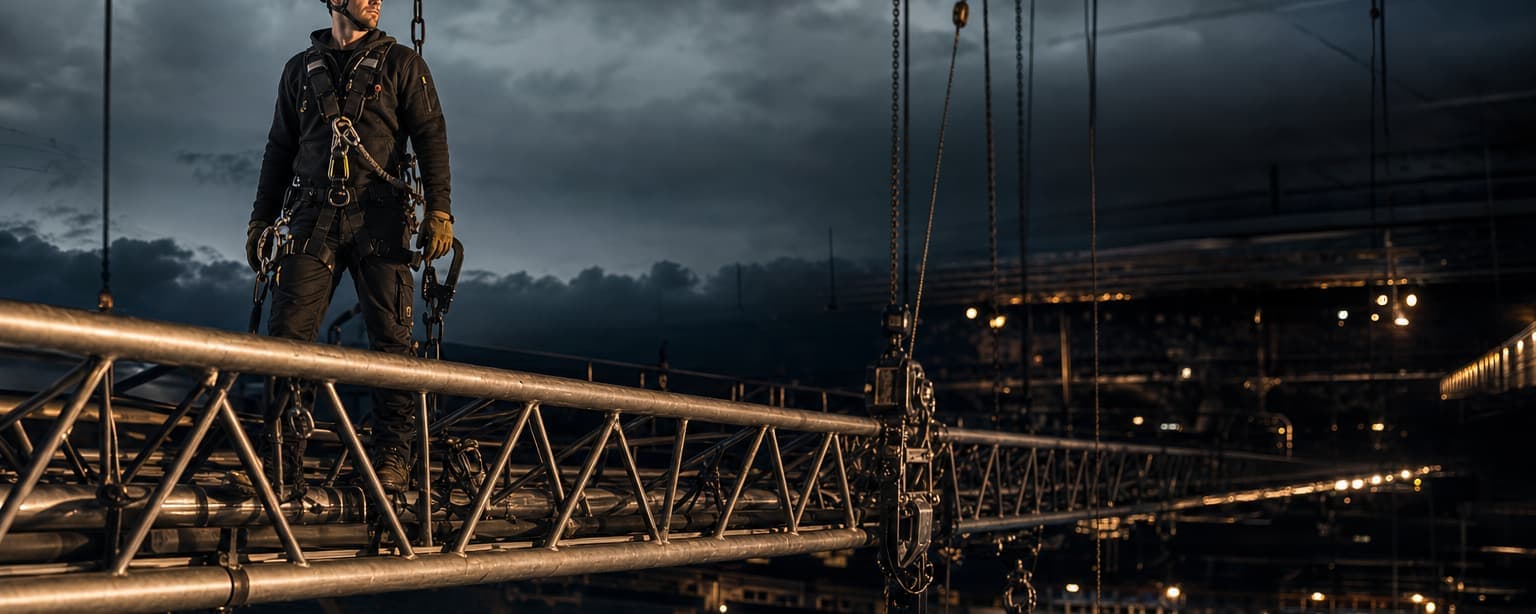
Everything you install is above somebody’s head.Founded by an Emmy-nominated television editor.
Underwriters price a staging or rigging company on climbing height, flown versus ground-supported loads, engineering sign-off and ETCP supervision, and we build the submission around those facts for stage, truss, roof and grip companies.
Tell us the situation.
One licensed human replies the same business day — not five agents, not an auto-responder. If the policy you have is already the right one, we will tell you.
We use this to quote and service your insurance, and we do not sell it or pass it to lead networks. Privacy policy.
We were editing television long before we were insuring it.

Kevin Kelsey
Founder | Principal Agent
IATSE Local 700 member
Boring’s founder, Kevin Kelsey, edited television for fifteen years before he sold a policy. He was Emmy-nominated for The Muppets Mayhem, cut Shark Tank, Big Brother, Dancing with the Stars and Wheel of Fortune, and handled compliance and risk for some of Hollywood’s largest production companies. So the person building your coverage has been on a crew list, dealt with the permit offices, and met network and streamer requirements from the production side, rather than working from a rate manual. He also builds post-production software. Manifest Post is the board episodic post teams use to track every episode, and B/side is a video editor for people who cut together. He holds a number of patents on that software. So he knows the post side of a production as a vendor to it. We insure productions from Los Angeles to Atlanta, New York and Toronto, with worldwide and foreign production coverage.
The work is placed with the markets that actually write film, television and live entertainment — Zurich through ISC Entertainment (formerly Abacus), Philadelphia Insurance Companies, Take1 and Alive Risk — rather than with a general small-business carrier asked to try.
Send us what you have. We’ll tell you if it’s right.
Your current policy paperwork, a renewal notice, or nothing at all. A licensed agent reads it and replies the same business day.
What staging and rigging businesses actually need.
General liability
Third-party bodily injury and property damage. It is the line nearly every contract names by default.
Without it — A dropped or failed rig injures people who were never your customer, in a venue full of them, and the claim names whoever built it.
Workers compensation
Required in almost every state the moment you have employees. Priced on payroll and class code, which is why the class code is worth arguing about.
Without it — Height, load and lifting are the severity classes of this trade, and the climbing share of your payroll is rated on its own.
Inland marine & equipment
Tools, equipment and property in transit. It picks up exactly where commercial property stops, which is the moment the item leaves the building.
Without it — Truss, motors, decks, roofs and points are high value, constantly on the road and stored in venues you do not control.
Contractors errors & omissions
Covers faulty workmanship and professional mistakes: the cost of the work itself being wrong, which general liability excludes by design.
Without it — A rigging plot or a load calculation is engineering advice, and a plot that miscalculates a load is a professional failure rather than an accident.
Commercial auto
Vehicles the business owns and the people who drive them for work.
Without it — Trucks move heavy gear between venues on a schedule that does not forgive delay.
Umbrella & excess liability
Extra limit stacked above general liability, auto and employers liability. Usually the cheapest million dollars on the policy.
Without it — Venue and production contracts specify limits above primary before you are allowed on site, and a failure above a crowd reaches them.
Third party property damage
Damage to property in your care while you are shooting on it, meaning the location itself and the fixtures in it. General liability excludes property in your care, custody and control, which is precisely what a location is.
Without it — The building you are rigging into is somebody else’s property, and a beam clamp that marks a historic ceiling is a claim.
Stunts & pyrotechnics
Coverage for productions running stunt work, vehicle action or pyrotechnics. The standard production policy carries a printed stunt and pyrotechnic exclusion, so this is not a limit that quietly sits there. The production has to be scheduled and underwritten before the exclusion comes off.
Without it — Performer flying and any rig carrying a person is a different underwriting conversation from carrying a lamp.
What the regulators actually wrote down.
ANSI E1.21, Temporary Structures Used for Technical Production of Outdoor Entertainment Events, sets minimum design and performance parameters for the design, manufacture, use and maintenance of temporary ground-supported structures at outdoor events. ESTA notes the 2024 edition is referenced by the 2024 International Fire Code and correlated with the 2024 International Building Code.
ESTA Technical Standards Program, published standards · checked 2026-10-03
ANSI E1.6-1, Powered Hoist Systems, covers the design, installation, inspection and maintenance of powered hoists used to lift and suspend loads in performance and theatrical production, and expressly does not apply to systems for flying people.
ESTA Technical Standards Program, ANSI E1.6-1-2021 · checked 2026-10-03
ANSI E1.2 governs the design, manufacture and use of aluminum trusses and towers in entertainment, including head blocks, sleeve blocks, tower bases and corner blocks.
ESTA Technical Standards Program, ANSI E1.2-2021 · checked 2026-10-03
The Entertainment Technician Certification Program, run by ESTA, certifies arena riggers, theater riggers, entertainment electricians and portable power distribution technicians.
ETCP, Entertainment Services and Technology Association · checked 2026-10-03
An entertainment program’s rental house application asks a staging company for its percentage of climbing payroll, the maximum and average height climbed, average stage dimensions, the type of guy wire and the weights in the staging support. It then asks whether an engineer signs off on staging installations and what share of staging and rigging work has an ETCP-certified technician present and supervising.
Alive Risk, Rental House Supplemental Application (rev. 11/22) · checked 2026-10-03
The same application asks whether independent contractors used for installation, staging or rigging provide proof of coverage, hold the applicant harmless and name the applicant as additional insured, and requires a copy of the rental agreement, the safety and maintenance programs and five years of loss history.
Alive Risk, Rental House Supplemental Application (rev. 11/22) · checked 2026-10-03
The 2011 Indiana State Fair stage collapse killed seven people and injured dozens when a gust of about 59 mph hit a temporary roof whose lateral load resisting system, guy lines tied to concrete Jersey barriers held by their own weight and friction, was inadequate, and the claims later settled for nearly $50 million in total, $11 million of it from the state.
Thornton Tomasetti report to the State Fair Commission (2012); IndyStar (2014) · checked 2026-10-04
Federal OSHA requires general industry employers to protect workers on surfaces with unprotected sides or edges 4 feet or more above a lower level, by guardrail, safety net or personal fall protection.
OSHA, 29 CFR 1910.28(b)(1)(i) · checked 2026-10-03
The claims we actually see.
Ordered by how often we see them, not by how dramatic they are. Each one names the coverage that answers it — and the policy people wrongly assume already does.
Most common
A crew member falls from truss, a ladder or a stage deck
Covered by Workers compensation
A freelance stagehand paid on a 1099 is usually your employee for workers comp purposes, and an uninsured one lands on your audit and your claim.
Common
Truss, motors or decking stolen from a truck or damaged in transit
Covered by Inland marine (equipment floater)
General liability never pays for your own gear, and many floaters exclude property left in an unattended vehicle unless it is locked and the truck is secured.
Common
Damage to the venue’s ceiling, floor or grid during load-in
Covered by Third-party property damage
The standard liability form excludes damage to the part of the property you are working on, which is exactly where a rigging point goes.
Rare, catastrophic
A rig, roof or stage fails over an audience
Covered by General liability and umbrella
A dry hire policy priced as equipment rental may not contemplate your crew installing the structure, so the installation has to be declared before the season, not after the wind.
Less common, severe
A permanent install fails years after you were paid
Covered by Products and completed operations
Completed operations coverage has to be on the policy, and the additional insured wording has to reach completed work, or the venue’s claim comes back to you alone.
A grip and rigging company that most contractors’ markets would not touch, because the work is at height over people and the standard forms treat that as a reason to decline.
We placed it on a package policy with a market that writes the class, kept it on the same form at renewal, and stood behind it when an attorney called to confirm coverage was in force on a date of loss. The owner’s public review says we were the only people he knew who were able to get it done.
What the insurance company will ask about your staging and rigging business
We read the applications the markets use for businesses in this field and pulled out what they actually ask. Have these answers ready and a quote takes a day instead of a week, because nobody has to come back to you for the missing piece.
About the business
- What does your company do?
- How many years has your business been operating?
- How many people work for you?
- Do you have a website, and if so, what is it?
- How many productions do you create or work on each year?
How you operate
- What's the largest production budget you handle for any single project?
- Describe the main type of stunt or production work you perform
- How do you make sure the content you create is accurate and original?
- Do you require your contractors and service providers to carry insurance?
- What's the total value of productions and materials you keep at any one location at one time?
Safety and controls
- What steps do you take to prevent problems or claims?
- Do you have a lawyer on staff or on retainer, and what do they help you with?
- Does a lawyer review the content of all your productions before they go out?
- Do you obtain written releases from people whose names or likenesses appear in your productions?
- Do you have written disclaimers for any financial, legal, or medical advice you give?
Your history
- Has your company changed its name, acquired another business, or merged with another company in the past five years?
- Do you know of any incident where your company suffered a data breach or loss of private information?
- In the past five years, has your company sued any clients for non-payment, and if so, were you countersued?
- In the past five years, has anyone who owns or works for you been investigated, cited, or fined by a government agency?
- Has your company ever been denied, cancelled, or not renewed for insurance like this before?
Money and people
- What are your gross production costs?
- Who are your five largest clients, and how much do you do business with each of them?
- What is your current insurance company and policy number?
Have these ready
- Your last three years of claims history from your current or past insurance company, called loss runs
- A copy of your title and trademark report reviewed by a qualified attorney
- Copies of your contracts with your five largest clients, showing the dollar value, length, and type of services
You answer what you can; a licensed agent fills the rest with you.
What our staging and rigging clients ask us.
Why do so many carriers decline rigging?
Because it combines the two things underwriters like least, work at height and a suspended load over an audience. The severity is obvious and the frequency is low, a profile the standard market prices badly and often simply refuses. It is placeable, and it is the class we are asked about most in entertainment, but it goes to markets that understand the difference between a lighting hang and performer flying.
Does it matter whether the rig is flown or ground-supported?
Yes, and the application asks. Flown rigging hangs from the building’s structure on motors and points, so the questions are the building’s capacity, the load calculation and hoist inspection. Ground-supported systems, towers and outdoor roofs carry their own load, so the questions become ballast, guying and wind. Outdoor ground-supported roofs are where the catastrophic losses in this class have come from, and ANSI E1.21 exists for them.
Why does the underwriter ask whether an engineer signed off?
Because a stamped design and a load calculation turn a judgment call into a documented one. The rental house application asks it directly for staging installations. With a sign-off, a failure becomes a question of whether the plan was followed. Without one, it becomes a question of whether anyone made a plan, which is a far worse place to defend a claim from and a reason some markets decline outdoor staging outright.
Does ETCP certification lower my insurance cost?
We will not promise a discount, but it moves the conversation. The application asks what share of your staging and rigging work has an ETCP-certified technician present and what share they supervise, so an underwriter is pricing supervision, not the certificate on the wall. A crew where a certified arena or theater rigger runs every call reads very differently from one where certification is occasional.
Who is liable if rented truss collapses?
Whoever caused it, and then whoever agreed to pay for it. A manufacturer answers for design, the rental company for maintenance and inspection, the installer for assembly and the load calculation, and the producer or venue for the weather call. The rental agreement then shifts the cost, usually onto the renter through a hold harmless. That promise is only as good as the renter’s insurance, which is why your own completed operations coverage still matters.
We supply the staging and the producer’s crew builds it. Does that change anything?
It changes which policy you need. If the gear leaves without your people, you are a dry hire rental company and the exposure is your equipment plus products liability for what you supplied. If your crew installs, operates or supervises, you are a contractor on site with workers comp, height and completed operations exposure. Many companies do both, and the application asks for the percentage of each, so be honest about the split.
What do venues and producers ask a staging or rigging company for?
Commonly $1M per occurrence and $2M aggregate general liability, additional insured for ongoing and completed operations, primary and non-contributory wording, a waiver of subrogation, workers comp with $1M employers liability, auto liability, and an umbrella that often starts at $5M for hotels, arenas and touring work. Send the rider or venue agreement when you bid, not when you load in.
A venue wants a $5M umbrella and additional insured status for our load-in. Can we get that for one event?
Usually it is cheaper to carry it annually, because a one-off umbrella still needs the underlying policy and a market willing to write the class. Entertainment program markets build excess towers well above that, one lists up to $25M. Before buying anything, read the requirement itself. We have seen a hotel’s own $50M certificate forwarded as though it were the vendor requirement, when the real ask was the standard program.
How should truss, motors and decks be insured?
On an inland marine equipment floater that follows the gear in transit, at the venue and in storage, scheduled item by item for the expensive pieces with a blanket limit for the rest. Insure at replacement cost. Add a limit for equipment you rent in from another house, because the rental agreement almost certainly makes you responsible for it, and declare any international work in advance.
Do I need workers comp for freelance stagehands?
Usually yes. A stagehand you schedule, direct and pay by the call is your employee in most states whatever the tax form says, and California presumes it. If a freelancer runs their own company with their own comp policy, collect the certificate every time. If they cannot produce one, expect the audit to add what you paid them to your payroll, in the climbing class if that is the work they did.
Does performer flying change the policy?
Completely. Once a rig carries a person it is treated as stunt work rather than rigging, and ANSI E1.6-1 itself excludes systems for flying people. The standard entertainment form carries a stunt exclusion, so it has to be declared and underwritten in advance, with the operator’s qualifications and the inspection regime in the submission. Discovering this after a show has been announced is the expensive version.
How long does completed operations matter for a rig?
Longer than most people assume. A permanent installation, such as a venue grid, a retail display or an architectural hang, can fail years after you were paid and long after your crew has forgotten the job. The claim arrives against whoever installed it, and if completed operations coverage was not on the policy when the work was done it does not help.
What should I have ready before I apply?
Three years of revenue split between rental, sales and installation, your climbing payroll and the maximum height you work at, a description of your stages and roofs and how they are ballasted, who signs off the engineering, how many calls an ETCP-certified rigger supervises, your subcontractor certificates and hold harmless terms, your rental agreement, the safety and maintenance programs, and five years of loss runs. The application asks for all of it.
What does a staging and rigging insurance application ask for?
The applications for staging and rigging businesses ask about 4 things above all: what does your company do; what's the largest production budget you handle for any single project; what steps do you take to prevent problems or claims; has your company changed its name, acquired another business, or merged with another company in the past five years. Have your last three years of claims history from your current or past insurance company, called loss runs and a copy of your title and trademark report reviewed by a qualified attorney ready and a quote takes a day instead of a week.
Commercial insurance is 96% of what we do — it is not a department here, it is the whole business. Not ready to talk? The guides answer the questions this page raises in more depth. Already insured with us and need a certificate or a policy change? Ask the service team rather than starting a quote — it is faster and it goes to the people whose job it is. We also write home and auto, which is usually cheaper alongside the business policy than apart from it.
Handed a lease, a vendor packet or a client contract with insurance requirements? Paste it into the COI Requirements Decoder to see what each one means for your business, or read what the requirements mean.