
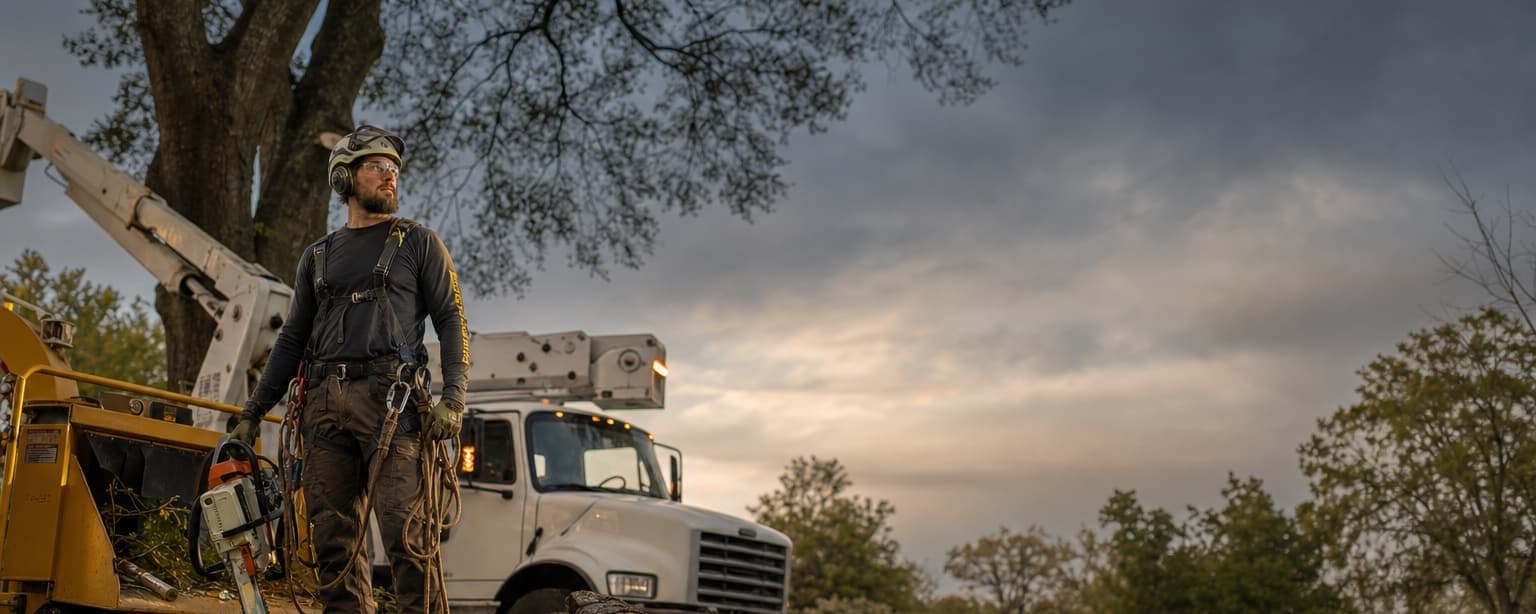
Everything changes the moment your feet leave the ground.
Commercial insurance for tree services, arborists and removal crews: the class most standard carriers decline, placed in the markets that actually look at the work.
Tell us the situation.
One licensed human replies the same business day — not five agents, not an auto-responder. If the policy you have is already the right one, we will tell you.
We use this to quote and service your insurance, and we do not sell it or pass it to lead networks. Privacy policy.
Send us what you have. We’ll tell you if it’s right.
Your current policy paperwork, a renewal notice, or nothing at all. A licensed agent reads it and replies the same business day.
What tree service businesses actually need.
General liability
Third-party bodily injury and property damage. It is the line nearly every contract names by default.
Without it — A dropped limb through a roof, a car or a fence is the defining claim of this trade, and the damage is done before anyone can react.
Workers compensation
Required in almost every state the moment you have employees. Priced on payroll and class code, which is why the class code is worth arguing about.
Without it — Climbing falls, chainsaw injuries and struck-by incidents are severe by nature, and this is the coverage standard carriers decline first.
Commercial auto
Vehicles the business owns and the people who drive them for work.
Without it — Chip trucks, bucket trucks and loaded chippers are heavy, frequently in traffic, and rated as such.
Inland marine & equipment
Tools, equipment and property in transit. It picks up exactly where commercial property stops, which is the moment the item leaves the building.
Without it — Climbing gear, saws, chippers and stump grinders are high-value, mobile and excluded by property coverage once they leave the yard.
Umbrella & excess liability
Extra limit stacked above general liability, auto and employers liability. Usually the cheapest million dollars on the policy.
Without it — A tree through an occupied structure exhausts a primary limit before the repair is even scoped.
Contractors pollution liability
Bodily injury, property damage and clean-up caused by a pollutant your work released: chemical drift, run-off, fuel spills. The standard general liability form excludes all of it.
Without it — Hydraulic and fuel releases from a bucket truck or grinder on a customer’s property are clean-up claims a general liability policy excludes.

Joe Gorman
Co-Founder | President of Commercial Lines
Came up in construction, on site and in the office, then moved into sales. Went out on a limb to become Boring’s first dedicated salesperson when the agency had no sales team at all, and now leads it. Landscaping is the class he writes most: grounds maintenance, tree work, irrigation and the spray operations that push an account out of preferred appetite.
The Grounds Guys — Franchise owners are referred to us by their corporate office. We are not affiliated with, or endorsed by, The Grounds Guys.
Five endorsements, and a certificate is none of them.
A certificate is evidence a policy existed the day it was printed — it says so on its own face. The coverage a contract is really asking for lives on the policy as named endorsements, and this is the list they come from.
- Additional insured — ongoing operationsCG 20 10Covers the general contractor for claims arising from your work while the job is in progress.Without it: They fund their own defense on a claim your work caused, then look to you for it.
- Additional insured — completed operationsCG 20 37Extends that coverage to claims arising after your work is finished.Without it: The claim arrives years later, when the policy that should have carried it has renewed several times. Cheaper policies often exclude this or do not offer it.
- Primary and non-contributoryCG 20 01Puts your policy first and stops your insurer demanding a contribution from theirs.Without it: Two insurers argue about who pays while the defense waits.
- Waiver of subrogationCG 24 04Stops your insurer recovering from the party you agreed in writing to protect.Without it: Your insurer pays, then sues your customer, which ends the relationship.
- Per-project aggregateCG 25 03Gives each job its own general aggregate instead of sharing one across the year.Without it: Another project’s claims quietly spend the limit that was meant to cover this one.
Tract, condominium and apartment work is the exception that undoes all five — an exclusion for multi-unit residential removes the coverage before any endorsement can apply. What national homebuilders require covers that in full — D.R. Horton, Pulte Group, Blackrock Homes and the rest of the national builders set the strictest terms a sub will see, and they do not negotiate them.
Contracts ask for more than these five. Every contract insurance requirement, explained, or paste your exhibit into the Contract Insurance Decoder to see the endorsement behind each clause.
How high do you work?
Third floor and above is a different account. The exposure is not only the fall — it is what gets dropped, who is underneath, and how far a tool travels before it lands. Carriers ask for a height limit and many stop at two or three stories, so work you take on because it was offered can quietly put a renewal into a market you were not in last year. Tell us the tallest job you do, not the usual one.
Residential or commercial?
Underwriters treat these as separate trades even when the work is identical. Residential carries construction-defect exposure that follows the job for years and a homeowner who sues; commercial carries bigger limits, tighter contracts and a general contractor who enforces them. A book that is mostly one prices very differently from a book that is evenly split, and the mix is usually the second question on the application.
“They stay on top of our rates and premiums. They notify us of any potential increase and automatically shop all options to ensure we get the best possible rates. When we initially switched to them they literally cut our premiums in half for both of our companies…”
What the insurance company will ask about your tree service business
We read 3 applications the markets use for this kind of business and pulled out what they actually ask. Have these answers ready and a quote takes a day instead of a week, because nobody has to come back to you for the missing piece.
About the business
- What services do you provide and what percentage of your work is residential versus commercial
- How long have you been in business
- What's your business structure: sole proprietorship, LLC, corporation, or partnership
- Do you belong to any industry associations or groups
How you operate
- How many full-time and part-time employees do you have
- What equipment do you use on the job, and what's your maintenance program
- Do you subcontract any work, and if so, what type
- Do you work more than 50 miles from your main location
- When utilities are available, do you contact them to locate underground lines before you start work
Safety and controls
- What records do you keep: work orders, bid agreements, accident reports, and billing documents
- Do you ask subcontractors to provide proof of liability insurance
- Do you limit your tree work to one story or below
Your history
- Who is your current insurance company, or your last one if you don't have coverage now
- Have you or anyone who owned this business before ever had a claim or loss
- In the last three years, has your insurance been cancelled, not renewed, or dropped for nonpayment
- In the last five years, have you or any owner personally had bankruptcy or unpaid tax judgments
Money and people
- What was your total annual gross income last year
- What is your total annual payroll
- Do you own or lease any equipment to rent or loan to others
Have these ready
- Your business name, mailing address, and current location address
- A list of all owned and leased equipment with manufacturer, model, year, and serial numbers
- Your last five years of claims history from your current insurer, called loss runs, with details of each claim
- Names and contact information for anyone who should be added to the policy as an additional insured
You answer what you can; a licensed agent fills the rest with you.
What our tree service clients ask us.
Why will so few carriers write tree service?
Because the work combines high frequency with high severity, which is the combination underwriters like least. Crews work thirty to a hundred feet up on ropes and in lifts, next to power lines, over roofs and parked cars. A single mistake produces a claim far larger than the invoice for the job. Most standard markets decline the class outright, so placing it means going to carriers that specialize in it rather than shopping the same package everyone else quotes.
Is ground-only trimming rated differently from climbing?
Substantially, yes. Trimming from the ground is close to ordinary landscaping. Climbing, aerial lift work and removals are a different rate and often a different carrier entirely. If your operations are genuinely ground-only, that needs to be stated and documented, because it is worth real money, and if it is not true, saying it is the fastest route to a denied claim.
Does stump grinding change my quote?
It does, more than most operators expect. Grinding throws debris, sits close to buried utilities and irrigation, and reads to an underwriter as a separate operation from trimming. It is one of the handful of add-ons that moves a landscaping account out of preferred appetite on its own.
Do you write crane-assisted removals?
They are placeable, but they are underwritten as their own thing. The crane, the rigging plan and the operator’s experience all matter, and hired-in cranes raise questions about who is insuring what. Tell us before the job rather than after, because this is a class where a certificate issued for the wrong operation is worse than none.
What does a tree service insurance application ask for?
The applications for tree service businesses ask about 4 things above all: what services do you provide and what percentage of your work is residential versus commercial; how many full-time and part-time employees do you have; what records do you keep: work orders, bid agreements, accident reports, and billing documents; who is your current insurance company, or your last one if you don't have coverage now. Have your business name, mailing address, and current location address and a list of all owned and leased equipment with manufacturer, model, year, and serial numbers ready and a quote takes a day instead of a week.
Commercial insurance is 96% of what we do — it is not a department here, it is the whole business. Not ready to talk? The guides answer the questions this page raises in more depth. Already insured with us and need a certificate or a policy change? Ask the service team rather than starting a quote — it is faster and it goes to the people whose job it is. We also write home and auto, which is usually cheaper alongside the business policy than apart from it.