
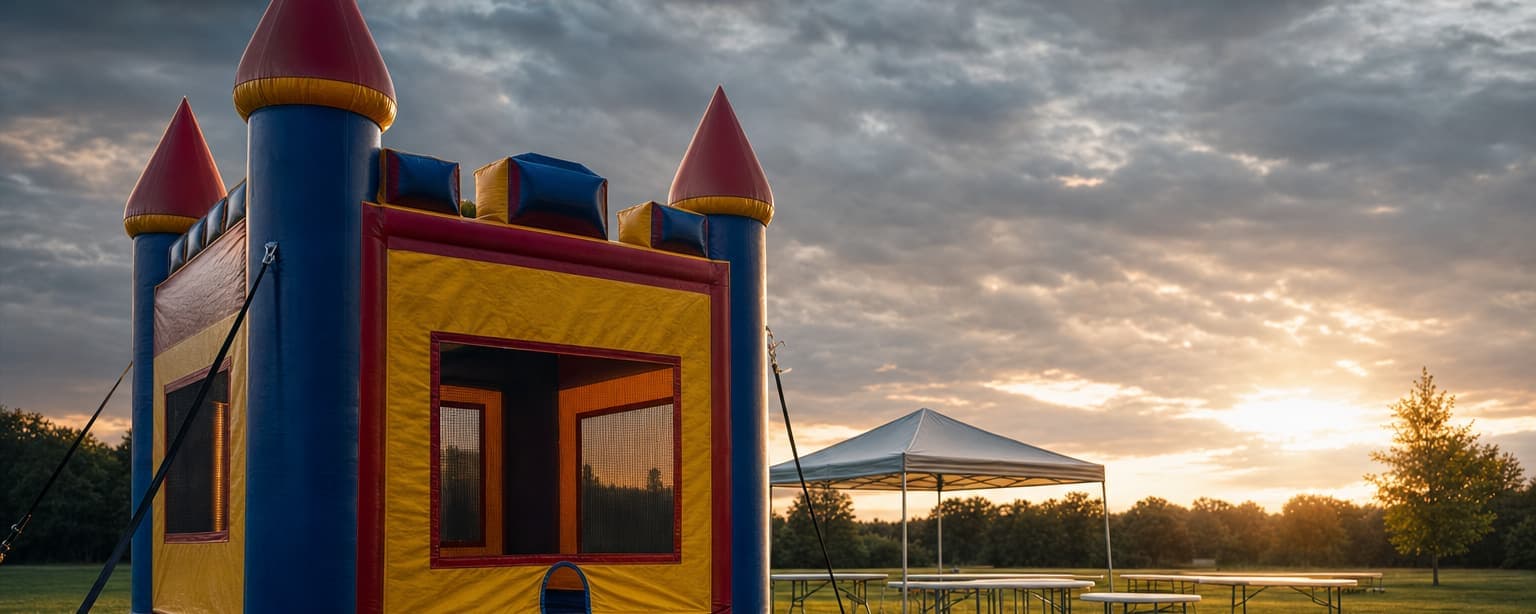
You deliver it, you set it up, and you are gone when it fails.
We cover party and event rental operators, from inflatables and tents to staging, tables and chairs. The equipment travels, the public uses it unsupervised, and the venue wants naming before you may set up.
Tell us the situation.
One licensed human replies the same business day — not five agents, not an auto-responder. If the policy you have is already the right one, we will tell you.
We use this to quote and service your insurance, and we do not sell it or pass it to lead networks. Privacy policy.
Send us what you have. We’ll tell you if it’s right.
Your current policy paperwork, a renewal notice, or nothing at all. A licensed agent reads it and replies the same business day.
What party and event rental business businesses actually need.
General liability with participant coverage
Injury to people using the equipment, which is the point of the business.
Without it — Many general liability forms exclude participants unless it is bought back.
Rental equipment on the move
Inflatables, tents, staging, dance floors, tables, chairs, linens and generators, in storage, in transit and on site.
Without it — The whole asset base leaves the building several times a week.
Tents and temporary structures
Erection, anchoring and wind loading on anything you put up.
Without it — A marquee is a structure over a crowd and is underwritten as one.
Commercial auto
Delivery vehicles and trailers.
Without it — Personal auto excludes business use, and delivery is the business.
Additional insured for venues
Parks, schools and venues that require naming before you may set up.
Without it — Municipal parks and school districts will not permit setup without it.
Abuse and molestation
Where staff supervise children at events.
Without it — Excluded from general liability and relevant wherever staff attend.
Crime and social engineering
Equipment that disappears between rentals, and a deposit refunded to somebody who never booked.
Without it — A refund released to somebody who never booked is not burglary, and property coverage does not reach it. Social engineering is bought separately.
What our party and event rental business clients ask us.
Are participants covered, or just bystanders?
Check, because this is the exclusion that guts the policy. Some general liability forms written for rental businesses exclude injury to participants, the people actually using the equipment, which in this trade is everyone who matters. A policy that covers a passer-by tripping on your cable and not the child who broke an arm inside the unit is not cover for this business. Ask for participant liability explicitly and read the limit.
We rent tents, tables and staging as well as inflatables. Same policy?
Same policy, and they need describing separately because they fail differently. Inflatables are a participant-injury risk driven by anchoring and wind. Tents and temporary structures are a collapse risk over a crowd, and underwriters ask about engineering, anchoring method, wind ratings and who signs off the erection.
What do underwriters ask about?
Anchoring, wind and supervision, in that order, because those are what turn an ordinary event into a serious claim. Expect questions about stake versus sandbag anchoring, your maximum wind speed and who decides to shut down, whether you supervise or leave the unit with the customer, written safety rules and signed rental agreements, and whether you inspect units between hires. Wind is the one that produces catastrophic losses in this class, and a written wind policy you actually follow is worth real money.
The customer signed a waiver. Is that enough?
It helps and it will not stop a claim. Waivers do not bind minors, and the participants here are almost entirely minors: a parent generally cannot sign away a child’s own right to sue. They are also read narrowly and do nothing about defense costs. Keep the signed agreement, keep the safety rules attached to it, and treat the policy as the thing that actually pays.
Do venues and parks have their own requirements?
Almost always, and they are specific. Municipal parks, schools and HOAs typically require a $1,000,000 general liability limit with the venue named as an additional insured, sometimes a permit, and occasionally proof of participant coverage. Ask for the requirement in writing when the booking is taken rather than the week before: a certificate in the wrong form is the usual reason an operator loses a booking.
Commercial insurance is 96% of what we do — it is not a department here, it is the whole business. Not ready to talk? The guides answer the questions this page raises in more depth. Already insured with us and need a certificate or a policy change? Ask the service team rather than starting a quote — it is faster and it goes to the people whose job it is. We also write home and auto, which is usually cheaper alongside the business policy than apart from it.
Handed a lease, a vendor packet or a client contract with insurance requirements? Paste it into the COI Requirements Decoder to see what each one means for your business, or read what the requirements mean.