
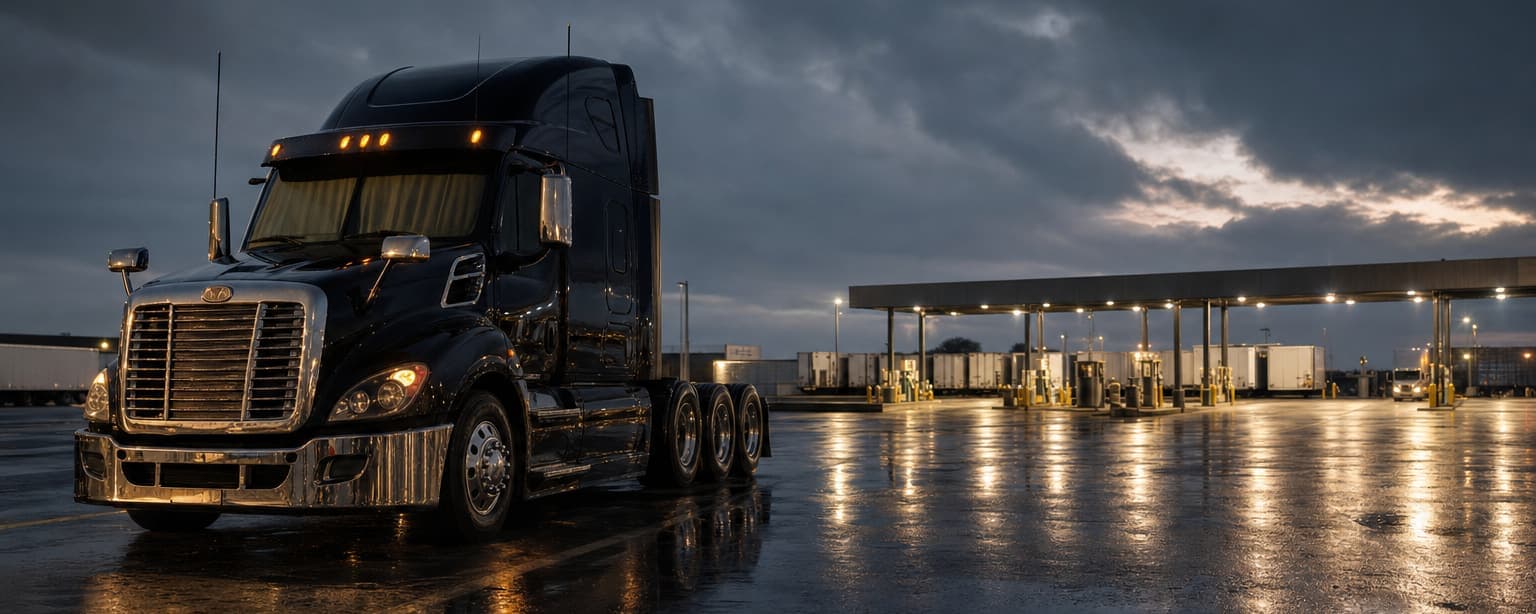
On one power unit, most carriers want the owner behind the wheel.
A one-truck authority is underwritten by different rules than a fleet. Several markets require the owner to be the driver, and minimum premiums matter more than rate.
Tell us the situation.
One licensed human replies the same business day — not five agents, not an auto-responder. If the policy you have is already the right one, we will tell you.
We use this to quote and service your insurance, and we do not sell it or pass it to lead networks. Privacy policy.
Send us what you have. We’ll tell you if it’s right.
Your current policy paperwork, a renewal notice, or nothing at all. A licensed agent reads it and replies the same business day.
What single-truck and owner-operator coverage businesses actually need.
Commercial auto
Vehicles the business owns and the people who drive them for work.
Without it — The federal filing is the same on one truck as on fifty, and it is what keeps the authority active.
Motor truck cargo
The freight itself while you are hauling it. Separate from the liability on the truck.
Without it — Brokers filter loads on the cargo limit before they look at anything else about you.
Auto physical damage
Damage to your own tractor and trailer. Primary liability pays for what you do to everyone else and nothing for your equipment, so without this a rollover you caused leaves you paying off a truck you can no longer run.
Without it — On one truck the tractor is the whole business, and a lender will require it anyway.
Non-trucking liability
Covers the tractor when it is being driven outside dispatch, home from the yard or to the shop. The motor carrier’s primary liability generally responds only while you are under dispatch, and that gap is exactly when an owner-operator is driving on their own time.
Without it — Primary liability stops off dispatch, and an owner-operator drives off dispatch constantly.
Occupational accident
Medical and disability coverage for owner-operators and contract drivers who sit outside workers compensation. It is not workers comp and does not satisfy a state that requires workers comp. It fills the gap where none is required.
Without it — An owner-operator is usually outside workers compensation, and this is what stands in for it.
Truckers general liability
General liability written for a motor carrier: the yard, the dock, loading and customer premises. The auto policy answers for the vehicle; this answers for everything else.
Without it — Loading docks, yards and customer premises sit outside the auto policy entirely.

Lori Adams, TRS
Commercial Trucking Insurance Advisor
Twenty-five years in trucking insurance. Knows the filings, the radius rules and the carriers that will actually take the risk.
Transportation Risk Specialist (TRS)
What the insurance company will ask about your single-truck and owner-operator coverage business
We read 2 applications the markets use for this kind of business and pulled out what they actually ask. Have these answers ready and a quote takes a day instead of a week, because nobody has to come back to you for the missing piece.
About the business
- What type of business structure do you have (individual, corporation, partnership, or other)?
- How long have you owned this business?
- What is your annual revenue?
- What is your total annual payroll?
- Do you own any other businesses involved in trucking or commercial operations?
How you operate
- What commodities do you haul?
- Are your loads truckload size or less than truckload?
- What percentage of your loads come through freight brokers versus direct contracts?
- What percentage of your loads go to regular or fixed destinations?
- What states and major cities do you travel into or through?
Safety and controls
- Do your vehicles have GPS, cameras, or other tracking systems installed?
- Do you have Electronic Log Book systems in your trucks?
- Do you have someone or a system that tracks when drivers need their medical certificate renewals?
- Are drivers required to complete inspection reports on vehicle condition at the end of each shift?
- What are your hiring standards for drivers, and do you check references on driver applications?
Your history
- What claims or losses have you had in the last three years?
- Who was your previous insurance company for the last three years?
- If you did not have prior insurance, what business experience do you have?
Money and people
- What is the maximum cargo value per load you typically haul, and what is your average cargo value?
- What deductibles are you looking for?
- What cargo deductible amount do you prefer?
- What excess liability limits do you need?
- Do any of your customers require you to add them as additional insureds, waive subrogation, or agree to primary coverage?
Have these ready
- Your loss runs from your current insurance company for the last three years (showing any claims)
- Your driver list with each driver's name, date of birth, driver's license number, CDL expiration date, years holding a CDL, and any accidents or violations from the last three years
- A list of all your trucks with the year, current or projected value, and your preferred deductible for each
- A copy of any customer contracts that have insurance requirements or certificate of insurance requests
- A sample of your driver inspection report form if you use one
You answer what you can; a licensed agent fills the rest with you.
What our single-truck and owner-operator coverage clients ask us.
Why do carriers keep asking whether the owner drives?
Because on a single power unit it is one of the strongest predictors they have. An owner driving their own truck has their livelihood in the vehicle, and the loss experience reflects it. Several of our markets make it an eligibility rule rather than a preference. On one unit, both Canal and Northland require the owner to be the driver, and Canal extends it upward: above one unit the owner still drives and any additional drivers must be W-2 employees rather than contractors. An owner-operator planning to hire a driver on a 1099 should know that puts several markets out of reach before price is even discussed.
Is one truck too small to get quoted properly?
No, and the market is wider than a one-truck operator is usually told. Several markets bind a single unit on their own authority rather than sending it to a carrier queue: Northland binds one to ten units in house, Canal one to four, and Berkshire Hathaway Homestate runs one to ten through an online rater. Progressive quotes one to nine in about a day. What actually changes at one truck is not availability, it is that minimum premiums start to dominate: below a certain premium the carrier is not pricing your risk, it is pricing the cost of issuing a policy.
What does that mean for what I pay?
That shopping on rate alone stops working. On a single truck the number is often at or near the market’s minimum premium, so two carriers can quote the same figure for very different forms, and the difference between them is the cargo limit, the physical damage deductible, whether non-trucking liability is included, and how the deductible applies per occurrence. It is also why adding a second truck rarely doubles the premium.
I am an owner-operator leased to a carrier. Do I need my own policy?
Usually yes, and not the one people expect. While you are under dispatch the motor carrier’s liability generally responds; the exposure that is yours is everything else: driving off dispatch, which is what non-trucking liability covers, the truck itself, which their policy does not insure, and your own injuries, which workers compensation will not pay if you are a contractor rather than an employee. Read the lease before buying anything: it will state what they carry and what they require of you, and those two lists rarely match.
How much insurance do I need for my own authority?
Federally, $750,000 of public liability for general freight in a truck rated 10,001 pounds or more, rising to $1,000,000 for oil and most hazardous materials and $5,000,000 for bulk hazardous substances. In practice brokers and shippers want $1,000,000 combined single limit and usually $100,000 of cargo before they will load you, so buying to the federal minimum makes you legal and hard to hire at the same time. Your insurer files the proof with FMCSA, and the authority also needs a BOC-3 on file.
A broker needs my certificate today. What do I send you?
Send the legal name exactly as it appears on your authority, your USDOT and MC numbers, the certificate holder’s name and address exactly as they should print, anything the holder requires on it (additional insured, specific limits, the VINs, reefer breakdown or trailer interchange), where the certificate has to go, and when you need it, through the certificate request form or by phone. Copy the holder wording from the broker’s carrier packet, because platforms like Highway and RMIS reject a certificate that does not match it, and Highway accepts certificates only when the agent sends them. During business hours a routine certificate takes us about 30 minutes, and once you are insured with us your dispatchers can be set up on our client portal to issue routine certificates themselves, from a phone, without waiting on the office.
I am leaving my lease to run under my own authority. What changes?
Almost everything you buy. Leased on, the carrier has exclusive possession and responsibility under the lease and its liability covers you under dispatch, so you carry non-trucking liability, physical damage and occupational accident. On your own authority you buy the primary liability, the cargo and the federal filing yourself, and the insurer files the BMC-91 before the authority is issued. Your years leased on still count as driver experience, so bring the lease and your settlement statements to the quote.
How much is the down payment on one truck?
In the six financed trucking quotes in our own files this year, the down payment ran from 18% to 24% of the annual premium, with the rest over ten monthly payments. Those are quotes rather than policies bought, and a one-truck owner-operator program can ask for much less down on non-trucking liability and physical damage alone. Know what you can put down before you call, and the quote can be built around it.
What does a single-truck and owner-operator coverage insurance application ask for?
The applications for single-truck and owner-operator coverage businesses ask about 4 things above all: what type of business structure do you have (individual, corporation, partnership, or other); what commodities do you haul; do your vehicles have gps, cameras, or other tracking systems installed; what claims or losses have you had in the last three years. Have your loss runs from your current insurance company for the last three years (showing any claims) and your driver list with each driver's name, date of birth, driver's license number, cdl expiration date, years holding a cdl, and any accidents or violations from the last three years ready and a quote takes a day instead of a week.
Commercial insurance is 96% of what we do — it is not a department here, it is the whole business. Not ready to talk? The guides answer the questions this page raises in more depth. Already insured with us and need a certificate or a policy change? Ask the service team rather than starting a quote — it is faster and it goes to the people whose job it is. We also write home and auto, which is usually cheaper alongside the business policy than apart from it.
Handed a lease, a vendor packet or a client contract with insurance requirements? Paste it into the COI Requirements Decoder to see what each one means for your business, or read what the requirements mean.