
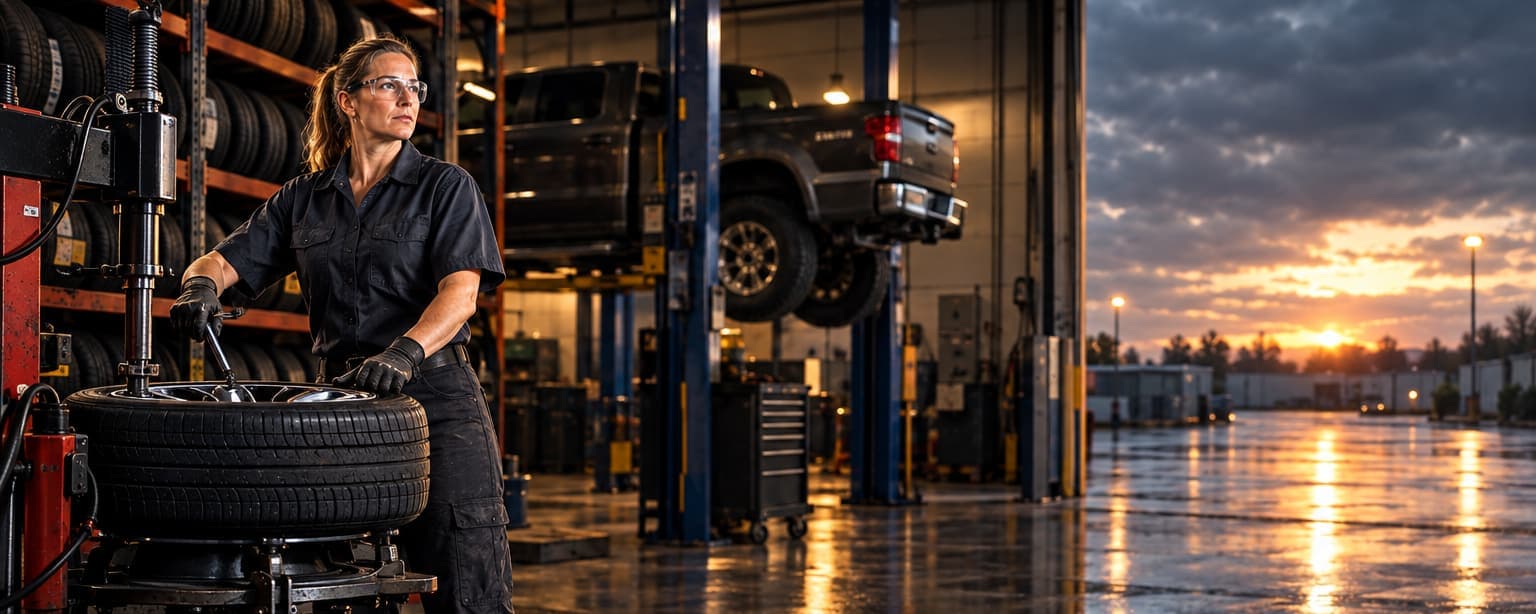
The wheel you torqued this morning is your claim if it comes off next week.
We insure tire shops and tire and wheel dealers: completed operations for the wheel-off claim, garagekeepers for the customer’s car, and products coverage for the tires you sell.
Tell us the situation.
One licensed human replies the same business day — not five agents, not an auto-responder. If the policy you have is already the right one, we will tell you.
We use this to quote and service your insurance, and we do not sell it or pass it to lead networks. Privacy policy.
Send us what you have. We’ll tell you if it’s right.
Your current policy paperwork, a renewal notice, or nothing at all. A licensed agent reads it and replies the same business day.
What tire shop businesses actually need.
General liability
Third-party bodily injury and property damage. It is the line nearly every contract names by default.
Without it — Completed operations for the work you release, products coverage for the tires and wheels you sell, and customers in the showroom.
Garagekeepers
Customer vehicles in your care, custody and control. Every repair shop and dealership has the exposure and most standard policies exclude it.
Without it — Customer cars on the lift, in the bay and parked overnight. The wheel scratched by a changer is the frequency claim.
Workers compensation
Required in almost every state the moment you have employees. Priced on payroll and class code, which is why the class code is worth arguing about.
Without it — Tire inflation injuries, lifting and lift accidents. Truck tire work raises the class.
Commercial property
Buildings and contents, valued at what it costs to rebuild today rather than what you paid.
Without it — The building, the lifts, the balancers and alignment rack, and a tire inventory that is heavy fire load.
Commercial auto
Vehicles the business owns and the people who drive them for work.
Without it — Service trucks for road calls and fleet work, and road tests in customer vehicles.
Contractors pollution liability
Bodily injury, property damage and clean-up caused by a pollutant your work released: chemical drift, run-off, fuel spills. The standard general liability form excludes all of it.
Without it — Scrap tire storage and the runoff from a tire fire, both excluded on general liability.
Crime & employee dishonesty
Theft by your own staff, funds transfer fraud, and the dishonesty bond a home care contract will ask you for by name.
Without it — Wheels and premium tires are portable, resaleable and frequently stolen by insiders.
The claims we actually see.
Ordered by how often we see them, not by how dramatic they are. Each one names the coverage that answers it — and the policy people wrongly assume already does.
Less common, severe
A wheel comes off on the road after a tire change because the lug nuts were not torqued
Covered by Completed operations under general or garage liability
Completed operations covers the injuries and the other car. It does not pay to replace your own work, and some forms limit it, so the aggregate limit matters.
Most common
A customer car is damaged on the lift or scratched by a tire machine
Covered by Garagekeepers
General liability excludes the car in your care. The scratched wheel from a tire changer is the most frequent claim in a tire shop and the one most often uninsured.
Less common, severe
A tire explodes during inflation and injures a technician
Covered by Workers compensation
An injured employee has no general liability claim against you. Inflating split-rim and truck tires without a cage is the classic severity loss in this trade.
Rare, catastrophic
The stored tire inventory catches fire
Covered by Commercial property, plus pollution for the runoff
Tire fires burn hot, long and dirty, and the water that puts them out becomes a pollution problem that property excludes.

Joe Gorman
Co-Founder | President of Commercial Lines
Has placed hundreds of auto service businesses: repair shops, mobile mechanics, heavy truck garages and the roadside operators most carriers will not look at. He knows which markets still take a garage risk and what garagekeepers limit a full lot actually needs. A mobile operation described the wrong way gets declined on sight, so he describes it the right way.
What the insurance company will ask about your tire shop business
We read the applications the markets use for businesses in this field and pulled out what they actually ask. Have these answers ready and a quote takes a day instead of a week, because nobody has to come back to you for the missing piece.
About the business
- What type of vehicle business do you run (selling, repairing, towing, or something else)?
- How many vehicles do you sell per year, if you sell them?
- What services do you offer (like oil changes, body work, tire repair, car wash)?
- Do you also run any other businesses besides the vehicle business?
- How long have you been doing this type of work?
How you operate
- Who drives your vehicles when you transport or deliver them (you, your employees, contractors)?
- Do you pick up or deliver customer vehicles? If yes, how far and how often?
- Do you do test drives with customers, or do you let customers test drive alone?
- Do you store vehicles anywhere other than your main location?
- Are your stored vehicles in a fenced and gated area, or inside a building?
Safety and controls
- Do you have spray painting in a separate ventilated room, or do you need to describe how you control the spray painting?
- Are your paints, resins and solvents stored in a fire-safe cabinet?
- Do you have no-smoking signs posted?
- Do you have warning signs to keep customers out of work areas?
- Is there anything buried on or under this location (like old fuel tanks)?
Your history
- Have you had any insurance claims or losses in the past? If yes, when and what happened?
- Has any insurance company cancelled, declined, or refused to insure you in the last three years?
- What insurance do you have right now, and with whom?
Money and people
- What is your business structure (sole owner, partnership, corporation)?
- How many employees do you have, and what do they do?
- Do any of your employees drive for work?
Have these ready
- A list of all owners, employees, drivers and anyone else who works for you (including part-time, 1099 contractors), their driver's license number, date of birth, and driving history
- Your loss runs from your current insurance company for the last three years (a record of any claims you've filed)
- Certificates of insurance from any contractors or subcontractors you use
You answer what you can; a licensed agent fills the rest with you.
What our tire shop clients ask us.
Am I liable if a wheel comes off after my shop changed the tire?
You can be, and it is the claim tire shops are underwritten around. A wheel-off after a tire service is usually alleged to be a torque or lug nut failure, which is a completed operations claim: injury or damage that happens after your work is finished and the car has left. General or garage liability with products and completed operations coverage answers the injuries and damage. A written retorque reminder, a torque stick on every job and a record of it on the repair order are what defend the claim.
Does selling tires add a products liability exposure?
Yes. The tires and wheels you sell are your products, and a claim that a tire failed can name the seller as well as the manufacturer. Products and completed operations coverage is part of a standard general liability form, but it needs to be declared and it carries its own aggregate limit. Used tires raise the question more sharply, because there is no manufacturer standing behind the condition of a tire you inspected and resold.
Do I need garagekeepers if the customer waits while we change the tires?
Yes. A car is in your care from the moment it is handed over until the keys go back, whether that is twenty minutes or two days. A car knocked off a lift or a wheel scratched by a tire machine during a while-you-wait job is a garagekeepers claim, and general liability excludes it.
Is roadside or fleet tire service covered on a shop policy?
Only if it is disclosed. Road calls put a technician beside traffic and a service truck on the road, and commercial truck tire work changes the workers comp class and the vehicles you are working on. Tell us how much of the revenue is road service and whether you work on commercial trucks, because a shop-only description is what gets a claim declined.
What does a tire shop insurance application ask for?
The applications for tire shop businesses ask about 4 things above all: what type of vehicle business do you run (selling, repairing, towing, or something else); who drives your vehicles when you transport or deliver them (you, your employees, contractors); do you have spray painting in a separate ventilated room, or do you need to describe how you control the spray painting; have you had any insurance claims or losses in the past? if yes, when and what happened. Have a list of all owners, employees, drivers and anyone else who works for you (including part-time, 1099 contractors), their driver's license number, date of birth, and driving history and your loss runs from your current insurance company for the last three years (a record of any claims you've filed) ready and a quote takes a day instead of a week.
Commercial insurance is 96% of what we do — it is not a department here, it is the whole business. Not ready to talk? The guides answer the questions this page raises in more depth. Already insured with us and need a certificate or a policy change? Ask the service team rather than starting a quote — it is faster and it goes to the people whose job it is. We also write home and auto, which is usually cheaper alongside the business policy than apart from it.
Handed a lease, a vendor packet or a client contract with insurance requirements? Paste it into the COI Requirements Decoder to see what each one means for your business, or read what the requirements mean.