
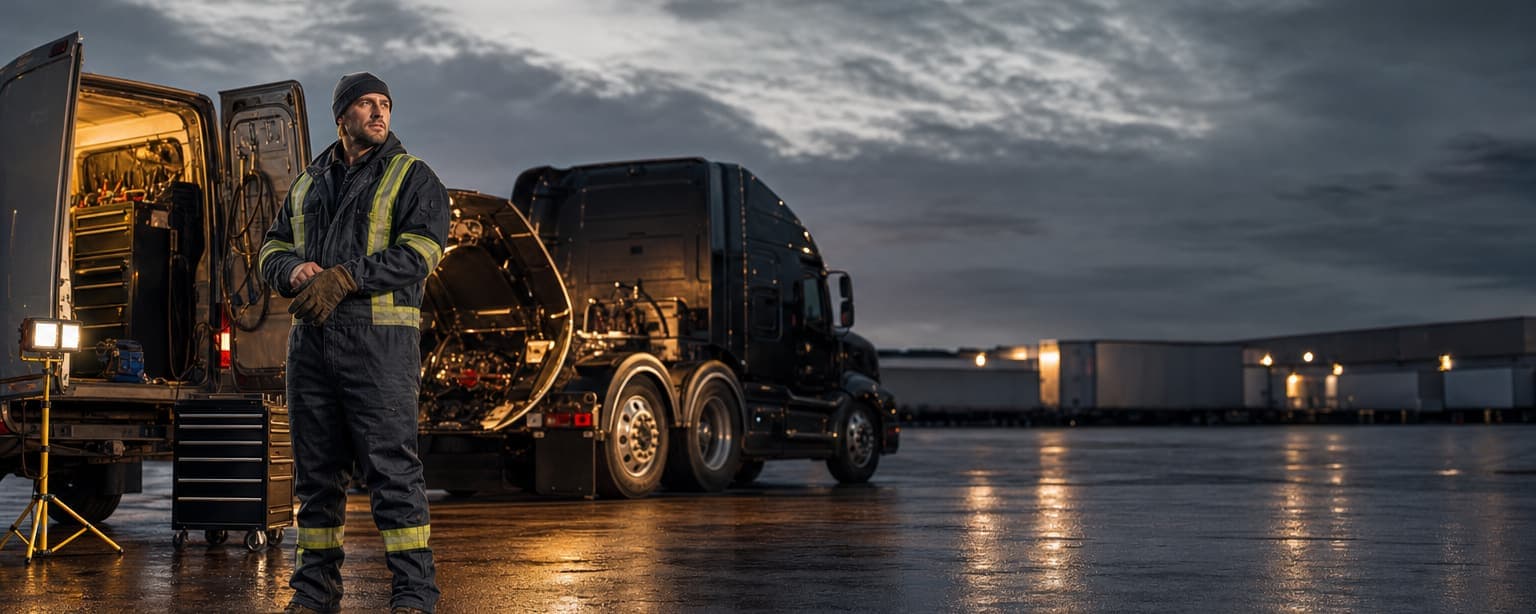
Your shop is the shoulder of a live interstate.
We write mobile repair, heavy truck garages and roadside service with garagekeepers, on-hook and in-tow, built for work performed on an open roadway. Our general liability for mobile mechanics covers work on heavy trucks, which most mechanic programs leave out.
Tell us the situation.
One licensed human replies the same business day — not five agents, not an auto-responder. If the policy you have is already the right one, we will tell you.
We use this to quote and service your insurance, and we do not sell it or pass it to lead networks. Privacy policy.
Send us what you have. We’ll tell you if it’s right.
Your current policy paperwork, a renewal notice, or nothing at all. A licensed agent reads it and replies the same business day.
What mobile repair and heavy truck service businesses actually need.
Garagekeepers
Customer vehicles in your care, custody and control. Every repair shop and dealership has the exposure and most standard policies exclude it.
Without it — The customer’s vehicle is in your care the moment you start work on it, wherever that is, and general liability excludes damage to property in your care outright.
Commercial auto
Vehicles the business owns and the people who drive them for work.
Without it — Service trucks are on the road constantly and frequently stopping on shoulders, which is the worst place a vehicle can be.
General liability
Third-party bodily injury and property damage. It is the line nearly every contract names by default.
Without it — Completed operations matter here: a repair that fails at speed later is your claim, not the driver’s.
Motor truck cargo
The freight itself while you are hauling it. Separate from the liability on the truck.
Without it — On-hook and in-tow coverage, where you recover or move vehicles as part of the service, because the vehicle you are towing is not covered by liability.
Workers compensation
Required in almost every state the moment you have employees. Priced on payroll and class code, which is why the class code is worth arguing about.
Without it — Working beside live traffic is the defining injury exposure in this class, and struck-by claims are catastrophic.
Inland marine & equipment
Tools, equipment and property in transit. It picks up exactly where commercial property stops, which is the moment the item leaves the building.
Without it — Tools, diagnostic equipment and the fit-out of a service truck are worth more than the truck.
Umbrella & excess liability
Extra limit stacked above general liability, auto and employers liability. Usually the cheapest million dollars on the policy.
Without it — Fleet accounts and roadside contracts require limits above primary, and a highway incident exhausts them.
Commercial property
Buildings and contents, valued at what it costs to rebuild today rather than what you paid.
Without it — The shop, the lifts and the parts inventory still need replacing after a loss.

Joe Gorman
Co-Founder | President of Commercial Lines
Has placed hundreds of auto service businesses: repair shops, mobile mechanics, heavy truck garages and the roadside operators most carriers will not look at. He knows which markets still take a garage risk and what garagekeepers limit a full lot actually needs. A mobile operation described the wrong way gets declined on sight, so he describes it the right way.
Five endorsements, and a certificate is none of them.
A certificate is evidence a policy existed the day it was printed — it says so on its own face. The coverage a contract is really asking for lives on the policy as named endorsements, and this is the list they come from.
- Additional insured — ongoing operationsCG 20 10Covers the general contractor for claims arising from your work while the job is in progress.Without it: They fund their own defense on a claim your work caused, then look to you for it.
- Additional insured — completed operationsCG 20 37Extends that coverage to claims arising after your work is finished.Without it: The claim arrives years later, when the policy that should have carried it has renewed several times. Cheaper policies often exclude this or do not offer it.
- Primary and non-contributoryCG 20 01Puts your policy first and stops your insurer demanding a contribution from theirs.Without it: Two insurers argue about who pays while the defense waits.
- Waiver of subrogationCG 24 04Stops your insurer recovering from the party you agreed in writing to protect.Without it: Your insurer pays, then sues your customer, which ends the relationship.
- Per-project aggregateCG 25 03Gives each job its own general aggregate instead of sharing one across the year.Without it: Another project’s claims quietly spend the limit that was meant to cover this one.
Tract, condominium and apartment work is the exception that undoes all five — an exclusion for multi-unit residential removes the coverage before any endorsement can apply. What national homebuilders require covers that in full — D.R. Horton, Pulte Group, Blackrock Homes and the rest of the national builders set the strictest terms a sub will see, and they do not negotiate them.
Contracts ask for more than these five. Every contract insurance requirement, explained, or paste your exhibit into the Contract Insurance Decoder to see the endorsement behind each clause.
How high do you work?
Third floor and above is a different account. The exposure is not only the fall — it is what gets dropped, who is underneath, and how far a tool travels before it lands. Carriers ask for a height limit and many stop at two or three stories, so work you take on because it was offered can quietly put a renewal into a market you were not in last year. Tell us the tallest job you do, not the usual one.
Residential or commercial?
Underwriters treat these as separate trades even when the work is identical. Residential carries construction-defect exposure that follows the job for years and a homeowner who sues; commercial carries bigger limits, tighter contracts and a general contractor who enforces them. A book that is mostly one prices very differently from a book that is evenly split, and the mix is usually the second question on the application.
A mobile truck repair operation running a fleet of service vehicles, paying what the market had told them the class costs.
They saw around a 50% saving on the fleet policy when they moved to us. Nothing about the risk changed. What changed was how it was presented and which credits were applied. This class is priced badly by default because most submissions do not explain what the operation actually is, and the discounts available to a well-run service fleet are not offered to anyone who does not ask for them.
What the insurance company will ask about your mobile repair and heavy truck service business
We read 3 applications the markets use for this kind of business and pulled out what they actually ask. Have these answers ready and a quote takes a day instead of a week, because nobody has to come back to you for the missing piece.
About the business
- What types of auto repair work do you do most often (like oil changes, body work, painting, tire service)
- Do you also sell new or used vehicles, and if so what percentage of your business is sales versus repairs
- How many years have you been doing this type of work
- Do you have a dealer's license, and if so in which states
How you operate
- How many employees do you have working on site
- Do you ever drive customer vehicles to pick them up or deliver them, and how many times per week
- Do you perform any work at customer locations or off-site
- Do you store vehicles on your property overnight after business hours
- Do you ever lease, rent, or loan vehicles to customers
Safety and controls
- If you do painting, do you have a separate spray booth with proper ventilation and explosion-proof lighting
- Do you store paints and solvents in a fire-resistant cabinet outside the paint booth
- Do you have fire extinguishers that are serviced and charged on site
- Are car keys stored in a secure location that only authorized people can access
- Do you leave keys in vehicles
Your history
- What is your claims history from the last three years
- Have you ever had an insurance policy cancelled, declined, or not renewed
- What insurance do you currently have or did you have before
Money and people
- What were your total annual receipts in the last year, broken down by repairs, parts sales, vehicle sales, and any other income sources
- Do you own or operate any other businesses besides this repair shop
Have these ready
- Your last three years of claims history from your current or previous insurer, called loss runs
- A copy of your dealer's license if you have one
- Documentation of any specialized training or certifications you hold related to auto repair
You answer what you can; a licensed agent fills the rest with you.
What our mobile repair and heavy truck service clients ask us.
Does my general liability cover work on semi trucks and other heavy trucks?
Often not, and it is worth checking before the next job. Many general liability programs written for mechanics are built around passenger cars and light trucks, and they exclude or sharply limit work on heavy trucks. We place mobile mechanic general liability with a specialty market that includes heavy truck work, so a repair on a tractor or a trailer is covered the same way as a repair on a pickup.
Why is mobile repair harder to place than a shop?
Because the work moves to the roadway. A technician working in a bay is in a controlled environment; the same technician on the shoulder of an interstate at night is exposed to traffic at highway speed, and struck-by injuries are severe when they happen. Carriers that write ordinary auto repair frequently will not write roadside work, and the ones that do want to know how much of your revenue it is.
Do I need garagekeepers if I do not have a shop?
Yes, and this is the most common gap in mobile operations. Garagekeepers covers damage to a customer’s vehicle in your care, custody and control, and it is in your care while you are working on it in their yard, at a truck stop or on a shoulder, exactly as it would be on your lot. General liability excludes it wherever the work happens, so a mobile operator without garagekeepers is uncovered for the most likely claim they have. Check the per-vehicle limit as well. A mobile mechanic program we place carries $50,000 per vehicle with a $1,000 deductible, which suits cars and light trucks and does not replace a tractor.
Who pays if my repair fails a week later and causes a crash?
Your general liability, under completed operations, for the injuries and the damage to other people’s property. Completed operations is the part of a general liability policy that answers for work after you have finished it and left. It does not pay to redo the repair itself, which is the faulty workmanship exclusion, and the customer’s own auto policy will pay its insured first and then pursue you. A signed repair order and photos of the finished work are the defense.
What if I also do towing or roadside recovery?
Then you need on-hook and in-tow coverage as well, and it has to be disclosed rather than assumed. The vehicle attached to your truck is not covered by your liability policy, and a repair-written program usually does not contemplate towing at all. Where roadside assistance is part of the offer, say so at submission. This is a class where discovering it at claim is the bad outcome.
Can this class actually be cheaper than what I am paying?
Frequently, and by more than people expect. Mobile and heavy truck service is priced badly by default because most submissions do not describe the operation properly: the split between shop and roadside, the technician experience, the safety equipment on the service trucks, the fleet controls. Presented properly, with the credits a well-run fleet qualifies for, the difference can be very large. Our largest mobile truck repair client saw about half.
What does a mobile repair and heavy truck service insurance application ask for?
The applications for mobile repair and heavy truck service businesses ask about 4 things above all: what types of auto repair work do you do most often (like oil changes, body work, painting, tire service); how many employees do you have working on site; if you do painting, do you have a separate spray booth with proper ventilation and explosion-proof lighting; what is your claims history from the last three years. Have your last three years of claims history from your current or previous insurer, called loss runs and a copy of your dealer's license if you have one ready and a quote takes a day instead of a week.
Commercial insurance is 96% of what we do — it is not a department here, it is the whole business. Not ready to talk? The guides answer the questions this page raises in more depth. Already insured with us and need a certificate or a policy change? Ask the service team rather than starting a quote — it is faster and it goes to the people whose job it is. We also write home and auto, which is usually cheaper alongside the business policy than apart from it.