
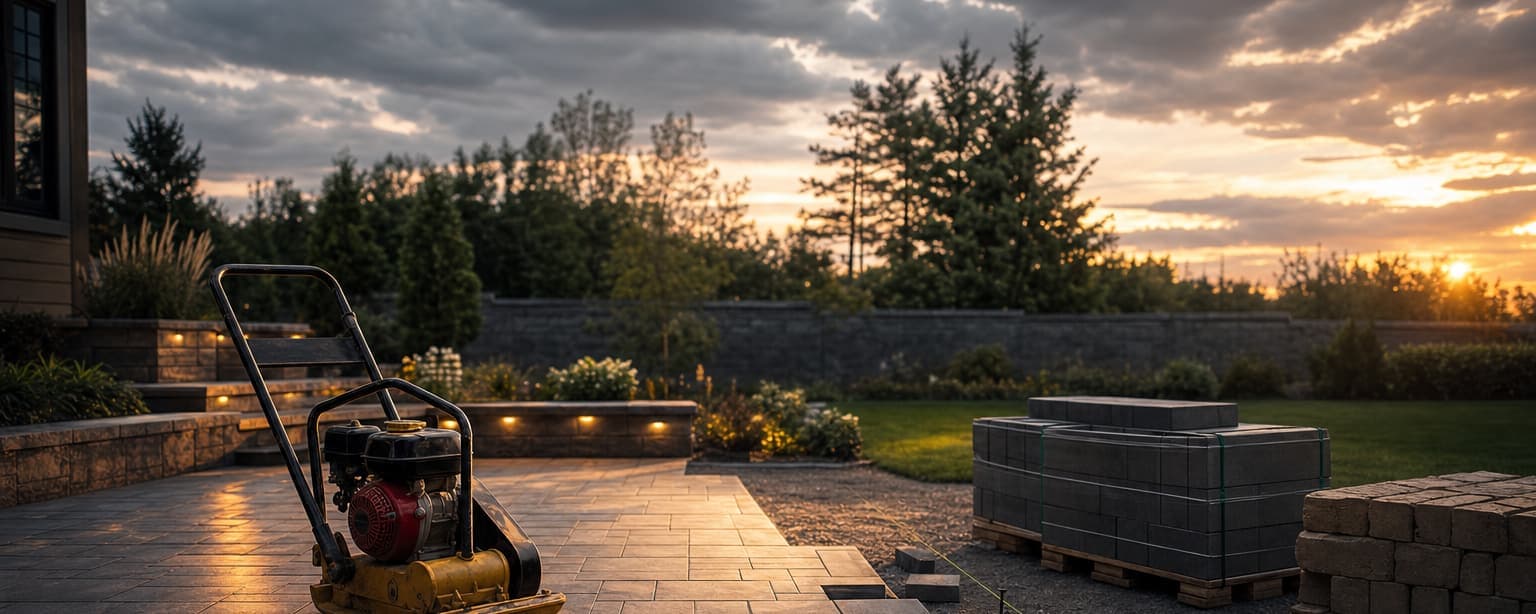
A retaining wall is a structure, and it is rated like one.
Commercial insurance for hardscape, paver and retaining wall contractors: the masonry and excavation exposures that push an account out of a landscaping class.
Tell us the situation.
One licensed human replies the same business day — not five agents, not an auto-responder. If the policy you have is already the right one, we will tell you.
We use this to quote and service your insurance, and we do not sell it or pass it to lead networks. Privacy policy.
Send us what you have. We’ll tell you if it’s right.
Your current policy paperwork, a renewal notice, or nothing at all. A licensed agent reads it and replies the same business day.
What hardscape and retaining wall work businesses actually need.
General liability
Third-party bodily injury and property damage. It is the line nearly every contract names by default.
Without it — A retaining wall that moves takes the ground behind it, and the neighboring property with it.
Workers compensation
Required in almost every state the moment you have employees. Priced on payroll and class code, which is why the class code is worth arguing about.
Without it — Heavy material, machinery and excavation produce the serious injuries in this trade.
Contractors errors & omissions
Covers faulty workmanship and professional mistakes: the cost of the work itself being wrong, which general liability excludes by design.
Without it — A wall that was engineered wrong, or built to the wrong specification, is a professional failure rather than an accident.
Inland marine & equipment
Tools, equipment and property in transit. It picks up exactly where commercial property stops, which is the moment the item leaves the building.
Without it — Plate compactors, saws, skid steers and trailers are high-value and live on job sites.
Commercial auto
Vehicles the business owns and the people who drive them for work.
Without it — Material deliveries and towed equipment are constant and all business use.
Contractors pollution liability
Bodily injury, property damage and clean-up caused by a pollutant your work released: chemical drift, run-off, fuel spills. The standard general liability form excludes all of it.
Without it — Disturbed soil, silt run-off into a storm drain and fuel spills on a customer’s property are excluded by general liability.
Umbrella & excess liability
Extra limit stacked above general liability, auto and employers liability. Usually the cheapest million dollars on the policy.
Without it — Structural failure claims and the earth movement behind them exhaust primary limits quickly.

Joe Gorman
Co-Founder | President of Commercial Lines
Came up in construction, on site and in the office, then moved into sales. Went out on a limb to become Boring’s first dedicated salesperson when the agency had no sales team at all, and now leads it. Landscaping is the class he writes most: grounds maintenance, tree work, irrigation and the spray operations that push an account out of preferred appetite.
The Grounds Guys — Franchise owners are referred to us by their corporate office. We are not affiliated with, or endorsed by, The Grounds Guys.
Five endorsements, and a certificate is none of them.
A certificate is evidence a policy existed the day it was printed — it says so on its own face. The coverage a contract is really asking for lives on the policy as named endorsements, and this is the list they come from.
- Additional insured — ongoing operationsCG 20 10Covers the general contractor for claims arising from your work while the job is in progress.Without it: They fund their own defense on a claim your work caused, then look to you for it.
- Additional insured — completed operationsCG 20 37Extends that coverage to claims arising after your work is finished.Without it: The claim arrives years later, when the policy that should have carried it has renewed several times. Cheaper policies often exclude this or do not offer it.
- Primary and non-contributoryCG 20 01Puts your policy first and stops your insurer demanding a contribution from theirs.Without it: Two insurers argue about who pays while the defense waits.
- Waiver of subrogationCG 24 04Stops your insurer recovering from the party you agreed in writing to protect.Without it: Your insurer pays, then sues your customer, which ends the relationship.
- Per-project aggregateCG 25 03Gives each job its own general aggregate instead of sharing one across the year.Without it: Another project’s claims quietly spend the limit that was meant to cover this one.
Tract, condominium and apartment work is the exception that undoes all five — an exclusion for multi-unit residential removes the coverage before any endorsement can apply. What national homebuilders require covers that in full — D.R. Horton, Pulte Group, Blackrock Homes and the rest of the national builders set the strictest terms a sub will see, and they do not negotiate them.
Contracts ask for more than these five. Every contract insurance requirement, explained, or paste your exhibit into the Contract Insurance Decoder to see the endorsement behind each clause.
How high do you work?
Third floor and above is a different account. The exposure is not only the fall — it is what gets dropped, who is underneath, and how far a tool travels before it lands. Carriers ask for a height limit and many stop at two or three stories, so work you take on because it was offered can quietly put a renewal into a market you were not in last year. Tell us the tallest job you do, not the usual one.
Residential or commercial?
Underwriters treat these as separate trades even when the work is identical. Residential carries construction-defect exposure that follows the job for years and a homeowner who sues; commercial carries bigger limits, tighter contracts and a general contractor who enforces them. A book that is mostly one prices very differently from a book that is evenly split, and the mix is usually the second question on the application.
What the insurance company will ask about your hardscape and retaining wall work business
We read 1 application the markets use for this kind of business and pulled out what they actually ask. Have these answers ready and a quote takes a day instead of a week, because nobody has to come back to you for the missing piece.
About the business
- What types of crane and rigging work do you do (crane rental with operator, bare crane rentals, rigging, steel erection, millwright work, or other)?
- What percentage of your work is commercial versus residential?
- How do you break down your annual income across different types of work?
- What industries or types of customers make up most of your business?
- Are you an AISC member for steel fabrication work?
How you operate
- What is the typical weight of items you lift, and what is your average and maximum on-hook value?
- Do you use load charts for all lifts?
- Are boom angle indicators on your equipment and actually used?
- Do you perform dual or tandem lifts, and if so, how do you coordinate them?
- How do you communicate with your team during lifts?
Safety and controls
- What is your minimum age requirement for operators?
- How do you screen or check references for new operators?
- Are your operators and crew members union or non-union?
- Do you conduct regular safety meetings with your employees?
- Do you have a safety manager responsible for your safety program?
Your history
- Have you had any losses over $5,000 in the past five years?
- What losses or claims has your company had in the past five years?
Money and people
- How many crane operators do you have?
- How many oilers do you have?
- How many other employees do you have?
- How much do you spend annually on renting or leasing equipment from other companies?
- Do you use standard written contracts with your clients?
Have these ready
- Your last five years of claims history from your current insurer, called loss runs, showing carrier name, policy term, number of claims, open claims, and amounts paid and reserved
- A copy of your standard rental agreement or job ticket that shows what insurance your clients must have
- A copy of your written crane inspection form
- A list of all your crane operators with their dates of birth and whether they are licensed or certified
- A copy of any warranty you provide on used equipment you sell
You answer what you can; a licensed agent fills the rest with you.
What our hardscape and retaining wall work clients ask us.
Why is hardscape rated apart from landscaping?
Because it is masonry and excavation rather than grounds maintenance. Retaining walls hold back earth, pavers and patios involve base preparation and drainage, and the failure mode is subsidence or collapse rather than a broken window. It is one of the operations that on its own moves a landscaping account out of preferred appetite, which is why it is worth describing separately rather than letting it sit inside a maintenance class code.
Does the height of a retaining wall matter?
A great deal. Above a certain height most jurisdictions require engineering and a permit, and underwriters ask for the same reason the building department does: the consequence of failure rises sharply with the load retained. Walls built to an engineer’s design, with the drainage detailed, are a materially easier risk to place than walls built by eye.
Am I covered if the wall fails years later?
That is a completed operations claim, and whether you are covered depends on whether the policy carries completed operations and whether it still does at the time the claim arrives. Earth movement and subsidence exclusions are worth checking too, since they can reach the exact failure this trade produces. It is one of the places a cheaper policy is cheaper for a specific reason.
What does a hardscape and retaining wall work insurance application ask for?
The applications for hardscape and retaining wall work businesses ask about 4 things above all: what types of crane and rigging work do you do (crane rental with operator, bare crane rentals, rigging, steel erection, millwright work, or other); what is the typical weight of items you lift, and what is your average and maximum on-hook value; what is your minimum age requirement for operators; have you had any losses over $5,000 in the past five years. Have your last five years of claims history from your current insurer, called loss runs, showing carrier name, policy term, number of claims, open claims, and amounts paid and reserved and a copy of your standard rental agreement or job ticket that shows what insurance your clients must have ready and a quote takes a day instead of a week.
Commercial insurance is 96% of what we do — it is not a department here, it is the whole business. Not ready to talk? The guides answer the questions this page raises in more depth. Already insured with us and need a certificate or a policy change? Ask the service team rather than starting a quote — it is faster and it goes to the people whose job it is. We also write home and auto, which is usually cheaper alongside the business policy than apart from it.