
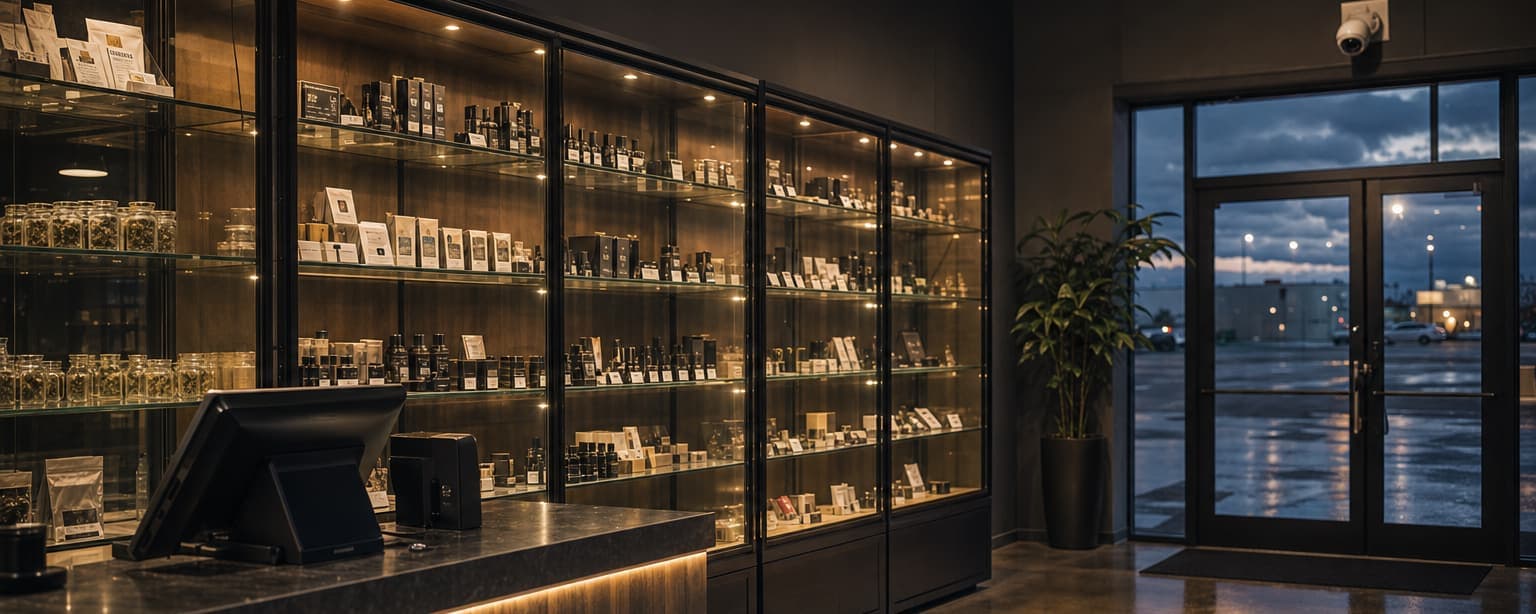
A retail shop that cannot fully use a bank, holding cash and a controlled product.
Restricted banking leaves cannabis retail and delivery holding cash, and the crime exposure follows. We cover that, product liability at point of sale, and the license you cannot operate without.
Tell us the situation.
One licensed human replies the same business day — not five agents, not an auto-responder. If the policy you have is already the right one, we will tell you.
We use this to quote and service your insurance, and we do not sell it or pass it to lead networks. Privacy policy.
Send us what you have. We’ll tell you if it’s right.
Your current policy paperwork, a renewal notice, or nothing at all. A licensed agent reads it and replies the same business day.
What dispensary businesses actually need.
Crime and cash
Robbery, burglary and employee theft, at limits set for real cash on hand.
Without it — Limited banking access makes this the defining retail exposure.
General liability
Customer injury, and the ordinary exposures of a retail floor.
Without it — A queue, a security checkpoint and a public counter.
Product liability
Claims from product sold: potency, labeling, contamination, edibles.
Without it — A retailer is in the chain of supply even when it made nothing.
Property and inventory
Fit-out, safes, security systems and product on the shelf and in the vault.
Without it — Inventory value per square foot is high and it is portable.
Delivery operations
Vehicles, drivers and product in transit.
Without it — A vehicle carrying cash and product is a distinct target.
Group health and benefits
Budtenders leave for the store paying fifty cents more, and every one takes their compliance training with them.
Without it — In a licensed business, an untrained new hire is a regulatory risk as well as a service one. Benefits are what stops the churn.
What our dispensary clients ask us.
Why is the crime exposure so much larger than ordinary retail?
Because federal banking restrictions leave many operators without full banking services, so dispensaries hold cash in amounts an ordinary shop never would, on a known schedule, in a known location. That is a different risk from shrinkage. It is armed robbery and it is what underwriters price. Expect detailed questions about safes and their rating, cash pickup frequency and whether armoured transport is used, camera coverage and retention, access control between the sales floor and the vault, and whether staff are ever alone with the cash.
Are we liable for product we did not make?
Yes. Product liability follows the chain of supply, so a retailer is a defendant alongside the cultivator and manufacturer. In practice you may be the most reachable one. Get named as an additional insured on your suppliers’ policies, collect certificates annually, and carry your own limits regardless. Testing records and the state track-and-trace data are what defend these claims, so make sure you can retrieve them by batch.
What does the state license have to do with insurance?
Two things. Many state programs set minimum liability limits as a condition of licensure, so the policy is a compliance document as well as protection, so check the requirement rather than guessing at a limit. And your license status governs your federal position: since April 2026 marijuana under a qualifying state medical license is Schedule III while adult-use product is still Schedule I, so what you are licensed for changes how the business is regulated and how carriers see it.
Does delivery need something separate?
Yes. Commercial auto for the vehicles, coverage for product and cash in transit, and a look at how drivers are engaged. Contractor drivers with personal policies are excluded for this use, and their reclassification as employees is a live question across delivery generally. Underwriters also ask about route randomisation, vehicle marking, GPS and whether drivers carry cash back.
Commercial insurance is 96% of what we do — it is not a department here, it is the whole business. Not ready to talk? The guides answer the questions this page raises in more depth. Already insured with us and need a certificate or a policy change? Ask the service team rather than starting a quote — it is faster and it goes to the people whose job it is. We also write home and auto, which is usually cheaper alongside the business policy than apart from it.
Handed a lease, a vendor packet or a client contract with insurance requirements? Paste it into the COI Requirements Decoder to see what each one means for your business, or read what the requirements mean.