
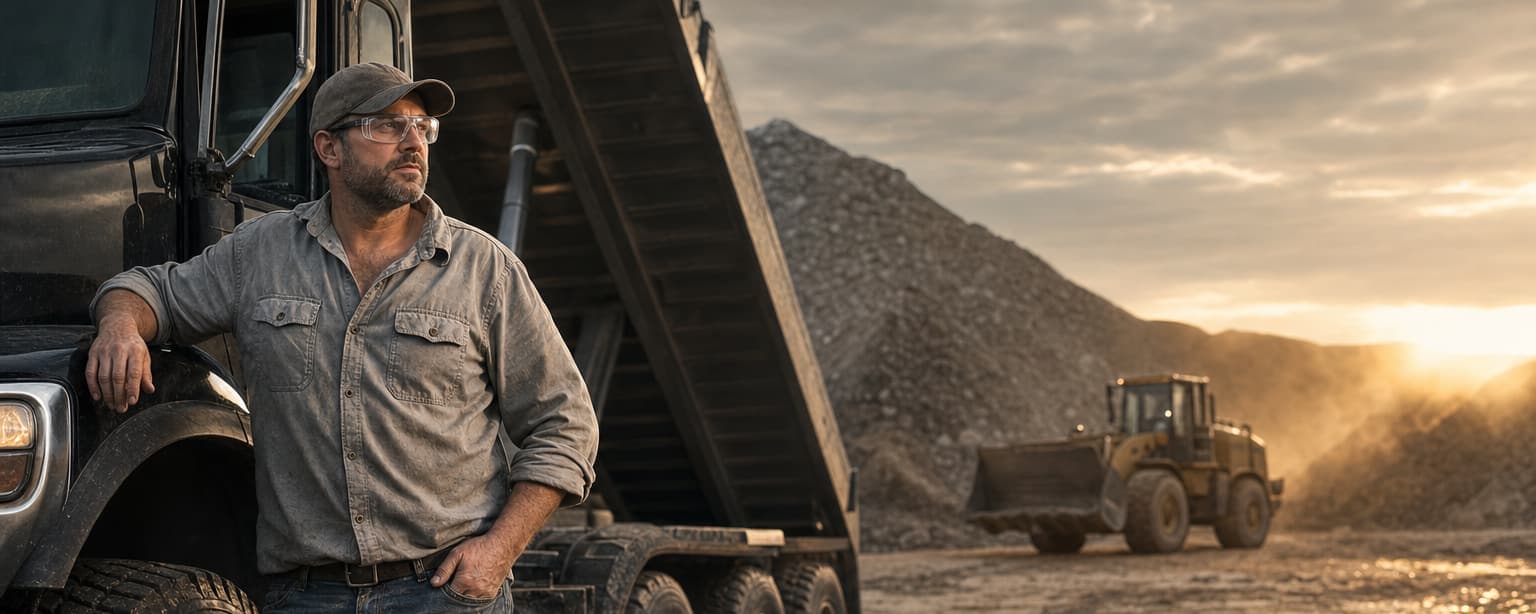
Short miles, heavy loads, and a body that raises into things.
Commercial insurance for dump truck and aggregate haulers: the overturn, site and seasonal exposures that a general freight policy is not rated for.
Tell us the situation.
One licensed human replies the same business day — not five agents, not an auto-responder. If the policy you have is already the right one, we will tell you.
We use this to quote and service your insurance, and we do not sell it or pass it to lead networks. Privacy policy.
Send us what you have. We’ll tell you if it’s right.
Your current policy paperwork, a renewal notice, or nothing at all. A licensed agent reads it and replies the same business day.
What dirt, sand and gravel hauling businesses actually need.
Commercial auto
Vehicles the business owns and the people who drive them for work.
Without it — Loaded dump trucks are top-heavy and the overturn exposure is unlike anything in general freight.
Auto physical damage
Damage to your own tractor and trailer. Primary liability pays for what you do to everyone else and nothing for your equipment, so without this a rollover you caused leaves you paying off a truck you can no longer run.
Without it — Dump bodies, hoists and trailers are expensive and are damaged on site rather than on the road.
General liability
Third-party bodily injury and property damage. It is the line nearly every contract names by default.
Without it — Work on a construction site brings you inside somebody else’s project and their contract requirements.
Motor truck cargo
The freight itself while you are hauling it. Separate from the liability on the truck.
Without it — Material lost or contaminated in transit is still owed to whoever bought it.
Workers compensation
Required in almost every state the moment you have employees. Priced on payroll and class code, which is why the class code is worth arguing about.
Without it — Site work, tarping and climbing on equipment is where the injuries are.
Umbrella & excess liability
Extra limit stacked above general liability, auto and employers liability. Usually the cheapest million dollars on the policy.
Without it — Construction contracts require limits above primary, and a raised bed into a power line is a catastrophic loss.
Contractors pollution liability
Bodily injury, property damage and clean-up caused by a pollutant your work released: chemical drift, run-off, fuel spills. The standard general liability form excludes all of it.
Without it — Hauling contaminated spoil, or spilling material into a watercourse, is a clean-up claim liability excludes.

Lori Adams, TRS
Commercial Trucking Insurance Advisor
Twenty-five years in trucking insurance. Knows the filings, the radius rules and the carriers that will actually take the risk.
Transportation Risk Specialist (TRS)
A paving contractor in Wisconsin could not insure his tractor. A 1099 contractor of his had been caught trafficking drugs across state lines in a company truck, and after that no carrier would look at the vehicle. It sat unused for a year while he was told the risk was uninsurable.
He was covered within a week of asking us. He said he would dance at our founder’s wedding if we could get it done. We are holding him to that. The serious point underneath the joke is that "uninsurable" usually means "nobody has taken it to a market that will read the file", and a criminal act by a contractor is a fact an underwriter can be walked through rather than a permanent disqualification.
A husband and wife driving two dump trucks, hauling dirt, sand and gravel in Texas, came to us after their carrier doubled their rate at renewal. As they understood it, a previous claim had been underreported by their agent, and the price corrected all at once when it surfaced.
We placed them at 25% below the doubled rate, and they kept hauling. A claim reported properly at the time is a number an underwriter rates; the same claim surfacing later is a reason to walk away, and a two-truck operation has no room for the difference.
What the insurance company will ask about your dirt, sand and gravel hauling business
We read the applications the markets use for businesses in this field and pulled out what they actually ask. Have these answers ready and a quote takes a day instead of a week, because nobody has to come back to you for the missing piece.
About the business
- What commodities do you haul?
- How many years have you been in business?
- Do you own any other businesses?
- What is your annual revenue?
How you operate
- Do you haul full truckloads or less than truckload?
- What percentage of your loads come through freight brokers versus contracts?
- What percentage of your loads go to regular fixed destinations?
- What states and major cities do you travel into or through?
- Do you haul any hazardous materials?
Safety and controls
- Are your vehicles equipped with GPS, cameras, or other tracking devices?
- Do you have any ownership, management, or name changes in the past five years?
- Do you lease trucks to other operators?
Your history
- List all losses and accidents from the last three years
- What insurance companies have covered you in the last three years?
Money and people
- What is your annual mileage?
- How many drivers do you have?
- What cargo limit do you need per truck?
Have these ready
- Your vehicle information including year, make, model, and current value for each truck and trailer
- Three years of loss runs from your current and prior insurance companies
- Driver records including dates they earned their CDL
- Any contracts that require specific insurance coverage
You answer what you can; a licensed agent fills the rest with you.
What our dirt, sand and gravel hauling clients ask us.
Which markets actually write dump trucks?
Fewer than write general freight, and each of them counts years before it counts anything else. Canal treats dump as a core class and is a primary market for it at two or more years in operation. Northland writes it at three years, and six in Texas, Florida and Georgia, with no losses or coverage gaps in the preceding thirty-six months and drivers aged twenty-five or over. Berkshire Hathaway Homestate names dirt, sand and gravel work in its appetite. The pattern is consistent: dump concentrates hazards ordinary freight does not — construction sites, unpaved ground, overhead obstructions, tipping while raised, more stops per mile — so carriers answer with tenure requirements rather than with price. A first-year dump operator is a genuinely hard placement and worth starting early.
Why is my dump truck rated differently from a tractor-trailer?
Because the exposure is site work rather than highway miles. Loaded aggregate raises the center of gravity, most of the driving is short-radius and repetitive, and a meaningful share of losses happen off the road entirely: on a site, at a pit, or with the bed up. A carrier that rates you as general freight is usually rating the wrong thing in both directions.
Does construction site work change my requirements?
It does, and often more than the trucking side. A general contractor will want additional insured status, primary and non-contributory wording and a waiver of subrogation from you exactly as they would from any other trade. Hauliers are frequently the last party on a site to realize their certificate has to satisfy a construction contract.
Can I reduce coverage in the off season?
Sometimes, and it is worth asking rather than assuming. Some carriers permit seasonal suspension of physical damage on parked units, which is real money on a fleet that stands still for months. Liability and the filing generally have to stay in force to keep your authority, so the saving is on the equipment side.
Can a new authority get dump truck insurance?
It is one of the hardest classes to place in year one. Several new-venture programs exclude dump trucks outright, and the established dump markets want years of experience and no lapse in coverage. What helps is verifiable time driving a dump for someone else, local radius evidence and a contractor relationship that shows where the work comes from.
What does a dirt, sand and gravel hauling insurance application ask for?
The applications for dirt, sand and gravel hauling businesses ask about 4 things above all: what commodities do you haul; do you haul full truckloads or less than truckload; are your vehicles equipped with gps, cameras, or other tracking devices; list all losses and accidents from the last three years. Have your vehicle information including year, make, model, and current value for each truck and trailer and three years of loss runs from your current and prior insurance companies ready and a quote takes a day instead of a week.
Commercial insurance is 96% of what we do — it is not a department here, it is the whole business. Not ready to talk? The guides answer the questions this page raises in more depth. Already insured with us and need a certificate or a policy change? Ask the service team rather than starting a quote — it is faster and it goes to the people whose job it is. We also write home and auto, which is usually cheaper alongside the business policy than apart from it.
Handed a lease, a vendor packet or a client contract with insurance requirements? Paste it into the COI Requirements Decoder to see what each one means for your business, or read what the requirements mean.