
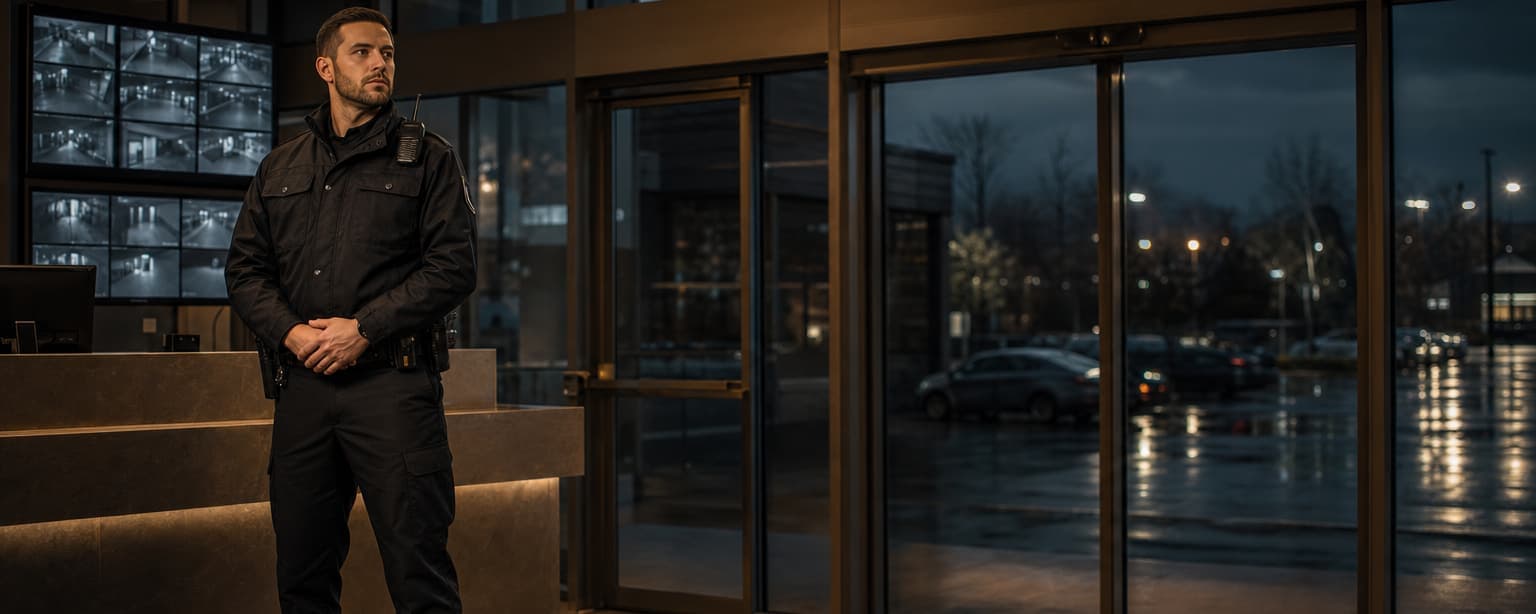
Your general liability excludes the thing you are hired for.
Commercial insurance for security guard and patrol companies, written around assault and battery, false arrest and the armed-versus-unarmed line.
Tell us the situation.
One licensed human replies the same business day — not five agents, not an auto-responder. If the policy you have is already the right one, we will tell you.
We use this to quote and service your insurance, and we do not sell it or pass it to lead networks. Privacy policy.
Send us what you have. We’ll tell you if it’s right.
Your current policy paperwork, a renewal notice, or nothing at all. A licensed agent reads it and replies the same business day.
What security services businesses actually need.
Assault & battery
A fight in a bar is an intentional act, and general liability excludes intentional acts, so the claim most likely to arrive from a late-night venue is the one most often uninsured.
Without it — A standard general liability policy excludes intentional acts, and physical intervention by a guard is exactly that. The coverage puts it back.
General liability
Third-party bodily injury and property damage. It is the line nearly every contract names by default.
Without it — Ordinary premises and operations claims still happen, and it is the policy the assault and battery coverage attaches to.
Professional liability
Covers the advice, the drawing, the diagnosis. The work itself, rather than someone getting hurt on your premises.
Without it — Failing to prevent something you were hired to prevent is a service failure rather than an accident, and it is how most guard claims are pleaded.
Workers compensation
Required in almost every state the moment you have employees. Priced on payroll and class code, which is why the class code is worth arguing about.
Without it — Guards are assaulted, and lone working at night in premises they do not control raises both frequency and severity.
Commercial auto
Vehicles the business owns and the people who drive them for work.
Without it — Patrol vehicles cover a lot of miles at night between sites, which is the highest-risk driving profile there is.
Employment practices liability
Wrongful termination, discrimination and harassment claims brought by your own employees. General liability specifically excludes these.
Without it — High turnover, shift work and a large hourly workforce produce wage, discrimination and wrongful termination claims.
Umbrella & excess liability
Extra limit stacked above general liability, auto and employers liability. Usually the cheapest million dollars on the policy.
Without it — A serious injury caused by a guard is a bodily injury claim with a plaintiff, a video and no natural ceiling.
Crime & employee dishonesty
Theft by your own staff, funds transfer fraud, and the dishonesty bond a home care contract will ask you for by name.
Without it — Employees are placed alone inside client premises with access to everything in them.
Cyber & tech E&O
Breach response, ransomware and the notification costs that follow. Technology errors and omissions sits on the same policy and covers the software or service itself failing a client, which is the half most tech companies find out about too late.
Without it — Access control, camera systems and guard tour data are client security information held by you.
What the insurance company will ask about your security services business
We read the applications the markets use for businesses in this field and pulled out what they actually ask. Have these answers ready and a quote takes a day instead of a week, because nobody has to come back to you for the missing piece.
About the business
- What is your business structure (individual, corporation, partnership, or other)?
- How many years have you been in business?
- What other names has your business been known by?
- What is your annual gross income?
- What is your annual payroll?
How you operate
- Describe the rigging work you do, including what items you typically hoist, lower, load, or rig
- What is your average project value and your maximum project value?
- How many jobs do you do per year?
- What is the average length of your projects?
- How many jobs do you usually have going at the same time (minimum and maximum)?
Safety and controls
- Do you have a maintenance program for your equipment and how often do you inspect it?
- Do you have written instructions for operating your equipment?
- Do you have a safety or training program for your operators?
- Do you investigate accidents?
- Do your operators complete daily equipment check sheets?
Your history
- Has your business or anyone related to it ever had a claim?
- Have you had any incidents, events, losses, or accidents that might result in a claim before a new policy starts?
- Who is your current insurance company (or most recent if you don't have current coverage)?
- What insurance companies have covered you in the last three years, what did they cover, and when did those policies expire?
Money and people
- How many full-time and part-time employees do you have?
- Do you lease any operators or equipment?
- How do you transport property from storage to job sites (your own vehicles, common carrier, contract carrier, rail, or air)?
- Where do you store property when it's not at a job site?
- What is the average value of property in storage and the maximum value?
Have these ready
- Your complete five-year claims or loss history from all insurance companies you've used (called loss runs)
- Name, email, phone, years with your company, and job duties of any employee who handles safety, loss control, inspections, engineering, or consulting
You answer what you can; a licensed agent fills the rest with you.
What our security services clients ask us.
Why is assault and battery coverage a separate thing?
Because general liability is built to cover accidents, and an assault is not an accident. The standard form excludes expected or intended injury, and most policies carry a specific assault and battery exclusion on top of it. For nearly any other business that is a remote issue. For a guard company it removes the central exposure, because physical intervention is part of the service. Coverage is bought back by endorsement, often with its own limit lower than the policy limit, and reading that sublimit is the most important thing you will do on the quote.
How much difference does armed make?
It is the difference between a broad market and a narrow one. Unarmed observe-and-report work is placeable with many carriers. Armed work is written by a much smaller group, priced substantially higher, and comes with conditions on training, qualification, retention of records and sometimes on which sites may be covered. Mixed operations need to be declared accurately: a small armed division on a policy rated as unarmed is the kind of misstatement that voids coverage on the claim it matters for.
What is false arrest coverage and do I need it?
It responds to detaining someone who should not have been detained: a shoplifting stop that was wrong, a trespass ejection that went too far. If your guards detain anyone, or are placed in retail or venue environments where they will, you need it, and it is usually found in the same endorsement family as assault and battery. Observe-and-report contracts with a genuine no-touch policy have a much lower need, and it is worth having that policy in writing because underwriters ask for it.
Does it matter whether my work is regular sites or one-off events?
It matters more than almost anything else on the application. Underwriters want to see standing contracts. The same guards, at the same site, day in and day out, under an agreement that runs for a term. That is a known environment with known risks and a client who has agreed in writing what the guards do.
Executive protection and touring work: can that be placed?
Yes, and it is a different market from ordinary guard business rather than a harder version of it. Close protection, residential details for high-profile clients, tour and venue security and the armed end of all three are written by a small number of underwriters who specialize in it, price it on the calibre of the operation rather than on headcount, and are not reachable through most agencies. We have that access. If you are being told the work is uninsurable, what you are usually being told is that the person you asked cannot reach the market for it.
Clients want to be additional insureds. Is that a problem?
It is normal and expected, and most guard contracts require it, along with a waiver of subrogation and often primary and non-contributory wording. The thing to watch is whether the additional insured endorsement extends to the assault and battery coverage or stops at the general liability. A client added to a policy whose central coverage they cannot reach has not got what the contract asked for, and that is discovered at claim time unless it is checked at placement.
What does a security services insurance application ask for?
The applications for security services businesses ask about 4 things above all: what is your business structure (individual, corporation, partnership, or other); describe the rigging work you do, including what items you typically hoist, lower, load, or rig; do you have a maintenance program for your equipment and how often do you inspect it; has your business or anyone related to it ever had a claim. Have your complete five-year claims or loss history from all insurance companies you've used (called loss runs) and name, email, phone, years with your company, and job duties of any employee who handles safety, loss control, inspections, engineering, or consulting ready and a quote takes a day instead of a week.
Commercial insurance is 96% of what we do — it is not a department here, it is the whole business. Not ready to talk? The guides answer the questions this page raises in more depth. Already insured with us and need a certificate or a policy change? Ask the service team rather than starting a quote — it is faster and it goes to the people whose job it is. We also write home and auto, which is usually cheaper alongside the business policy than apart from it.
Handed a lease, a vendor packet or a client contract with insurance requirements? Paste it into the COI Requirements Decoder to see what each one means for your business, or read what the requirements mean.