
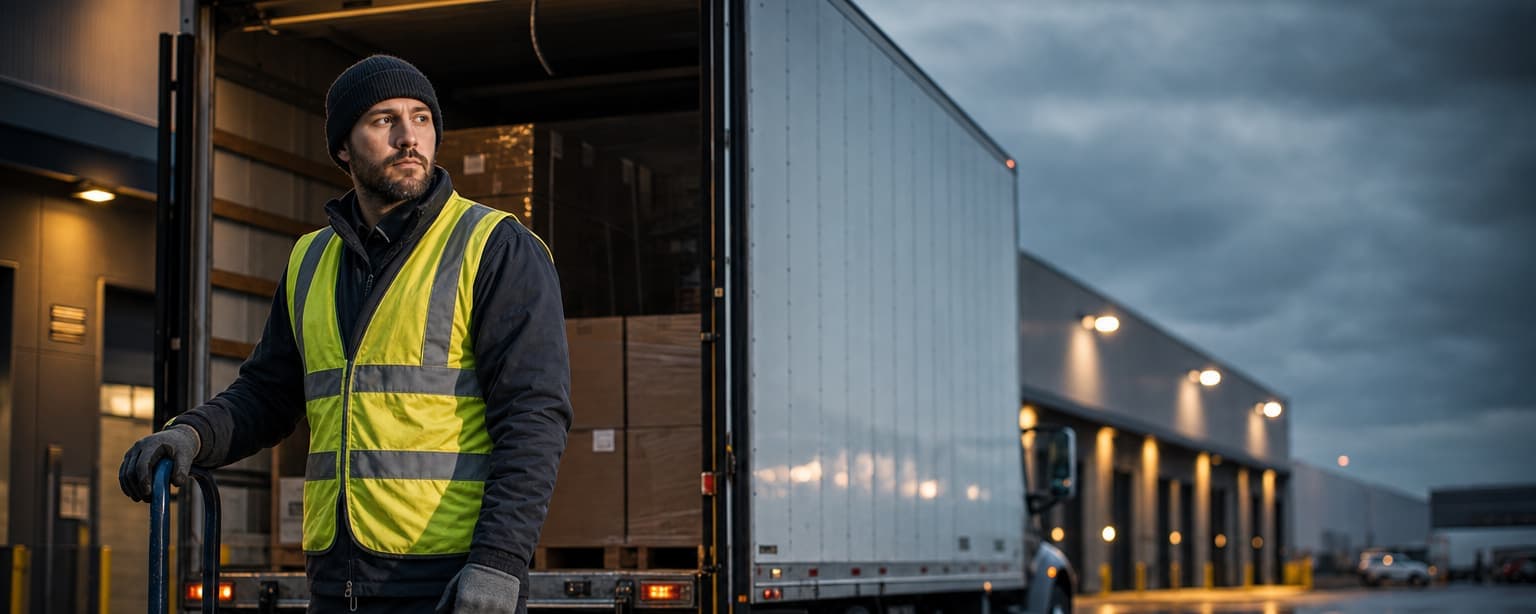
The driver is the rating factor, because the truck needs no CDL.
Commercial insurance for box truck and straight truck operators, including the authority requirements that apply whether or not the driver holds a CDL.
Tell us the situation.
One licensed human replies the same business day — not five agents, not an auto-responder. If the policy you have is already the right one, we will tell you.
We use this to quote and service your insurance, and we do not sell it or pass it to lead networks. Privacy policy.
Send us what you have. We’ll tell you if it’s right.
Your current policy paperwork, a renewal notice, or nothing at all. A licensed agent reads it and replies the same business day.
What box truck operations businesses actually need.
Commercial auto
Vehicles the business owns and the people who drive them for work.
Without it — The filing applies to the freight and the authority, not to whether the vehicle needs a CDL to drive.
Motor truck cargo
The freight itself while you are hauling it. Separate from the liability on the truck.
Without it — Freight in the box is owed to the shipper if it is damaged or stolen.
Auto physical damage
Damage to your own tractor and trailer. Primary liability pays for what you do to everyone else and nothing for your equipment, so without this a rollover you caused leaves you paying off a truck you can no longer run.
Without it — Box trucks are financed and liability contributes nothing toward your own vehicle.
General liability
Third-party bodily injury and property damage. It is the line nearly every contract names by default.
Without it — Delivery premises, loading and anything off the truck sits outside the auto policy.
Workers compensation
Required in almost every state the moment you have employees. Priced on payroll and class code, which is why the class code is worth arguing about.
Without it — Lift gates, hand trucks and repeated loading produce the injuries in this class.
Hired & non-owned auto
Covers vehicles the business does not own but its people drive on the job: rentals, and employees running errands in their own cars. Their personal auto policy will not cover a business trip, and the claim lands on the business. Pricing depends entirely on HOW it is bought: as an endorsement on a general liability policy we write, HNOA often costs a few hundred dollars; as a stand-alone (monoline) policy it runs $2,500 to $5,000, and association practitioner programs (CPH, CM&F and similar) generally cannot take the endorsement, so "add HNOA to my existing policy for $300-$800" is usually not a real option. A package carrying GL, professional liability and HNOA together is typically cheaper than the monoline.
Without it — Rented or borrowed trucks used to cover a peak are not on your schedule.
Umbrella & excess liability
Extra limit stacked above general liability, auto and employers liability. Usually the cheapest million dollars on the policy.
Without it — A straight truck in city traffic still produces serious injury claims.

Lori Adams, TRS
Commercial Trucking Insurance Advisor
Twenty-five years in trucking insurance. Knows the filings, the radius rules and the carriers that will actually take the risk.
Transportation Risk Specialist (TRS)
What the insurance company will ask about your box truck operations business
We read the applications the markets use for businesses in this field and pulled out what they actually ask. Have these answers ready and a quote takes a day instead of a week, because nobody has to come back to you for the missing piece.
About the business
- What is your business structure (sole proprietorship, partnership, corporation, or LLC)?
- Do you have any sister or subsidiary companies, and do you share equipment with them?
- Have you had any changes in ownership, management, or business name in the past five years?
How you operate
- What types of freight do you haul, and what percentage of your business is each type (refrigerated, dry van, auto hauling, tanker, flatbed, other)?
- How many company drivers, owner-operators, and subcontractors do you have?
- Do you operate double or triple trailers, and if so, what percentage of your mileage?
- Do you slip-seat your vehicles, and if so, what percentage?
- Do you have team drivers, and if so, how many?
Safety and controls
- Do you have a safety manager, and if so, is it full-time or part-time?
- Do any of your vehicles have advanced technology like electronic logging devices or collision avoidance systems, and what percentage of your fleet has them?
Money and people
- How many revenue units (tractors and straight trucks) do you operate?
- What is your gross annual revenue and total annual mileage for the past four years?
- If you hire non-owned vehicles, how many employees use them?
- If you hire vehicles, what is your annual estimated cost?
- Do you operate from a residence, and if so, do you have on-premises fuel storage?
Your history
- What coverage types do you need (auto liability, physical damage, cargo, general liability)?
- What liability limits, deductibles, and coverage options do you prefer?
- Do you need excess or umbrella coverage above standard limits?
Have these ready
- Count of each vehicle type you operate (tractors, straight trucks, trailers by type)
- Your gross revenue and miles for the current year and past four years
- Your last three years of claims history from your current insurer, called loss runs
- Current policy documents if you want limits higher than $150,000
- Copy of your homeowner's policy if you operate from a residence
You answer what you can; a licensed agent fills the rest with you.
What our box truck operations clients ask us.
Do I need commercial trucking insurance for a non-CDL box truck?
If you are hauling regulated freight for hire in interstate commerce, yes. The authority, the filing and the minimum limit follow the operation rather than the driving license. Under 26,001 pounds you may not need a CDL, and that has no bearing on your obligation as a motor carrier. This is one of the most expensive misunderstandings in the class.
Why do underwriters ask so much about my drivers?
Because in a non-CDL class the driver pool is the largest variable there is. There is no CDL screen, turnover is higher, and MVRs vary far more than they do in a tractor-trailer fleet. A clean driver list and a documented hiring standard are worth real money at quoting time, and are the first thing an underwriter asks to see.
Does using rental trucks for peak season affect my policy?
It should be on it. A truck you hired for a busy month is not on your schedule, and hired and non-owned auto is what answers for it. Seasonal fleets that spike and shrink are placeable, but the arrangement needs to be described up front rather than found at audit.
Does a box truck need a DOT number or an MC number?
A DOT number, almost certainly, and an MC number if you haul for hire across state lines. Federal rules apply to any vehicle in interstate commerce rated over 10,000 pounds, which is every box truck, and to any vehicle carrying placarded hazmat or nine or more passengers. Operating authority is for carrying other people’s freight for hire in interstate commerce. Purely intrastate rules are set by each state and many require a state DOT number too. Check both at fmcsa.dot.gov before you take a load.
Can I insure a box truck under a brand new authority?
Usually, and the federal minimum is the same $750,000 for general freight in any truck rated 10,001 pounds or more. Most box truck operators also need what their contract requires on top, which for delivery work is often $1,000,000 of auto liability, cargo and sometimes trailer interchange. The drivers matter more than the truck, because a non-CDL box truck is often driven by people with the least experience on the road.
What insurance does Amazon Relay require for a box truck?
Amazon sets its own requirements and revises them, so read the current Relay page before you buy. Our guide lists what it asked for when we last read it, and the usual trap is trailer interchange, which a box truck operator pulling Amazon trailers needs and often assumes is already included.
What does a box truck operations insurance application ask for?
The applications for box truck operations businesses ask about 4 things above all: what is your business structure (sole proprietorship, partnership, corporation, or llc); what types of freight do you haul, and what percentage of your business is each type (refrigerated, dry van, auto hauling, tanker, flatbed, other); do you have a safety manager, and if so, is it full-time or part-time; how many revenue units (tractors and straight trucks) do you operate. Have count of each vehicle type you operate (tractors, straight trucks, trailers by type) and your gross revenue and miles for the current year and past four years ready and a quote takes a day instead of a week.
Guides on box truck operations.
Commercial insurance is 96% of what we do — it is not a department here, it is the whole business. Not ready to talk? The guides answer the questions this page raises in more depth. Already insured with us and need a certificate or a policy change? Ask the service team rather than starting a quote — it is faster and it goes to the people whose job it is. We also write home and auto, which is usually cheaper alongside the business policy than apart from it.
Handed a lease, a vendor packet or a client contract with insurance requirements? Paste it into the COI Requirements Decoder to see what each one means for your business, or read what the requirements mean.