
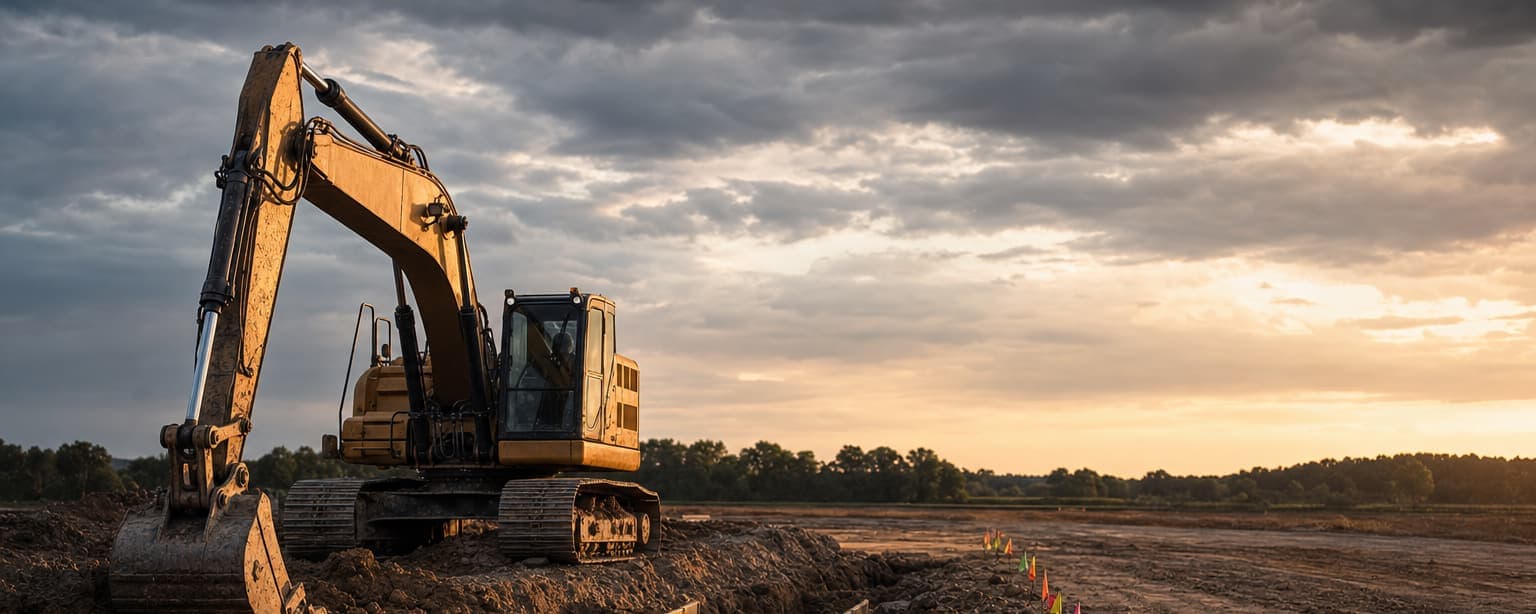
What is underground is not where the drawing says it is.
Commercial insurance for excavation, grading and earthmoving contractors, written around utility strikes, trench work and damage to what is next door.
Tell us the situation.
One licensed human replies the same business day — not five agents, not an auto-responder. If the policy you have is already the right one, we will tell you.
We use this to quote and service your insurance, and we do not sell it or pass it to lead networks. Privacy policy.
Send us what you have. We’ll tell you if it’s right.
Your current policy paperwork, a renewal notice, or nothing at all. A licensed agent reads it and replies the same business day.
What excavation and grading businesses actually need.
General liability
Third-party bodily injury and property damage. It is the line nearly every contract names by default.
Without it — A strike or a slope failure damages property and interrupts services for people who were never your customer.
Workers compensation
Required in almost every state the moment you have employees. Priced on payroll and class code, which is why the class code is worth arguing about.
Without it — Trench collapse and struck-by injuries are the fatality classes of this trade, not the strain injuries of most others.
General liability
Third-party bodily injury and property damage. It is the line nearly every contract names by default.
Without it — Cutting a gas main, a fiber trunk or a water main is damage to a utility, and the loss includes everyone that utility was serving, which is why the umbrella limit above the general liability is the number that decides this claim.
Contractors pollution liability
Bodily injury, property damage and clean-up caused by a pollutant your work released: chemical drift, run-off, fuel spills. The standard general liability form excludes all of it.
Without it — Disturbed contaminated soil, a struck fuel line or dewatering discharge is a clean-up obligation, and the GL pollution exclusion reaches all three.
Commercial auto
Vehicles the business owns and the people who drive them for work.
Without it — Haul trucks and lowboys move heavy plant on public roads, and an overturned load is a road closure as well as a claim.
Inland marine & equipment
Tools, equipment and property in transit. It picks up exactly where commercial property stops, which is the moment the item leaves the building.
Without it — Excavators, skid steers and attachments are the single largest asset on the books, and they sit unattended on sites overnight.
Equipment breakdown & spoilage
Covers the walk-in, the compressor and the line when they fail from the inside. A mechanical or electrical breakdown is excluded by property policies, and the stock that thawed goes with it.
Without it — Hydraulic and electrical failure on machines takes them out of service and stops the job.
Umbrella & excess liability
Extra limit stacked above general liability, auto and employers liability. Usually the cheapest million dollars on the policy.
Without it — A severed main or a trench fatality reaches numbers a primary limit was never sized for.
Builders risk
Covers a structure while it is going up, and ends at completion. Not the same as the contractor’s general liability.
Without it — Storm water undoes completed earthwork that has been paid for and not yet invoiced.
Surety bonds
License, bid and performance bonds. A bond guarantees you will finish the job. It protects the other party, not you, which is the part most people get wrong.
Without it — Public work is bonded work, and the bond decides which contracts can be bid.

Joe Gorman
Co-Founder | President of Commercial Lines
Came up in construction, on site and in the office, then moved into sales. Went out on a limb to become Boring’s first dedicated salesperson when the agency had no sales team at all, and now leads it. Landscaping is the class he writes most: grounds maintenance, tree work, irrigation and the spray operations that push an account out of preferred appetite.
Five endorsements, and a certificate is none of them.
A certificate is evidence a policy existed the day it was printed — it says so on its own face. The coverage a contract is really asking for lives on the policy as named endorsements, and this is the list they come from.
- Additional insured — ongoing operationsCG 20 10Covers the general contractor for claims arising from your work while the job is in progress.Without it: They fund their own defense on a claim your work caused, then look to you for it.
- Additional insured — completed operationsCG 20 37Extends that coverage to claims arising after your work is finished.Without it: The claim arrives years later, when the policy that should have carried it has renewed several times. Cheaper policies often exclude this or do not offer it.
- Primary and non-contributoryCG 20 01Puts your policy first and stops your insurer demanding a contribution from theirs.Without it: Two insurers argue about who pays while the defense waits.
- Waiver of subrogationCG 24 04Stops your insurer recovering from the party you agreed in writing to protect.Without it: Your insurer pays, then sues your customer, which ends the relationship.
- Per-project aggregateCG 25 03Gives each job its own general aggregate instead of sharing one across the year.Without it: Another project’s claims quietly spend the limit that was meant to cover this one.
Tract, condominium and apartment work is the exception that undoes all five — an exclusion for multi-unit residential removes the coverage before any endorsement can apply. What national homebuilders require covers that in full — D.R. Horton, Pulte Group, Blackrock Homes and the rest of the national builders set the strictest terms a sub will see, and they do not negotiate them.
Contracts ask for more than these five. Every contract insurance requirement, explained, or paste your exhibit into the Contract Insurance Decoder to see the endorsement behind each clause.
How high do you work?
Third floor and above is a different account. The exposure is not only the fall — it is what gets dropped, who is underneath, and how far a tool travels before it lands. Carriers ask for a height limit and many stop at two or three stories, so work you take on because it was offered can quietly put a renewal into a market you were not in last year. Tell us the tallest job you do, not the usual one.
Residential or commercial?
Underwriters treat these as separate trades even when the work is identical. Residential carries construction-defect exposure that follows the job for years and a homeowner who sues; commercial carries bigger limits, tighter contracts and a general contractor who enforces them. A book that is mostly one prices very differently from a book that is evenly split, and the mix is usually the second question on the application.
What the insurance company will ask about your excavation and grading business
We read 1 application the markets use for this kind of business and pulled out what they actually ask. Have these answers ready and a quote takes a day instead of a week, because nobody has to come back to you for the missing piece.
About the business
- What type of blasting work do you do, and where do you do it?
- How many full-time and part-time employees do you have?
- What is your annual payroll?
- How far from your main location do you typically work?
- Are you a member of any blasting trade associations?
How you operate
- Do all your blasters have experience with the types of shots you perform?
- Do you keep blasting logs current for every job?
- What percentage of your work is in undeveloped areas versus urban areas?
- How many shots did you perform in the past 12 months, and how many do you expect in the next 12 months?
- What types of rock do you blast (heavy rock, soft rock, fragmented rock)?
Safety and controls
- Do you use blasting mats when shooting in developed areas?
- Do you perform pre-blast surveys within 250 feet of the blast site?
- Do you use an independent surveyor for pre-blast surveys?
- Do you require the surveyor to carry insurance and name you as additionally insured?
- Do you require surveyor to carry professional liability insurance?
Money and people
- What are your estimated annual blasting-related receipts for the next 12 months?
- How long have you been under current management?
- How many years of experience does your management have?
Your history
- What is your business structure (individual, corporation, partnership, joint venture, other)?
- Has your business operated under any other names?
- Do you have any claims over $5,000 from the past?
- Who supplies your explosives?
Have these ready
- Your blasting safety program and hiring practices
- Your current financial statement
- Your last five years of claims history from your current insurer, called loss runs
- Sample contracts or hold harmless agreements you use with customers
- Information about your business (brochures or similar)
You answer what you can; a licensed agent fills the rest with you.
What our excavation and grading clients ask us.
I have started doing directional boring. Does my policy follow?
Usually not, and it is worth checking before the next crossing rather than after. Boring is treated as its own class: many general liability policies exclude damage to property below the surface, which removes coverage for the exact thing the rig does all day, and a struck fiber trunk brings claims from every business downstream of it rather than just the cost of the splice.
If I called in the locate ticket, am I covered when the mark is wrong?
Calling it in is what keeps you defensible, but it does not make the claim go away. Locate marks are frequently inaccurate or incomplete, particularly on older private services that were never mapped, and the argument after a strike is about whether you excavated with reasonable care inside the tolerance zone. Documentation is what wins it: the ticket number, dated photographs of the marks, and a record of hand digging where required. Keep those as a habit rather than after the first strike.
What is the coverage gap most excavators do not know they have?
Damage to adjacent property from removing lateral support, such as the neighboring wall that cracks because you took the soil out from beside it. Many general liability policies exclude subsidence, earth movement or damage from excavation, and the exclusion is not always obvious. On urban work next to existing structures it is the exposure worth checking the policy language for specifically, before the job rather than after.
Does the depth I dig change the market?
It changes the questions and often the price. Shallow grading and utility trenching sit in a much broader market than deep excavation, shoring and anything requiring a competent person on a protective system. Blasting is its own class entirely and is usually excluded unless specifically added. State your real maximum depth and whether you shore. Understating it is how a claim gets contested after a collapse.
My equipment is financed. What does the lender need?
Usually loss payee status on the inland marine or equipment policy, which entitles them to be paid, and sometimes additional insured on the liability. Note that those are different requests: loss payee is about money, additional insured is about defense. Getting the lender the right one at the outset avoids the call where a machine is a total loss and the paperwork is wrong.
What does a excavation and grading insurance application ask for?
The applications for excavation and grading businesses ask about 4 things above all: what type of blasting work do you do, and where do you do it; do all your blasters have experience with the types of shots you perform; do you use blasting mats when shooting in developed areas; what are your estimated annual blasting-related receipts for the next 12 months. Have your blasting safety program and hiring practices and your current financial statement ready and a quote takes a day instead of a week.
Commercial insurance is 96% of what we do — it is not a department here, it is the whole business. Not ready to talk? The guides answer the questions this page raises in more depth. Already insured with us and need a certificate or a policy change? Ask the service team rather than starting a quote — it is faster and it goes to the people whose job it is. We also write home and auto, which is usually cheaper alongside the business policy than apart from it.