
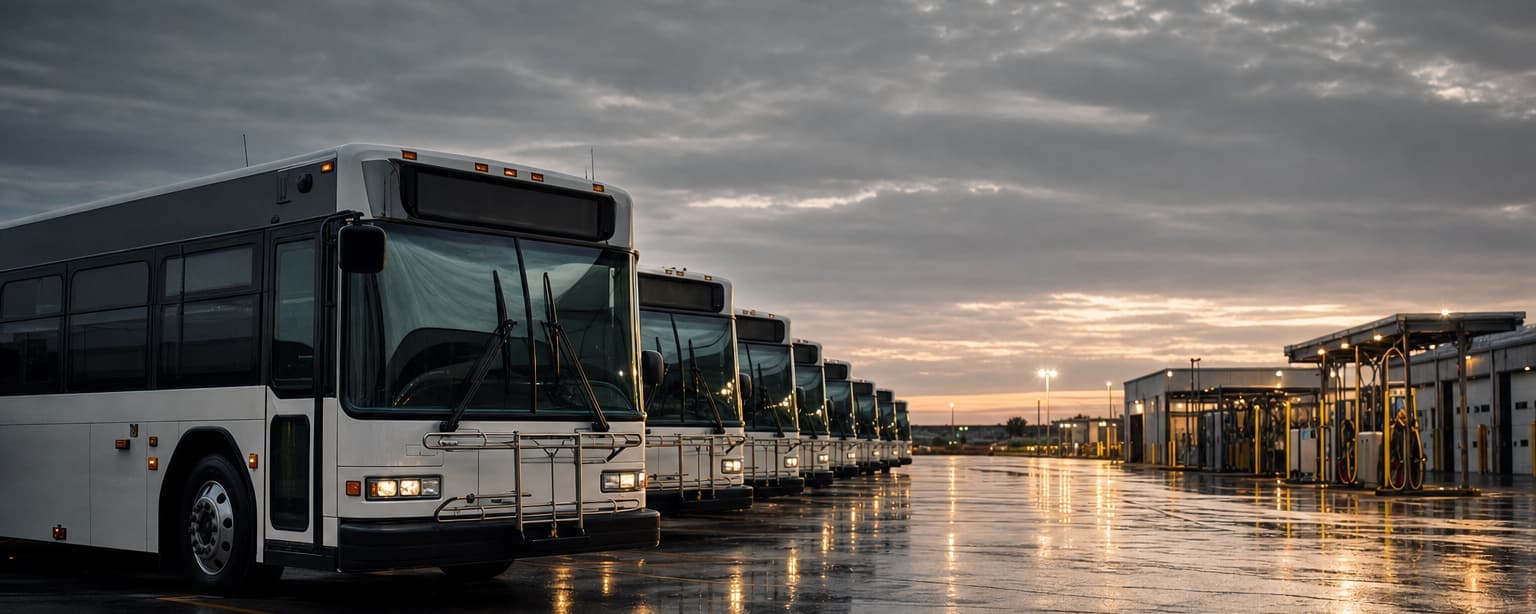
When the cargo is a person, almost every rule changes.
We insure public auto and for-hire passenger operators: taxi, limousine, bus, shuttle and non-emergency medical transport.
Tell us the situation.
One licensed human replies the same business day — not five agents, not an auto-responder. If the policy you have is already the right one, we will tell you.
We use this to quote and service your insurance, and we do not sell it or pass it to lead networks. Privacy policy.
Send us what you have. We’ll tell you if it’s right.
Your current policy paperwork, a renewal notice, or nothing at all. A licensed agent reads it and replies the same business day.
What public auto businesses actually need.
Commercial auto
Vehicles the business owns and the people who drive them for work.
Without it — Passenger carriers have their own federal minimums, set by seating capacity rather than by what is in the back.
Umbrella & excess liability
Extra limit stacked above general liability, auto and employers liability. Usually the cheapest million dollars on the policy.
Without it — One incident produces as many claimants as there are seats, which is how a primary limit disappears in a single event.
Sexual abuse & molestation
Covers allegations of abuse by staff or volunteers. General liability usually excludes it outright, and any organization working with children, patients or vulnerable adults will be asked to carry it by name.
Without it — Carrying passengers — particularly minors, elderly and disabled riders — is an allegation exposure that general liability excludes.
General liability
Third-party bodily injury and property damage. It is the line nearly every contract names by default.
Without it — Boarding, alighting and premises claims happen off the vehicle and outside the auto policy.
Workers compensation
Required in almost every state the moment you have employees. Priced on payroll and class code, which is why the class code is worth arguing about.
Without it — Drivers, and the physical assistance they give passengers, produce the injuries in this class.
Auto physical damage
Damage to your own tractor and trailer. Primary liability pays for what you do to everyone else and nothing for your equipment, so without this a rollover you caused leaves you paying off a truck you can no longer run.
Without it — Coaches, stretch vehicles and wheelchair-converted vans are expensive and slow to replace.
Hired & non-owned auto
Covers vehicles the business does not own but its people drive on the job: rentals, and employees running errands in their own cars. Their personal auto policy will not cover a business trip, and the claim lands on the business. Pricing depends entirely on HOW it is bought: as an endorsement on a general liability policy we write, HNOA often costs a few hundred dollars; as a stand-alone (monoline) policy it runs $2,500 to $5,000, and association practitioner programs (CPH, CM&F and similar) generally cannot take the endorsement, so "add HNOA to my existing policy for $300-$800" is usually not a real option. A package carrying GL, professional liability and HNOA together is typically cheaper than the monoline.
Without it — Owner-drivers and vehicles brought in to cover peaks sit outside the owned schedule.
One class, seven kinds of vehicle.
A stretch limousine, a party bus, a chauffeured sedan, a motorcoach, a school bus, a wheelchair van and a taxi fleet all carry passengers for hire, and each files at its own limit and answers to its own underwriter. Pick the page for what you drive.
- Ambulance Services
An ambulance service carries the exposures of a fleet operator, a medical provider and an employer at once, and the claim that follows a bad outcome usually names all three: the driving, the care in the back, and the crew. Insuring one is a matter of making four policies fit together without a gap between the auto and the professional liability, which is where an ambulance claim likes to fall. We place private ambulance companies, non-emergency medical transport with basic and advanced life support, and event medical providers, and the application is one of the longer ones because every exposure is asked about.
- Limousine Service
We insure limousine services, from one sedan to a fleet of stretch conversions, with the federal and state permit limits set by seating capacity and physical damage written for what a stretch is actually worth.
- Party Bus Operators
We insure party bus and limo bus operators, where the seat count puts the federal filing at $5,000,000 and alcohol on board adds a liquor exposure that a bus underwriter has to price and many will not.
- Black Car & Chauffeur Service
We insure black car, chauffeur and executive sedan services, where the vehicle looks like a personal car and the policy cannot be one, with the filed limit, the affiliate work and the airport runs written in.
- Charter Bus & Motorcoach
We insure charter bus and motorcoach operators at the $5,000,000 federal band, with the MCS-90B endorsement, the physical damage value of a coach and the limits that school districts and tour operators write into their contracts.
- Bus, Limo & Charter
Commercial insurance for bus, limousine and charter operators: the federal minimums set by seating capacity, and the alcohol and abuse exposures freight never faces.
- Non-Emergency Medical Transport
We insure NEMT and paratransit operators for wheelchair transport, broker contracts, and the abuse exposure that comes with transporting vulnerable riders.
- Taxi & Rideshare Fleets
Commercial insurance for taxi, livery and rideshare fleet operators, including vehicles leased to drivers and the exposure that creates.

Lori Adams, TRS
Commercial Trucking Insurance Advisor
Twenty-five years in trucking insurance. Knows the filings, the radius rules and the carriers that will actually take the risk.
Transportation Risk Specialist (TRS)
What the insurance company will ask about your public auto business
We read the applications the markets use for businesses in this field and pulled out what they actually ask. Have these answers ready and a quote takes a day instead of a week, because nobody has to come back to you for the missing piece.
About the business
- What type of transportation services do you provide, and where do you operate?
- When did you start this business?
- Is this a new business, or have you been operating for a while?
- How would you describe your business structure (sole owner, partnership, corporation)?
- Do you operate in more than one state?
How you operate
- How far do your typical trips go, and what's the farthest distance you operate?
- Do you transport passengers for ride-share apps like Uber or Lyft?
- Do you use rented vehicles for any of your trips?
- What percentage of your trips are subcontracted to other companies?
- Do you transport any special passengers, such as those with oxygen tanks, wheelchairs, or pregnant women?
Your drivers
- How many full-time drivers, part-time drivers, and backup drivers do you have?
- Do you hire employees or use independent contractors?
- What's your driver turnover rate each year?
- How often do you order driver records from the DMV?
- What are your hiring standards for drivers?
Safety and controls
- Do your vehicles have cameras installed? If so, are they one-way or two-way?
- Are any vehicles equipped with lights or sirens?
- Do your drivers take vehicles home? If yes, can they use them personally?
- Are all your drivers trained in wheelchair securement equipment if you transport wheelchairs?
- Do you have procedures in place to review accidents?
Your history
- Why are you looking for new insurance?
- Has your current insurance company offered to renew your policy?
- Have you or the business ever had an insurance claim or lawsuit?
- Have you ever been investigated or disciplined by a government agency or hospital?
- Are you aware of any incidents that could lead to a future claim?
Have these ready
- Your current insurance information and coverage details for the last three years, including any claims
- Your loss and claims history for the last five years from your current insurer (called loss runs)
- How many vehicles you have and how many are equipped with lifts or ramps
- A list of all owners and decision-makers with their contact information
- Any contracts you have with other companies or clients
You answer what you can; a licensed agent fills the rest with you.
What our public auto clients ask us.
Is there really a market for buses and limos, or just declinations?
There is a real market, and it is small enough to name. National Indemnity treats public auto as target business rather than an accommodation: buses, party buses, limousines, school buses and non-emergency medical transport — and will look at accounts carrying safety alerts. Lancer runs one of the strongest passenger transportation programs in the country, national for charter, school, transit and sightseeing work. Berkshire Hathaway Homestate writes taxi, limo, school bus and medical transport. What none of them writes is app-based rideshare, and intercity bus is excluded more often than not. Passenger work is underwritten as a specialty, so a decline from a general commercial auto carrier says very little about it.
What is public auto, and why is it rated separately?
It covers vehicles that carry people for hire: taxi, limousine, bus, shuttle, paratransit and non-emergency medical transport. It is rated apart because the exposure differs in kind. Federal minimums follow seating capacity rather than commodity. One accident produces many claimants at once. And the passengers bring exposures freight never has. A different set of carriers writes it too, which is why an agency strong in freight often cannot quote it.
Why is this class so hard to place right now?
Severity is high and the carrier list is short. Passenger vehicles combine urban driving, constant stops and high occupancy, with drivers who are often new to the operator. The specialty markets that write it are selective. New ventures face the largest loading, which usually eases after twelve clean months and again at three years.
Do you write single vehicles as well as fleets?
Yes. A single limousine or wheelchair van is placeable, and so is a fleet. The difference is which markets look at it. What matters more than size is that the operation is described accurately: seating capacity, whether passengers are ambulatory, whether you hold contracts with a broker or an authority, and who your drivers are.
What does a public auto insurance application ask for?
The applications for public auto businesses ask about 4 things above all: what type of transportation services do you provide, and where do you operate; how far do your typical trips go, and what's the farthest distance you operate; how many full-time drivers, part-time drivers, and backup drivers do you have; do your vehicles have cameras installed? if so, are they one-way or two-way. Have your current insurance information and coverage details for the last three years, including any claims and your loss and claims history for the last five years from your current insurer (called loss runs) ready and a quote takes a day instead of a week.
Also in this family
Commercial insurance is 96% of what we do — it is not a department here, it is the whole business. Not ready to talk? The guides answer the questions this page raises in more depth. Already insured with us and need a certificate or a policy change? Ask the service team rather than starting a quote — it is faster and it goes to the people whose job it is. We also write home and auto, which is usually cheaper alongside the business policy than apart from it.
Handed a lease, a vendor packet or a client contract with insurance requirements? Paste it into the COI Requirements Decoder to see what each one means for your business, or read what the requirements mean.