
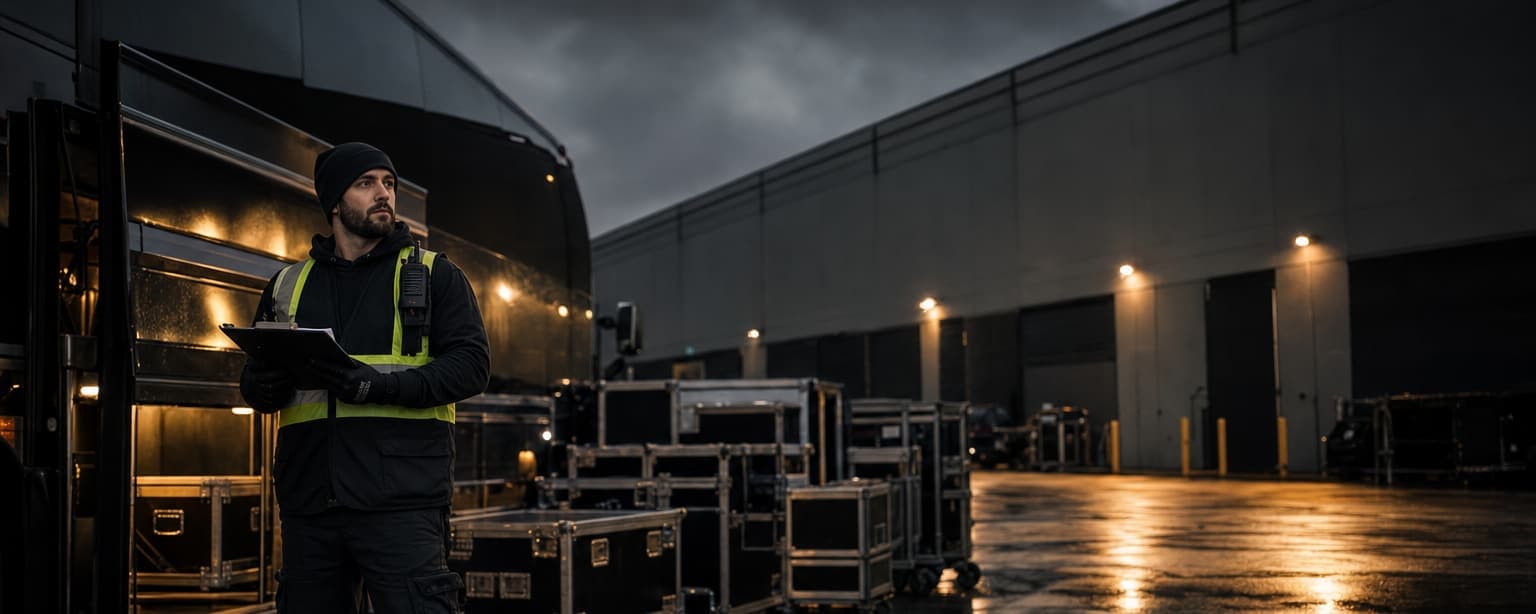
The gear is in a trailer in a parking lot in a city nobody knows.Founded by an Emmy-nominated television editor.
We insure touring bands, artists and comedians. That means instruments and backline on the road, the liability venues demand, and the coverage that answers when a date cannot happen.
Tell us the situation.
One licensed human replies the same business day — not five agents, not an auto-responder. If the policy you have is already the right one, we will tell you.
We use this to quote and service your insurance, and we do not sell it or pass it to lead networks. Privacy policy.
We were editing television long before we were insuring it.

Kevin Kelsey
Founder | Principal Agent
IATSE Local 700 member
Boring’s founder, Kevin Kelsey, edited television for fifteen years before he sold a policy. He was Emmy-nominated for The Muppets Mayhem, cut Shark Tank, Big Brother, Dancing with the Stars and Wheel of Fortune, and handled compliance and risk for some of Hollywood’s largest production companies. So the person building your coverage has been on a crew list, dealt with the permit offices, and met network and streamer requirements from the production side, rather than working from a rate manual. He also builds post-production software. Manifest Post is the board episodic post teams use to track every episode, and B/side is a video editor for people who cut together. He holds a number of patents on that software. So he knows the post side of a production as a vendor to it. We insure productions from Los Angeles to Atlanta, New York and Toronto, with worldwide and foreign production coverage.
The work is placed with the markets that actually write film, television and live entertainment — Zurich through ISC Entertainment (formerly Abacus), Philadelphia Insurance Companies, Take1 and Alive Risk — rather than with a general small-business carrier asked to try.
Send us what you have. We’ll tell you if it’s right.
Your current policy paperwork, a renewal notice, or nothing at all. A licensed agent reads it and replies the same business day.
What touring businesses actually need.
Inland marine & equipment
Tools, equipment and property in transit. It picks up exactly where commercial property stops, which is the moment the item leaves the building.
Without it — Instruments and backline are the working capital of a tour and they sleep in a vehicle every night.
General liability
Third-party bodily injury and property damage. It is the line nearly every contract names by default.
Without it — Every venue contract requires it, named, before you are allowed to load in.
Event cancellation
Reimburses the committed costs of an event that cannot go ahead for a reason outside your control, and the exposure peaks before the gates open, because most of the money is spent by then.
Without it — A cancelled run still owes the crew, the bus and the deposits.
Non-appearance
Responds when the specific named artist people bought tickets to see cannot perform, through illness, injury or travel failure, which general event coverage does not carry by default.
Without it — Illness on a routed tour takes several dates rather than one.
Commercial auto
Vehicles the business owns and the people who drive them for work.
Without it — A van and trailer crossing state lines on a schedule is a commercial use whatever the vehicle looks like.
Workers compensation
Required in almost every state the moment you have employees. Priced on payroll and class code, which is why the class code is worth arguing about.
Without it — Crew, techs and drivers are employees in most arrangements, and touring injuries are load-in injuries.
Umbrella & excess liability
Extra limit stacked above general liability, auto and employers liability. Usually the cheapest million dollars on the policy.
Without it — Arena and festival contracts specify limits well above what a club will ask for.
Media errors & omissions
Covers claims arising from the content itself: copyright, trademark, defamation and rights clearance. No distributor or streamer accepts delivery of a finished film without it.
Without it — Recorded and streamed shows are published content with their own rights exposure.
What the insurance company will ask about your touring business
We read 1 application the markets use for this kind of business and pulled out what they actually ask. Have these answers ready and a quote takes a day instead of a week, because nobody has to come back to you for the missing piece.
About the business
- How many band members do you have?
- How many years of experience do you have as a performer or entertainer?
- Do you currently have an album or CD in stores?
- Are any of your songs getting airplay on TV or radio right now?
- What is your website or internet address?
How you operate
- What types of venues do you perform at (nightclubs, bars, theaters, stadiums, concert halls, or other)?
- How many concerts or performances do you estimate per year?
- What is the smallest, largest, and average audience size at your shows?
- Do you handle your own promotion, or does a separate promoter book your shows?
- Who is responsible for audience safety liability at your performances?
Safety and controls
- Do you use any special effects, rigging, staging, or animals in your performances?
- What operations does your team or subcontractors handle (staging and lighting, audio and video rigging, security, merchandise sales)?
- How do you protect your equipment from theft and fire when it's in storage and when you're traveling?
- Do you have certificates of insurance from all subcontractors you work with?
Money and people
- What is your estimated annual payroll?
- What are your estimated annual record sales?
- What is the estimated cost to hire buses and other transportation?
Your history
- Do you have a current performance schedule to share?
Have these ready
- A copy of any lease or premises agreement you sign with venues
- Your performance schedule for the next year
- A list of your equipment and its value
- Copies of any contracts with transportation companies (buses or trucking)
- Certificates of insurance from any subcontractors you work with
You answer what you can; a licensed agent fills the rest with you.
What our touring clients ask us.
Is my gear covered when it is in the van overnight?
Only if the policy says so, and this is the single most important clause on a touring policy. Many instrument and equipment forms exclude or sublimit theft from an unattended vehicle, which describes the risk almost perfectly — gear is stolen from vehicles, at night, outside hotels. Ask specifically about unattended vehicle theft, whether there is an alarm or hidden-vehicle condition, and what the sublimit is. A policy that covers the gear in the venue and not in the van is not covering the tour.
The venue wants a certificate with them named. Is that normal?
Entirely, and it is worth arranging an annual policy rather than a certificate per show. A touring act playing thirty dates will be asked thirty times, usually at short notice, and an annual general liability with blanket additional insured wording turns a scramble into an email. It is also cheaper than the alternative.
Do we need anything different to tour internationally?
Yes, and it is the thing most often left too late. Territorial limits on a domestic policy frequently stop at the border, carnets and customs bonds have their own requirements, and some countries require locally admitted coverage before a venue will contract with you. Canada and the UK in particular have their own expectations. Tell us the routing when it is confirmed rather than when the first overseas date approaches.
What does a touring insurance application ask for?
The applications for touring businesses ask about 4 things above all: how many band members do you have; what types of venues do you perform at (nightclubs, bars, theaters, stadiums, concert halls, or other); do you use any special effects, rigging, staging, or animals in your performances; what is your estimated annual payroll. Have a copy of any lease or premises agreement you sign with venues and your performance schedule for the next year ready and a quote takes a day instead of a week.
Commercial insurance is 96% of what we do — it is not a department here, it is the whole business. Not ready to talk? The guides answer the questions this page raises in more depth. Already insured with us and need a certificate or a policy change? Ask the service team rather than starting a quote — it is faster and it goes to the people whose job it is. We also write home and auto, which is usually cheaper alongside the business policy than apart from it.
Handed a lease, a vendor packet or a client contract with insurance requirements? Paste it into the COI Requirements Decoder to see what each one means for your business, or read what the requirements mean.