
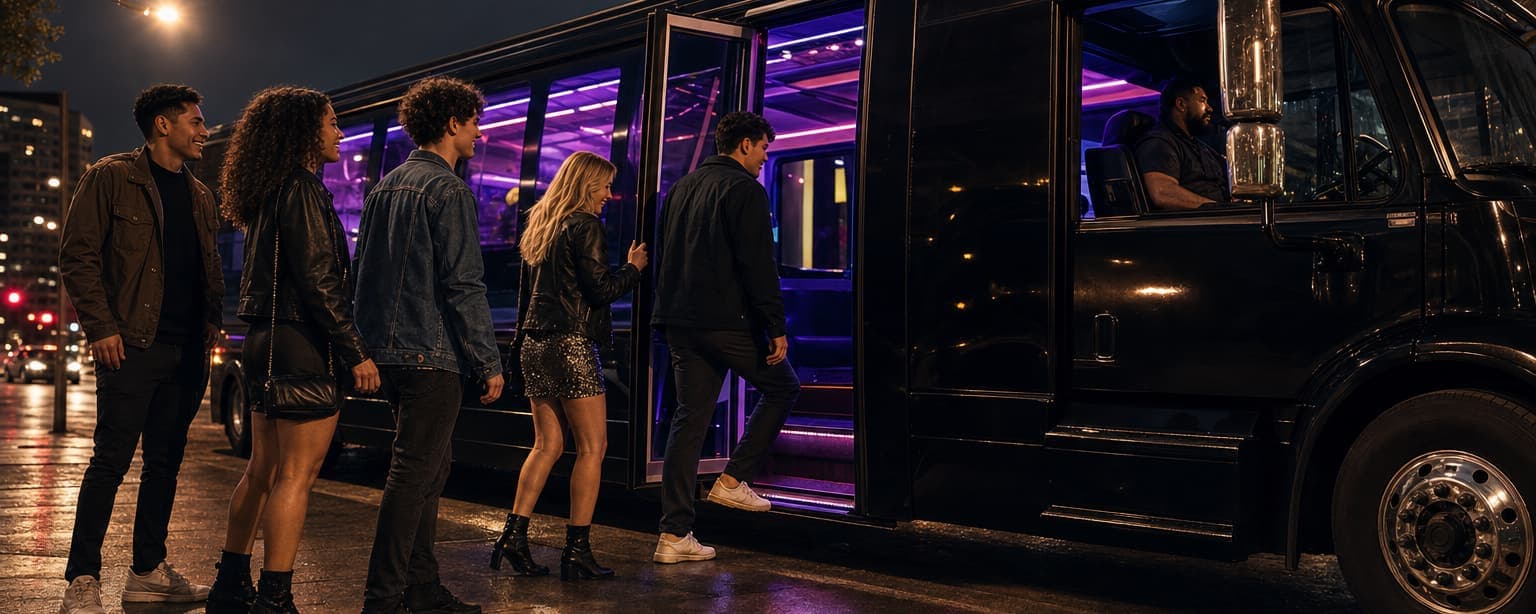
A bar on wheels is underwritten as both things at once.
We insure party bus and limo bus operators, where the seat count puts the federal filing at $5,000,000 and alcohol on board adds a liquor exposure that a bus underwriter has to price and many will not.
Tell us the situation.
One licensed human replies the same business day — not five agents, not an auto-responder. If the policy you have is already the right one, we will tell you.
We use this to quote and service your insurance, and we do not sell it or pass it to lead networks. Privacy policy.
Send us what you have. We’ll tell you if it’s right.
Your current policy paperwork, a renewal notice, or nothing at all. A licensed agent reads it and replies the same business day.
What party bus businesses actually need.
Commercial auto liability at $5,000,000
Almost every party bus seats sixteen or more including the driver, which puts it in the top federal band and the top California band. For-hire passenger carriers in interstate commerce need $5,000,000 of liability coverage on any vehicle seating 16 or more including the driver, and $1,500,000 on any vehicle seating 15 or fewer including the driver.
Without it — A policy written at the limousine band because the vehicle was described as a limo bus is under-filed, and an under-filed carrier is out of service before it is out of money.
Liquor liability
Injury caused by an intoxicated passenger, on board or after the drop-off, whether you poured the drink or let them bring it.
Without it — Operators who run bring-your-own believe they have no liquor exposure. A court deciding who allowed the drinking on a moving vehicle does not see it that way.
General liability
A guest hurt boarding, a fight that starts on the bus and ends on the sidewalk, the venue that names you in the suit.
Without it — Nothing that happens off the vehicle is on the auto policy, and a party bus night has a lot of off-vehicle.
Physical damage on a custom interior
The seating, sound, lighting, bar and floor that make the bus a party bus, valued as installed rather than as a school bus shell.
Without it — A fire from a lighting circuit destroys the interior and leaves the chassis. A policy valuing the chassis pays for the chassis.
Abuse and molestation
Defense and damages for an allegation involving a passenger, in a vehicle where the passengers are drinking and the driver is the only sober adult.
Without it — General liability commonly excludes abuse. The claim comes with the business, and so must the coverage.
Umbrella
A limit above the $5,000,000 filing, because a full bus on the freeway is thirty claimants at once.
Without it — A single rollover with standing passengers can exhaust a primary limit before the second lawyer has been retained.
Workers compensation
Drivers and any on-board host or security you employ, including injuries from breaking up what the passengers started.
Without it — A driver assaulted by a drunk passenger is a workers compensation claim first, and an uninsured one is a penalty on top.
Hired and non-owned auto
Liability for a bus you borrow or a run you farm out to another operator when your own vehicle is booked.
Without it — The client booked you. When the borrowed bus crashes, the suit names you.
The claims we actually see.
Ordered by how often we see them, not by how dramatic they are. Each one names the coverage that answers it — and the policy people wrongly assume already does.
Most common
A guest was standing and dancing when the driver braked hard. She went through the pole and broke her wrist.
Covered by Commercial auto liability
Operators assume a signed waiver ends it. A waiver signed by a drunk guest is weak, and the guest’s parents never signed anything.
Less common, severe
A passenger we dropped at a bar drove home and hit a cyclist. The cyclist’s lawyer found our booking.
Covered by Liquor liability
Most operators believe the exposure ends when the passenger steps off. Where a state’s dram shop law reaches whoever allowed the drinking, the bus is a bar that moves.
Common
Two groups fought on board. One guest lost teeth and is suing us for not stopping it.
Covered by General liability, with assault and battery not excluded
Many general liability policies for bars and venues exclude assault and battery. Read the exclusion before assuming a fight is covered.
Less common, severe
A lighting circuit caught fire in the garage overnight. The interior is gone.
Covered by Physical damage at a stated value including the conversion
The interior is most of the cost of a party bus, and a policy that values the vehicle as a bus does not know it is there.
What the insurance company will ask about your party bus business
We read 2 applications the markets use for this kind of business and pulled out what they actually ask. Have these answers ready and a quote takes a day instead of a week, because nobody has to come back to you for the missing piece.
About the business
- What type of livery service do you operate (taxi, limousine, airport shuttle, tour bus, or other)
- Describe what you do at each location where you operate
- What cities and states do you serve
- Do you use any special equipment like wheelchair lifts or medical equipment
- Are you involved in ride-share applications like Uber or Lyft, and if so what percentage of your business is that
How you operate
- How far on average do your passengers travel from pickup to drop-off
- What is the farthest distance you operate from your base (0-50 miles, 50-100 miles, or 100+ miles)
- Do you own and maintain your own vehicles, or do drivers provide their own
- Do you rent vehicles to drivers on a daily basis
- Do drivers do a written vehicle inspection at the end of each shift
Safety and controls
- What are your written policies and procedures for driver hiring, background checks, drug testing, and experience requirements
- What cameras do you have installed in vehicles and what do they record
- How do drivers report accidents, and who handles accident management
- How do customers report problems or complaints, and who manages them
- What is your vehicle maintenance and inspection program to keep cars safe for passenger service
Your history
- How long has your business been operating
- Have you ever had an insurance claim or lawsuit
- Are you aware of any accidents or incidents that might lead to a claim
- Why are you looking for new insurance coverage
- Has your current insurer offered a renewal quote
Money and people
- What is your annual gross revenue
- What is your annual payroll
- Who are the owners and decision makers in your business
- Do you have more than one business location
Have these ready
- Your last five years of claims history from your current insurer, called loss runs
- A list of all your drivers with their names, addresses, phone numbers, birthdates, years of experience, driver's license numbers, hire dates, and any accidents or violations
- A list of all your vehicles with year, make, model, passenger capacity, VIN, garaging location, and current value
- Your written policies and procedures manual and employee handbook
- Copies of any driver contracts and customer service agreements
You answer what you can; a licensed agent fills the rest with you.
What our party bus clients ask us.
We do not sell alcohol and guests bring their own. Do we still need liquor liability?
Yes, and the underwriter will ask about it before you do. Liquor liability answers for injury caused by an intoxicated person you served or permitted to drink. Bring-your-own on a vehicle you control is permitting, and a passenger who leaves your bus drunk and hurts someone is the claim the coverage exists for. The cheaper answer is to disclose the practice, carry the coverage, and write a drinking policy your drivers enforce.
What limit does a party bus have to carry?
For-hire passenger carriers in interstate commerce need $5,000,000 of liability coverage on any vehicle seating 16 or more including the driver, and $1,500,000 on any vehicle seating 15 or fewer including the driver. A party bus is almost always in the top band. California charter-party carriers file their limits with the Public Utilities Commission under General Order 115, which sets $5,000,000 at 16 seats or more, $1,500,000 at 9 through 15 seats and $750,000 at 8 seats or fewer, in every case counting the driver. Count the seats as manufactured, including the driver, and file at that number.
Why do so many carriers decline party buses?
Because the account combines the things each specialty market avoids on its own. Late-night driving, standing passengers, alcohol, and a vehicle at the top federal band. Some passenger carriers will not write alcohol on board at all. Others will, at a price, if the operator discloses it and shows a drinking policy, a driver screening process and clean loss runs. Disclosed, it is placeable. Discovered, it is a coverage argument in the middle of a claim.
Is a limo bus the same as a party bus to an insurer?
To an underwriter the name on the side matters less than the seat count and the use. A limo bus that seats eighteen and carries a bar is a party bus at $5,000,000. A stretch sedan that seats ten without alcohol is a limousine at $1,500,000. Describe the vehicle and the night, not the brand.
Do you write charter coaches and shuttles too?
Yes. A charter coach shares the $5,000,000 band and adds the MCS-90B endorsement and the contracts that come with school and tour work. An executive shuttle or sedan service sits at the other end, in the lower band with different underwriting questions.
How much does party bus insurance cost?
More than a limousine of the same age and less than the first quote suggests, and neither number is meaningful without the fleet in front of us. The seat count fixes the limit, and the alcohol, the hours, the drivers and the loss runs fix the rate. The cost guide walks through each one, including the ones you can change.
We run a few black cars as well. Same policy?
Same carrier, same policy in most cases, different vehicles at a different band. A sedan carrying one executive to the airport is priced on drivers and radius rather than on alcohol and standing passengers, and it files at the lower limit.
What does a party bus insurance application ask for?
The applications for party bus businesses ask about 4 things above all: what type of livery service do you operate (taxi, limousine, airport shuttle, tour bus, or other); how far on average do your passengers travel from pickup to drop-off; what are your written policies and procedures for driver hiring, background checks, drug testing, and experience requirements; how long has your business been operating. Have your last five years of claims history from your current insurer, called loss runs and a list of all your drivers with their names, addresses, phone numbers, birthdates, years of experience, driver's license numbers, hire dates, and any accidents or violations ready and a quote takes a day instead of a week.
Commercial insurance is 96% of what we do — it is not a department here, it is the whole business. Not ready to talk? The guides answer the questions this page raises in more depth. Already insured with us and need a certificate or a policy change? Ask the service team rather than starting a quote — it is faster and it goes to the people whose job it is. We also write home and auto, which is usually cheaper alongside the business policy than apart from it.
Handed a lease, a vendor packet or a client contract with insurance requirements? Paste it into the COI Requirements Decoder to see what each one means for your business, or read what the requirements mean.