
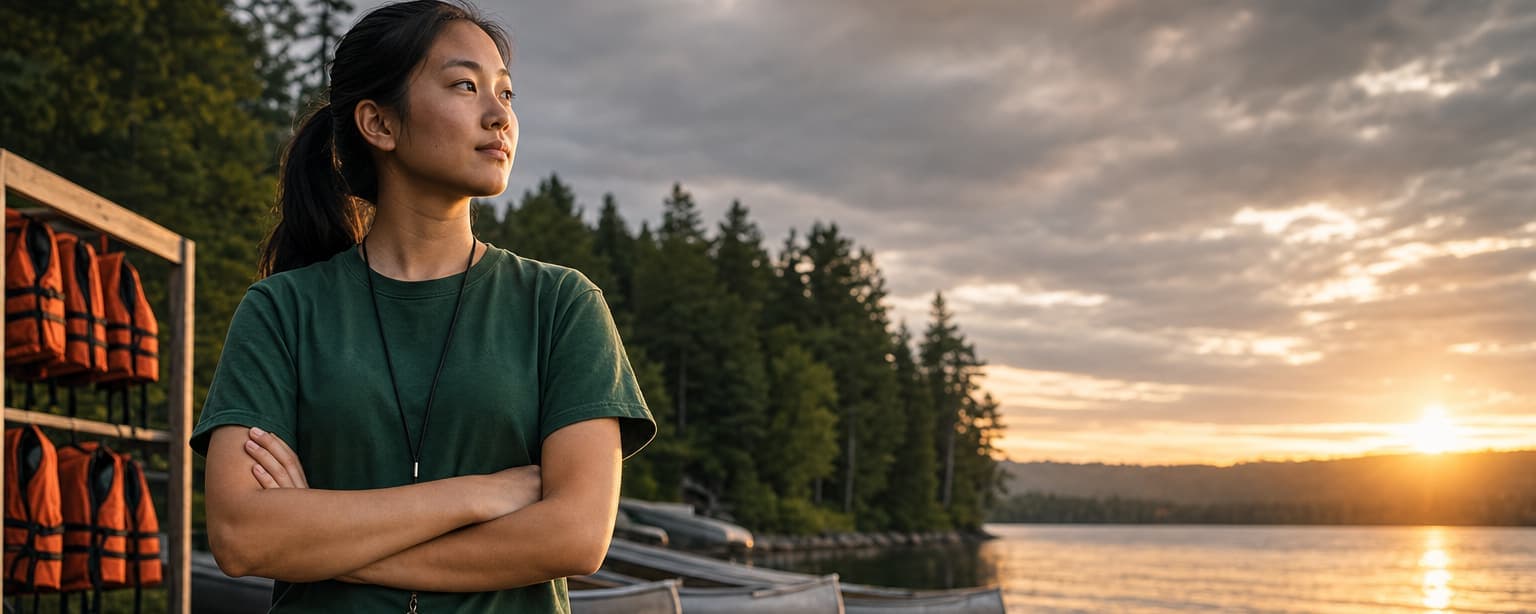
Other people’s children, a lake, a bus, and a horse.
An underwriter prices four things first at a camp: water, transport, animals and overnight stays. We add participant accident coverage to keep small injuries out of the liability policy, at the abuse and molestation limit parent contracts now require.
Tell us the situation.
One licensed human replies the same business day — not five agents, not an auto-responder. If the policy you have is already the right one, we will tell you.
We use this to quote and service your insurance, and we do not sell it or pass it to lead networks. Privacy policy.
Send us what you have. We’ll tell you if it’s right.
Your current policy paperwork, a renewal notice, or nothing at all. A licensed agent reads it and replies the same business day.
What summer camp businesses actually need.
General liability
Injury to campers and visitors, damage to the property you use, and the additional insured wording a school, church or park district requires before it hands you the keys.
Without it — No venue lets a camp on site without a certificate, and the camp is liable for the field it did not own.
Abuse and molestation
Allegations involving campers: the exposure of unsupervised adult access to children, which is what a camp is made of.
Without it — Excluded from general liability, and the coverage a parent’s attorney looks for first.
Participant accident
Medical bills for an injured camper regardless of fault, paid first, before anyone asks whose fault the broken arm was.
Without it — Without it, a parent’s only route to the medical bills is a liability claim, and most liability claims start as unpaid medical bills.
Commercial auto
Buses and vans on field trips and pickups, and counselors driving their own cars for the camp.
Without it — Transporting children is the highest-severity thing a camp does, and every field trip is a full bus of them.
Workers compensation
Counselors, lifeguards, kitchen staff and the seasonal hires who make up most of the payroll.
Without it — A seasonal, mostly young workforce doing physical work outdoors has the injury rate you would expect.
Property and equipment
Cabins, dining hall, docks and boats at a residential camp; equipment in a trailer at a day camp.
Without it — A residential camp is a small village that earns its whole year in ten weeks.
The nonprofit liability package
For nonprofit camps: general liability, abuse and molestation and board coverage on one policy, with volunteers covered as insureds.
Without it — Camps run by churches, youth organizations and nonprofits are a class the human-services carriers want and price accordingly.
The claims we actually see.
Ordered by how often we see them, not by how dramatic they are. Each one names the coverage that answers it — and the policy people wrongly assume already does.
Most common
A camper breaks a bone
Covered by Participant accident first, then general liability if the parents allege negligence
The commonest injury at every camp. Participant accident pays the medical bills without a fault argument, which is why carriers price the liability lower when it is in place: a paid bill rarely becomes a lawsuit.
Most common
A counselor is injured
Covered by Workers compensation
Seasonal staff are employees the day they start, and a volunteer counselor who is not elected onto the policy has no comp claim, only a lawsuit against the camp.
Less common, severe
An incident in the water
Covered by General liability
Drowning and near-drowning are the severity claims of the class, and the underwriter’s questions — certified lifeguards, ratios, buddy checks, whether the water is a pool, a lake or open ocean — are the ones a plaintiff’s attorney asks afterwards.
Less common, severe
A crash on a field trip
Covered by Commercial auto, and hired and non-owned auto for staff cars
A rented bus is covered by the rental company only to the extent the contract says, and a counselor’s personal policy will not cover a car full of campers on camp business. Hired and non-owned auto is the line most camps are missing.
Rare, catastrophic
An abuse allegation
Covered by Abuse and molestation
Excluded from general liability, often reported years later, and the claim that ends a camp. Screening, two-adult rules and training are what the underwriter reads before offering a limit, and the limit available depends on them.
What our summer camp clients ask us.
Who writes camp insurance, and can we buy it directly from the carrier?
Philadelphia Insurance Companies — PHLY, part of Tokio Marine, rated A++ by AM Best — is the carrier that has told us in writing it wants camps, and it is where most of our human-services submissions go first. PHLY does not sell to organizations directly: it works only through appointed agents, and we hold that appointment, so your file reaches their underwriter with our name on it rather than through a second intermediary. What their underwriter wants to see is specific and we assemble it before anything is sent — their supplemental application for your class, the standard applications, three years of valued loss runs (a report from each prior insurer showing every claim and its reserve), photographs of the premises, and your brochure or website. Payment plans are available once the annual price reaches $2,000. None of that is a promise to bind — every quote is subject to their underwriting review — but a complete file is the difference between a quote and a list of questions.
The school district that rents us the campus wants $3M/$6M abuse and molestation. Is that available?
Read the number carefully, because it decides your price. PHLY’s primary abuse and molestation limit is $1,000,000 per occurrence with a $1,000,000, $2,000,000 or — on occasion — $3,000,000 aggregate. Anything above that has to come from an umbrella, and their umbrella capacity is smaller in Los Angeles County than elsewhere, needs every control in place (screening, supervision, training, reporting) and is decided case by case. So a funder or landlord asking for $3,000,000 per occurrence and $6,000,000 aggregate is not asking for a bigger policy; they are asking for a tower — a primary plus one or more excess layers — and excess abuse coverage bought through the wholesale market runs roughly $15,000 per $1,000,000 of limit, often more than the underlying policy itself. Before you buy that, let us read the requirement. Many are boilerplate copied from a construction contract, and a sourced request to the funder explaining what the market actually offers gets them reduced more often than people expect. We quote the primary first, and build the tower only when the requirement genuinely will not move.
Stand-alone abuse and molestation: when it is the right route, and what it costs
How is a summer camp priced?
On campers and camper-days — how many children, for how many days — and then on four questions that move the number more than anything else: water (a pool with certified lifeguards prices differently from a lake, and both from open ocean), transport (how many vehicles, how many field trips, who drives), animals (horses in particular), and whether campers stay overnight. A day camp on a school campus with no water and no vehicles is one of the cheapest youth classes there is. A residential camp with a waterfront, a stable and a fleet of vans is priced as exactly that. Accreditation by the American Camp Association is read favorably by underwriters because its standards cover the same four questions.
Is a sports camp the same thing?
For insurance, not quite. A sports camp or clinic is a coaching program with a defined activity, often run on a rented field by a coach or a club; its exposure is participant injury in that sport. A summer camp is a general program — activities, meals, transport, sometimes overnight stays — and its underwriting covers water, travel, animals and residential supervision that a sports clinic never has. We have a separate page for sports camps and clinics because the questions are different.
Do we need participant accident coverage if we have liability?
You need it because you have liability. A camper’s medical bills are the start of almost every liability claim: a parent with an unpaid emergency-room bill and a form asking whose fault it was becomes a claimant. Participant accident pays those bills first, on a no-fault basis, up to its limit — commonly $25,000 to $50,000 per injury — and most parents never look further. Carriers know this, which is why some require it as a condition of the liability quote and most price the liability lower when it is in place. It is also the coverage that covers the injuries nobody was negligent about, which at a camp is most of them.
We run our camp on a church or school campus we do not own. What does the owner need from us?
A certificate naming them as additional insured on your general liability, usually at $1,000,000 per occurrence and $2,000,000 aggregate, and increasingly the abuse and molestation limit as well. School districts in particular now ask for it as a condition of a facilities-use permit. Read the permit before you sign it: the limits in it are the ones you have to meet, and if it asks for more abuse coverage than the market offers as a primary limit, that is a conversation to have with the district before the season, not the week of.
Commercial insurance is 96% of what we do — it is not a department here, it is the whole business. Not ready to talk? The guides answer the questions this page raises in more depth. Already insured with us and need a certificate or a policy change? Ask the service team rather than starting a quote — it is faster and it goes to the people whose job it is. We also write home and auto, which is usually cheaper alongside the business policy than apart from it.
Handed a lease, a vendor packet or a client contract with insurance requirements? Paste it into the COI Requirements Decoder to see what each one means for your business, or read what the requirements mean.