
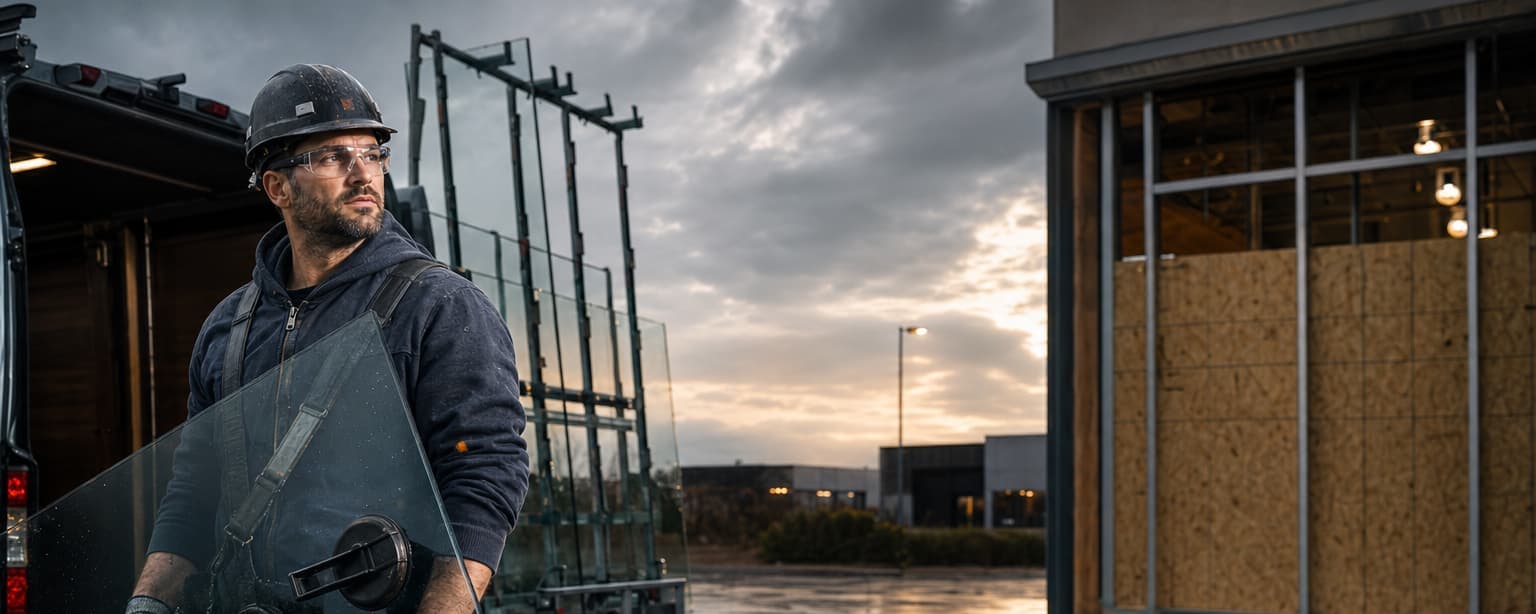
Above two stories, most of the market stops quoting.
Commercial insurance for glaziers and glass contractors: a class few carriers accept, placed on the stories you work and the contracts you sign.
Tell us the situation.
One licensed human replies the same business day — not five agents, not an auto-responder. If the policy you have is already the right one, we will tell you.
We use this to quote and service your insurance, and we do not sell it or pass it to lead networks. Privacy policy.
Send us what you have. We’ll tell you if it’s right.
Your current policy paperwork, a renewal notice, or nothing at all. A licensed agent reads it and replies the same business day.
What glass and glazing businesses actually need.
General liability
Third-party bodily injury and property damage. It is the line nearly every contract names by default.
Without it — Falling glass and falling tools are the claim, and a pane released from height reaches people and property well beyond the work area.
Workers compensation
Required in almost every state the moment you have employees. Priced on payroll and class code, which is why the class code is worth arguing about.
Without it — Working at height with heavy, sharp material is a severity class, and it is the coverage the standard market declines first.
PEO workers comp
Places workers compensation inside a co-employment arrangement with a professional employer organization, which is how the classes carriers decline (roofing, tree work, demolition, staffing) get covered at all. The PEO becomes co-employer, runs payroll and administers claims, and the coverage sits on their master policy rather than one issued to you.
Without it — When no carrier will write the class at all, a PEO is how the payroll gets covered, and how the clean loss record that eventually wins a standard market gets built.
Inland marine & equipment
Tools, equipment and property in transit. It picks up exactly where commercial property stops, which is the moment the item leaves the building.
Without it — Glass in transit and on a rack breaks, and property coverage stops at the yard.
Commercial auto
Vehicles the business owns and the people who drive them for work.
Without it — Racked glass on a truck is fragile cargo and a load shift is a total loss.
Umbrella & excess liability
Extra limit stacked above general liability, auto and employers liability. Usually the cheapest million dollars on the policy.
Without it — Commercial contracts require limits above primary, and a fall from height exhausts them.
Contractors errors & omissions
Covers faulty workmanship and professional mistakes: the cost of the work itself being wrong, which general liability excludes by design.
Without it — Specified glazing that fails to perform — thermal, structural or acoustic — is a professional claim rather than an accident.
Commercial property
Buildings and contents, valued at what it costs to rebuild today rather than what you paid.
Without it — The shop, the racks and the stock still need replacing after a loss.

Joe Gorman
Co-Founder | President of Commercial Lines
Came up in construction, on site and in the office, then moved into sales. Went out on a limb to become Boring’s first dedicated salesperson when the agency had no sales team at all, and now leads it. Landscaping is the class he writes most: grounds maintenance, tree work, irrigation and the spray operations that push an account out of preferred appetite.
Five endorsements, and a certificate is none of them.
A certificate is evidence a policy existed the day it was printed — it says so on its own face. The coverage a contract is really asking for lives on the policy as named endorsements, and this is the list they come from.
- Additional insured — ongoing operationsCG 20 10Covers the general contractor for claims arising from your work while the job is in progress.Without it: They fund their own defense on a claim your work caused, then look to you for it.
- Additional insured — completed operationsCG 20 37Extends that coverage to claims arising after your work is finished.Without it: The claim arrives years later, when the policy that should have carried it has renewed several times. Cheaper policies often exclude this or do not offer it.
- Primary and non-contributoryCG 20 01Puts your policy first and stops your insurer demanding a contribution from theirs.Without it: Two insurers argue about who pays while the defense waits.
- Waiver of subrogationCG 24 04Stops your insurer recovering from the party you agreed in writing to protect.Without it: Your insurer pays, then sues your customer, which ends the relationship.
- Per-project aggregateCG 25 03Gives each job its own general aggregate instead of sharing one across the year.Without it: Another project’s claims quietly spend the limit that was meant to cover this one.
Tract, condominium and apartment work is the exception that undoes all five — an exclusion for multi-unit residential removes the coverage before any endorsement can apply. What national homebuilders require covers that in full — D.R. Horton, Pulte Group, Blackrock Homes and the rest of the national builders set the strictest terms a sub will see, and they do not negotiate them.
Contracts ask for more than these five. Every contract insurance requirement, explained, or paste your exhibit into the Contract Insurance Decoder to see the endorsement behind each clause.
How high do you work?
Third floor and above is a different account. The exposure is not only the fall — it is what gets dropped, who is underneath, and how far a tool travels before it lands. Carriers ask for a height limit and many stop at two or three stories, so work you take on because it was offered can quietly put a renewal into a market you were not in last year. Tell us the tallest job you do, not the usual one.
Residential or commercial?
Underwriters treat these as separate trades even when the work is identical. Residential carries construction-defect exposure that follows the job for years and a homeowner who sues; commercial carries bigger limits, tighter contracts and a general contractor who enforces them. A book that is mostly one prices very differently from a book that is evenly split, and the mix is usually the second question on the application.
What the insurance company will ask about your glass and glazing business
We read the applications the markets use for businesses in this field and pulled out what they actually ask. Have these answers ready and a quote takes a day instead of a week, because nobody has to come back to you for the missing piece.
About the business
- What kind of contracting work do you do
- When did you start this business
- What licenses do you hold
- Have you ever operated under other business names
- What are your annual gross sales
How you operate
- How many people do you employ
- What is your total annual payroll
- Do you hire subcontractors
- Do you work on buildings higher than two stories
- Do you have a formal safety program in place
Safety and controls
- How do you screen or check out new equipment operators
- Do you collect and keep certificates of insurance from all your subcontractors
- Who reviews and maintains those certificates
Your history
- Who is your current insurance company, or your last one if you don't have coverage now
- Do you have any claims over $5,000 from the last few years
Money and people
- What other locations or job sites do you operate from
Have these ready
- Your last five years of claims history from your current insurer, called loss runs
- Certificates of insurance from your subcontractors showing your company as additional insured
- Copies of any rental agreements for equipment you lease from others
You answer what you can; a licensed agent fills the rest with you.
What our glass and glazing clients ask us.
Why is glazing so hard to insure?
Two reasons, and they compound. The work is performed at height with material that is heavy, sharp and breaks without warning, which makes the workers compensation severe. And the product is installed into somebody else’s building, so a failure years later is a completed operations claim on a facade. Plenty of standard carriers simply do not write the class, which is why the placement matters more than the shopping.
Does it matter how many stories I work?
It is usually the first question and often the deciding one. Ground floor and low-rise glazing is placeable in far more markets than high-rise work, and two stories is where a large part of the appetite stops. Swing stage, boom and suspended access work narrows it further. Stating your real maximum height accurately is what gets you to the carriers who will take it — understating it is how a claim gets contested.
What do general contractors ask glaziers for?
The full stack, almost always: additional insured for ongoing and completed operations, primary and non-contributory wording, a waiver of subrogation, and frequently a per-project aggregate. Glazing is a facade trade on a commercial building, so completed operations matters more here than on most subcontracts: the claim arrives years after the job, and the endorsement has to have been there all along.
Do you write auto glass as well as construction glazing?
They are different appetites and worth separating on the application. Auto glass is a service and mobile-installation exposure; architectural glazing is construction at height. Shops doing both should be described as both, because a policy written for one rarely contemplates the other.
What does a glass and glazing insurance application ask for?
The applications for glass and glazing businesses ask about 4 things above all: what kind of contracting work do you do; how many people do you employ; how do you screen or check out new equipment operators; who is your current insurance company, or your last one if you don't have coverage now. Have your last five years of claims history from your current insurer, called loss runs and certificates of insurance from your subcontractors showing your company as additional insured ready and a quote takes a day instead of a week.
Commercial insurance is 96% of what we do — it is not a department here, it is the whole business. Not ready to talk? The guides answer the questions this page raises in more depth. Already insured with us and need a certificate or a policy change? Ask the service team rather than starting a quote — it is faster and it goes to the people whose job it is. We also write home and auto, which is usually cheaper alongside the business policy than apart from it.