
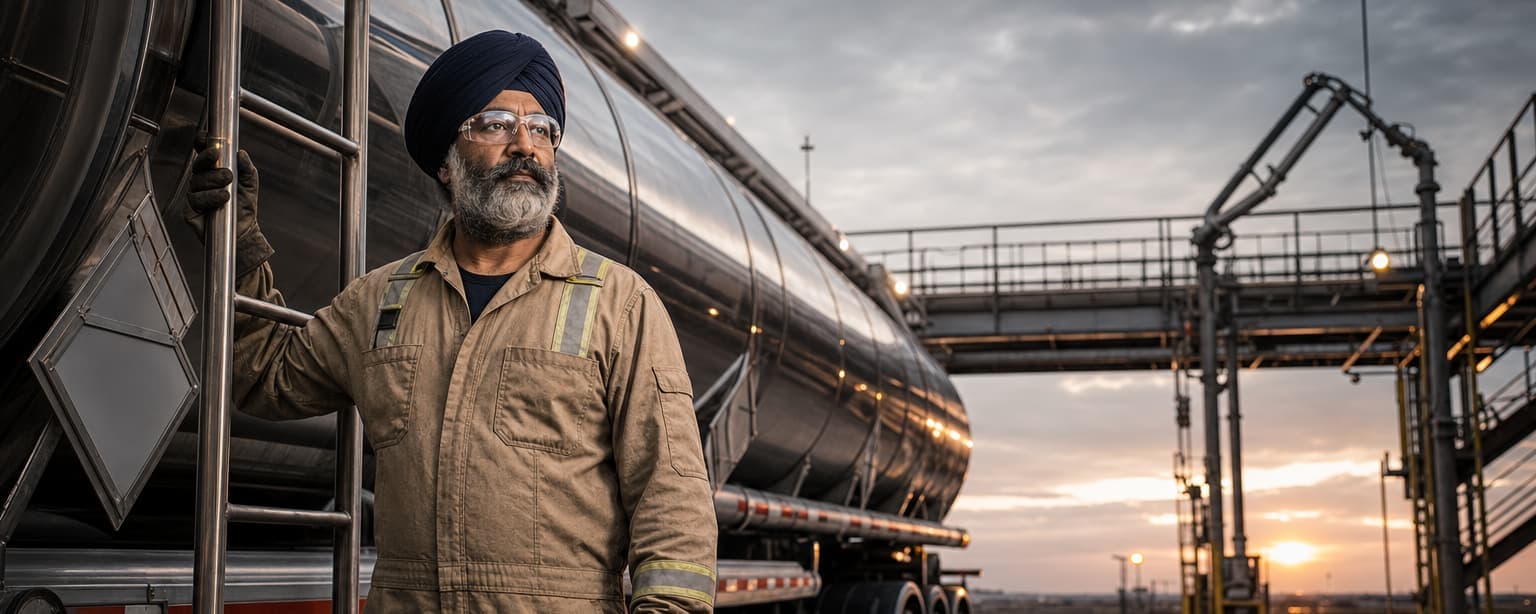
What is in the tank sets your federal minimum, not your revenue.
Commercial insurance for tanker and hazmat carriers: the $1M and $5M federal filings, pollution liability, and the rollover exposure that prices the class.
Tell us the situation.
One licensed human replies the same business day — not five agents, not an auto-responder. If the policy you have is already the right one, we will tell you.
We use this to quote and service your insurance, and we do not sell it or pass it to lead networks. Privacy policy.
Send us what you have. We’ll tell you if it’s right.
Your current policy paperwork, a renewal notice, or nothing at all. A licensed agent reads it and replies the same business day.
What tanker and hazmat hauling businesses actually need.
Commercial auto
Vehicles the business owns and the people who drive them for work.
Without it — The filing that keeps your authority active, at the higher minimum your commodity requires rather than the general freight figure.
Contractors pollution liability
Bodily injury, property damage and clean-up caused by a pollutant your work released: chemical drift, run-off, fuel spills. The standard general liability form excludes all of it.
Without it — A rollover that releases product is a clean-up bill owed to a regulator, and standard liability wording excludes it.
Motor truck cargo
The freight itself while you are hauling it. Separate from the liability on the truck.
Without it — A load of product lost in an incident is money owed to the shipper immediately.
Auto physical damage
Damage to your own tractor and trailer. Primary liability pays for what you do to everyone else and nothing for your equipment, so without this a rollover you caused leaves you paying off a truck you can no longer run.
Without it — Tank trailers are expensive and a rollover usually totals one.
Umbrella & excess liability
Extra limit stacked above general liability, auto and employers liability. Usually the cheapest million dollars on the policy.
Without it — Tanker losses combine bodily injury, property damage and remediation in a single event, which is how primary limits disappear.
Workers compensation
Required in almost every state the moment you have employees. Priced on payroll and class code, which is why the class code is worth arguing about.
Without it — Loading and unloading is where tanker injuries concentrate, not the driving.
Truckers general liability
General liability written for a motor carrier: the yard, the dock, loading and customer premises. The auto policy answers for the vehicle; this answers for everything else.
Without it — Yards, docks, loading and customer premises sit outside the auto policy entirely, and brokers ask for general liability by name.

Lori Adams, TRS
Commercial Trucking Insurance Advisor
Twenty-five years in trucking insurance. Knows the filings, the radius rules and the carriers that will actually take the risk.
Transportation Risk Specialist (TRS)
What the insurance company will ask about your tanker and hazmat hauling business
We read the applications the markets use for businesses in this field and pulled out what they actually ask. Have these answers ready and a quote takes a day instead of a week, because nobody has to come back to you for the missing piece.
About the business
- What commodities do you haul?
- How many years have you been in business?
- Do you own any other businesses?
- What is your annual revenue?
How you operate
- Do you haul full truckloads or less than truckload?
- What percentage of your loads come through freight brokers versus contracts?
- What percentage of your loads go to regular fixed destinations?
- What states and major cities do you travel into or through?
- Do you haul any hazardous materials?
Safety and controls
- Are your vehicles equipped with GPS, cameras, or other tracking devices?
- Do you have any ownership, management, or name changes in the past five years?
- Do you lease trucks to other operators?
Your history
- List all losses and accidents from the last three years
- What insurance companies have covered you in the last three years?
Money and people
- What is your annual mileage?
- How many drivers do you have?
- What cargo limit do you need per truck?
Have these ready
- Your vehicle information including year, make, model, and current value for each truck and trailer
- Three years of loss runs from your current and prior insurance companies
- Driver records including dates they earned their CDL
- Any contracts that require specific insurance coverage
You answer what you can; a licensed agent fills the rest with you.
What our tanker and hazmat hauling clients ask us.
What is my federal minimum if I haul hazmat?
It depends on the commodity, not on your size. General freight carriers sit at $750,000. Oil and most hazardous materials require $1,000,000, and the highest-hazard commodities — certain explosives, poison-inhalation-hazard gases and highway-route-controlled radioactive material — require $5,000,000. Bulk hazardous shipments in large cargo tanks fall into the $5,000,000 band as well. Getting this wrong is not a pricing error, it is an authority problem.
Is pollution really not covered by my liability policy?
Generally not. Auto liability policies carry pollution exclusions, and the MCS-90 endorsement is a public guarantee rather than coverage for you, where it pays a claim your policy excluded, the insurer can come back to you for the money. Clean-up cost after a release is the exposure that needs its own answer.
Does an empty tank still count as hazmat?
A tank with residue is treated very differently from a clean one, and the placarding rules follow the residue. This matters for insurance because your filing and your rating are based on what you are authorized and equipped to haul, not solely on what is in the tank today.
What does a tanker and hazmat hauling insurance application ask for?
The applications for tanker and hazmat hauling businesses ask about 4 things above all: what commodities do you haul; do you haul full truckloads or less than truckload; are your vehicles equipped with gps, cameras, or other tracking devices; list all losses and accidents from the last three years. Have your vehicle information including year, make, model, and current value for each truck and trailer and three years of loss runs from your current and prior insurance companies ready and a quote takes a day instead of a week.
Commercial insurance is 96% of what we do — it is not a department here, it is the whole business. Not ready to talk? The guides answer the questions this page raises in more depth. Already insured with us and need a certificate or a policy change? Ask the service team rather than starting a quote — it is faster and it goes to the people whose job it is. We also write home and auto, which is usually cheaper alongside the business policy than apart from it.
Handed a lease, a vendor packet or a client contract with insurance requirements? Paste it into the COI Requirements Decoder to see what each one means for your business, or read what the requirements mean.