
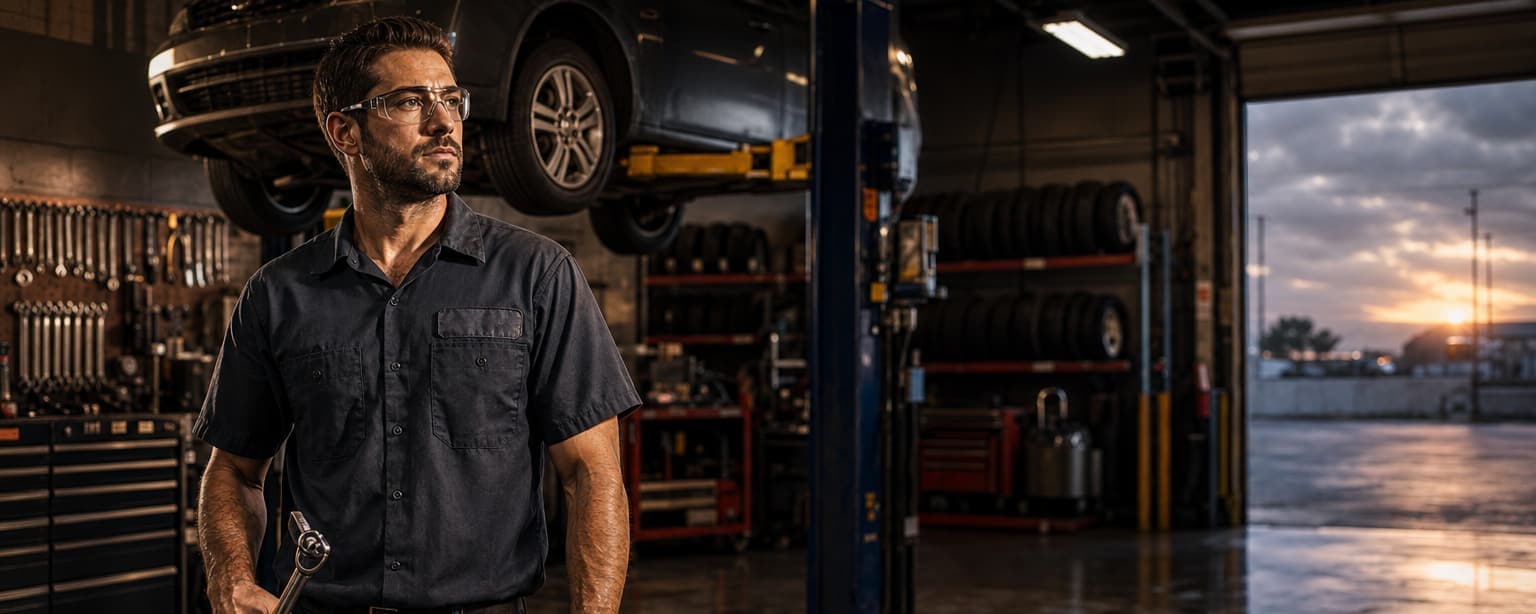
Your general liability policy excludes the cars on your lot.
Commercial insurance for auto repair, body and mechanic shops, built around customers’ vehicles in your care, which is the exposure a general liability policy specifically will not cover.
Tell us the situation.
One licensed human replies the same business day — not five agents, not an auto-responder. If the policy you have is already the right one, we will tell you.
We use this to quote and service your insurance, and we do not sell it or pass it to lead networks. Privacy policy.
Send us what you have. We’ll tell you if it’s right.
Your current policy paperwork, a renewal notice, or nothing at all. A licensed agent reads it and replies the same business day.
What auto repair businesses actually need.
Garagekeepers
Customer vehicles in your care, custody and control. Every repair shop and dealership has the exposure and most standard policies exclude it.
Without it — Customers’ vehicles on your lot and in your bays. General liability excludes property in your care, custody and control, so this is the coverage the whole risk turns on.
General liability
Third-party bodily injury and property damage. It is the line nearly every contract names by default.
Without it — A customer slips in the waiting area, and, under completed operations, a repair that fails on the road months after the invoice was paid.
Commercial auto
Vehicles the business owns and the people who drive them for work.
Without it — Shop trucks, the parts runner and road tests. An employee test-driving a customer’s car is operating a non-owned vehicle on your business.
Workers compensation
Required in almost every state the moment you have employees. Priced on payroll and class code, which is why the class code is worth arguing about.
Without it — Lifts, presses, solvents and hot work. Technician injuries are severity claims, and the class rates reflect it.
Commercial property
Buildings and contents, valued at what it costs to rebuild today rather than what you paid.
Without it — The building, the lifts, the alignment rack and the diagnostic equipment the shop cannot open without.
Contractors pollution liability
Bodily injury, property damage and clean-up caused by a pollutant your work released: chemical drift, run-off, fuel spills. The standard general liability form excludes all of it.
Without it — Waste oil, solvents, refrigerant and the tank under the yard. The pollution exclusion on a GL policy reaches all of it.
Equipment breakdown & spoilage
Covers the walk-in, the compressor and the line when they fail from the inside. A mechanical or electrical breakdown is excluded by property policies, and the stock that thawed goes with it.
Without it — A compressor or lift failure stops the shop, and the property policy treats mechanical breakdown as excluded.
Employment practices liability
Wrongful termination, discrimination and harassment claims brought by your own employees. General liability specifically excludes these.
Without it — Wage and hour claims are the common ones in shops paying flat rate.
The claims we actually see.
Ordered by how often we see them, not by how dramatic they are. Each one names the coverage that answers it — and the policy people wrongly assume already does.
Most common
A customer car is damaged in the bay, falls off a lift or is hit while being moved
Covered by Garagekeepers
General liability excludes property in your care, custody or control, and it excludes any auto your business operates. The customer car is outside it twice.
Common
A fire or break-in overnight damages cars nobody was working on
Covered by Direct primary garagekeepers; legal liability only if you were negligent
Most shops carry legal liability garagekeepers without knowing it, and it does not pay for a loss that was nobody’s fault.
Less common, severe
A brake or wheel job fails after the car leaves and causes a crash
Covered by Completed operations under garage or general liability
Completed operations pays for the injuries and the other car. It does not pay to redo your own faulty work.
Less common, severe
A technician road-testing a customer car hits another vehicle
Covered by Garage liability or commercial auto that covers customer vehicles you operate
General liability excludes autos, and the customer’s own personal auto policy excludes people employed in the business of repairing vehicles.

Joe Gorman
Co-Founder | President of Commercial Lines
Has placed hundreds of auto service businesses: repair shops, mobile mechanics, heavy truck garages and the roadside operators most carriers will not look at. He knows which markets still take a garage risk and what garagekeepers limit a full lot actually needs. A mobile operation described the wrong way gets declined on sight, so he describes it the right way.
What the insurance company will ask about your auto repair business
We read 3 applications the markets use for this kind of business and pulled out what they actually ask. Have these answers ready and a quote takes a day instead of a week, because nobody has to come back to you for the missing piece.
About the business
- What types of auto repair work do you do most often (like oil changes, body work, painting, tire service)
- Do you also sell new or used vehicles, and if so what percentage of your business is sales versus repairs
- How many years have you been doing this type of work
- Do you have a dealer's license, and if so in which states
How you operate
- How many employees do you have working on site
- Do you ever drive customer vehicles to pick them up or deliver them, and how many times per week
- Do you perform any work at customer locations or off-site
- Do you store vehicles on your property overnight after business hours
- Do you ever lease, rent, or loan vehicles to customers
Safety and controls
- If you do painting, do you have a separate spray booth with proper ventilation and explosion-proof lighting
- Do you store paints and solvents in a fire-resistant cabinet outside the paint booth
- Do you have fire extinguishers that are serviced and charged on site
- Are car keys stored in a secure location that only authorized people can access
- Do you leave keys in vehicles
Your history
- What is your claims history from the last three years
- Have you ever had an insurance policy cancelled, declined, or not renewed
- What insurance do you currently have or did you have before
Money and people
- What were your total annual receipts in the last year, broken down by repairs, parts sales, vehicle sales, and any other income sources
- Do you own or operate any other businesses besides this repair shop
Have these ready
- Your last three years of claims history from your current or previous insurer, called loss runs
- A copy of your dealer's license if you have one
- Documentation of any specialized training or certifications you hold related to auto repair
You answer what you can; a licensed agent fills the rest with you.
What our auto repair clients ask us.
Why will my general liability not cover a customer’s car?
Because of the care, custody and control exclusion, and it is deliberate rather than an oversight. General liability covers damage you cause to property that belongs to other people and is NOT in your keeping. The moment a car is handed over for work it is in your keeping, so the exclusion applies to precisely the property you are surrounded by all day. Garagekeepers exists to cover exactly that, which is why a shop with a million in general liability can still be uninsured for the twelve cars parked outside overnight.
Legal liability or direct primary, which do I want?
Direct primary, in almost every case. Legal liability pays only where the damage was your fault, so an overnight theft or a fire with no negligence on your part may not respond at all. Direct primary pays regardless of fault, which is what your customer assumes you have and what every dispute turns on. It costs more. Explaining to a customer that their car burned in your building and you are not paying is a worse outcome than the premium difference.
Are test drives covered?
Not automatically, and this is the one shops get wrong. General liability excludes any auto your business operates. The customer’s personal auto policy excludes people employed in the business of repairing or servicing vehicles, and says expressly that this includes road testing. In California the statute makes the shop’s policy primary whenever the shop’s employee is driving. So the road test needs auto liability written to include customers’ cars, and damage to the customer’s car itself needs collision on your garagekeepers. Shops that hand keys to a lot attendant or a valet service have the same exposure with more people involved.
How much garagekeepers do auto repair shops usually carry?
On the garage quotes we have written, shops asked for between $60,000 and $450,000 per location, and $100,000 and $300,000 were the most common requests, with liability at $1,000,000 per occurrence and $2,000,000 aggregate. The right number is the value of a full lot on a busy day, including cars waiting on parts. Check the per-vehicle cap too, and the deductible. A $1,000 deductible per car with a $5,000 maximum per event is a common structure.
Which garagekeepers do most shops actually have?
Legal liability, usually without knowing it. Every garagekeepers binder in our own garage book that we reviewed in 2026 was on the default legal liability form, which pays only when the shop was negligent. Direct primary was offered and not bought. If your policy paperwork does not say direct primary or direct excess, assume legal liability.
What about the cars I store for customers who never come back?
They are still in your care, and they are still your exposure, often for years. Abandoned vehicles accumulate in almost every shop, they sit outside, and a hailstorm does not distinguish between a car booked in yesterday and one abandoned in 2019. Tell your broker how many are on the lot, because a garagekeepers limit set for the working bays will not respond to the whole yard, and mechanics liens take time to clear.
Does it matter that I do bodywork rather than mechanical?
Yes, on two fronts. Bodywork brings paint, which means a spray booth, solvent storage and a fire load that changes the property rate and the underwriter’s appetite. It also brings overspray, which is property damage to vehicles and buildings nobody was working on. Mechanical shops carry more of their severity in the workers comp class and in completed operations: a wheel or brake job that fails is a different claim from a paint job that runs.
What does a auto repair insurance application ask for?
The applications for auto repair businesses ask about 4 things above all: what types of auto repair work do you do most often (like oil changes, body work, painting, tire service); how many employees do you have working on site; if you do painting, do you have a separate spray booth with proper ventilation and explosion-proof lighting; what is your claims history from the last three years. Have your last three years of claims history from your current or previous insurer, called loss runs and a copy of your dealer's license if you have one ready and a quote takes a day instead of a week.
Commercial insurance is 96% of what we do — it is not a department here, it is the whole business. Not ready to talk? The guides answer the questions this page raises in more depth. Already insured with us and need a certificate or a policy change? Ask the service team rather than starting a quote — it is faster and it goes to the people whose job it is. We also write home and auto, which is usually cheaper alongside the business policy than apart from it.
Handed a lease, a vendor packet or a client contract with insurance requirements? Paste it into the COI Requirements Decoder to see what each one means for your business, or read what the requirements mean.