
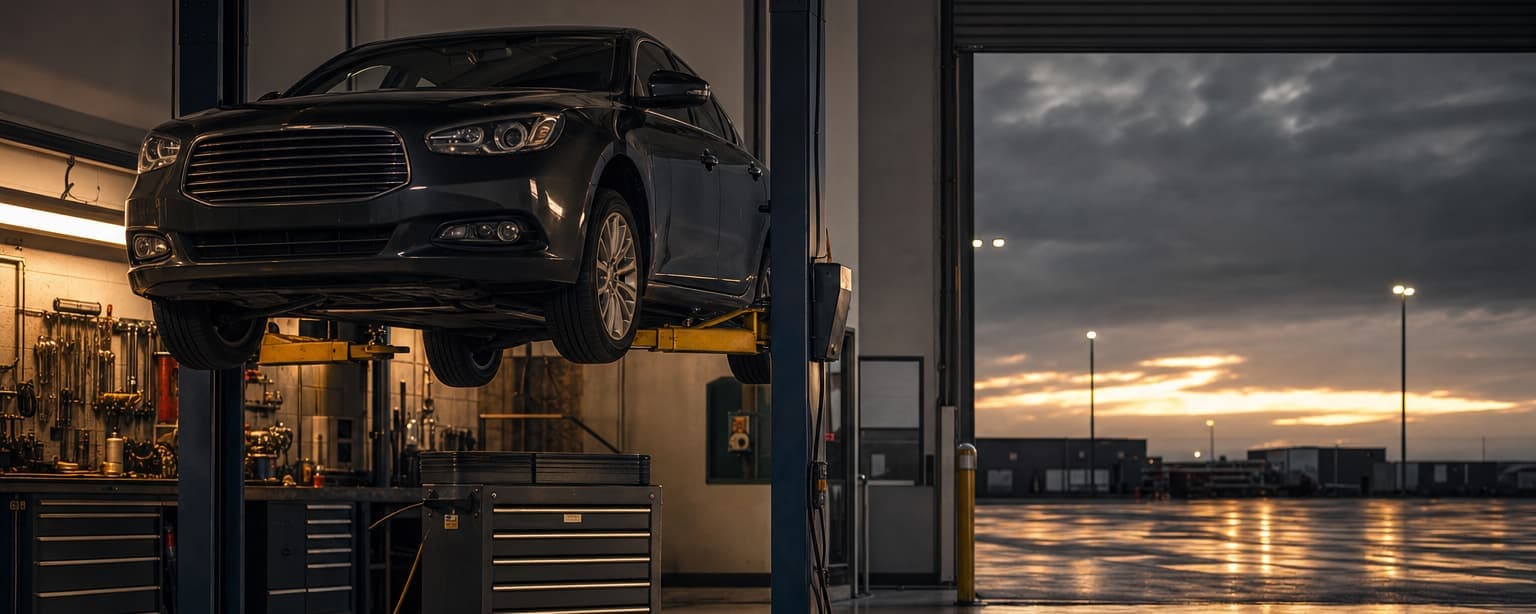
Customer cars in your care are the exposure standard policies exclude.
Garage liability and garagekeepers for repair shops, truck shops, mobile mechanics, body shops, tire shops, detailers and dealers, built around the customer vehicles a general liability policy excludes.
Tell us the situation.
One licensed human replies the same business day — not five agents, not an auto-responder. If the policy you have is already the right one, we will tell you.
We use this to quote and service your insurance, and we do not sell it or pass it to lead networks. Privacy policy.
Send us what you have. We’ll tell you if it’s right.
Your current policy paperwork, a renewal notice, or nothing at all. A licensed agent reads it and replies the same business day.
What auto service and garage businesses actually need.
Garagekeepers
Customer vehicles in your care, custody and control. Every repair shop and dealership has the exposure and most standard policies exclude it.
Without it — A customer vehicle damaged, stolen or burned while in your shop is your bill, and general liability specifically excludes it.
General liability
Third-party bodily injury and property damage. It is the line nearly every contract names by default.
Without it — A customer injured in the waiting area or the lot has a direct claim with nothing behind it.
Commercial property
Buildings and contents, valued at what it costs to rebuild today rather than what you paid.
Without it — Lifts, diagnostic equipment and the building itself have to be replaced at today’s prices out of cash.
Workers compensation
Required in almost every state the moment you have employees. Priced on payroll and class code, which is why the class code is worth arguing about.
Without it — Technician injuries are frequent in this trade and become uncapped claims without it.
Commercial auto
Vehicles the business owns and the people who drive them for work.
Without it — Shop trucks, loaners and test drives are all uninsured business use.
Crime & employee dishonesty
Theft by your own staff, funds transfer fraud, and the dishonesty bond a home care contract will ask you for by name.
Without it — Parts theft and till shortages by staff are a routine loss nobody plans for.
Find the page for what you actually are.
Every one of these is written for that specific operation — the coverages it needs, the questions underwriters ask it, and what it usually gets wrong.
- Auto Repair Shops
Commercial insurance for auto repair, body and mechanic shops, built around customers’ vehicles in your care, which is the exposure a general liability policy specifically will not cover.
- Heavy Truck & Diesel Repair Shops
We insure heavy truck and diesel repair shops with general liability that covers work on semi trucks, garagekeepers limits sized to Class 8 tractors and loaded trailers, and the road tests and tows a truck shop runs every day.
- Mobile Mechanics & Heavy Truck Repair
We write mobile repair, heavy truck garages and roadside service with garagekeepers, on-hook and in-tow, built for work performed on an open roadway. Our general liability for mobile mechanics covers work on heavy trucks, which most mechanic programs leave out.
- Auto Body & Collision Shops
We insure auto body and collision repair shops: garagekeepers for the customer and insurer-referred cars in your care, the spray booth on the property policy, and the paint work that comes back as a claim months later.
- Tire Shops
We insure tire shops and tire and wheel dealers: completed operations for the wheel-off claim, garagekeepers for the customer’s car, and products coverage for the tires you sell.
- Auto Detailing, Ceramic Coating & Tint
We insure mobile and fixed auto detailers, ceramic coating and paint protection film installers and window tint shops, with garagekeepers for the customer’s car wherever you work on it.
- Car Washes
We cover car washes and detailers with garagekeepers for the vehicles you handle, plus the equipment that runs the tunnel and the water and slip exposures of the site.
- Auto Dealers
We cover franchise and independent dealers: garage liability, the inventory on open lot, customer vehicles in for service, and the finance-office exposure nobody quotes for.
- Tow Truck & Recovery
We insure tow operators, wreckers and recovery for on-hook, garagekeepers and the police rotation limits. Most carriers avoid the class; we write it.
- Valet Parking
Whether you run a valet company under contract or a restaurant or hotel that parks cars with its own staff, the customer’s car is excluded from the liability policy you already have. Garagekeepers is what answers for it, and this page covers the rest of what a valet operation carries.

Joe Gorman
Co-Founder | President of Commercial Lines
Has placed hundreds of auto service businesses: repair shops, mobile mechanics, heavy truck garages and the roadside operators most carriers will not look at. He knows which markets still take a garage risk and what garagekeepers limit a full lot actually needs. A mobile operation described the wrong way gets declined on sight, so he describes it the right way.
A dealer came to us after five claims in under two years, having been told by several agents that he was uninsurable. He did not believe we would place it either.
We placed it, and he is still with us two years later, including after an employee caused around $10,000 of damage to two customer vehicles in the dealership’s custody, which is exactly the garagekeepers claim the coverage exists for. A loss history is a reason to shop the account properly, not a reason nobody will write it.
What the insurance company will ask about your auto service and garage business
We read the applications the markets use for businesses in this field and pulled out what they actually ask. Have these answers ready and a quote takes a day instead of a week, because nobody has to come back to you for the missing piece.
About the business
- What type of repair and service work do you do?
- How long have you been in business?
- What is your business structure (sole owner, partnership, corporation, etc.)?
- What states do you operate in?
- How much of your work is mobile repairs versus repairs done at your location?
How you operate
- What percentage of your work involves different types of vehicles (cars, trucks, motorcycles, RVs, etc.)?
- Do you lease or rent vehicles to customers?
- Do you have any other business operations besides repair and service?
- Do you test drive vehicles over 26,000 pounds off-site?
- Do you park customer vehicles on public streets?
Safety and controls
- Are your work areas separated from where customers wait?
- Do you do spray painting, and if so, is it in a separate ventilated room?
- How do you store paints, solvents, and fiberglass resins?
- Do you have fire extinguishers on site, and are they serviced and charged?
- Do you get certificates of insurance from all subcontractors?
Your history
- What was your gross revenue from tire sales, installation, and repair in the last year?
- Have you had any insurance claims or losses in the past five years?
- Have you ever been canceled or refused coverage by an insurance company?
- Who is your current or most recent insurance company?
Money and people
- How many employees do you have?
- Do any of your drivers have commercial driver's licenses?
- Do you have any vehicles with dealer or repair plates?
Have these ready
- Your last five years of claims history from your current insurer, called loss runs
- A list of all owners, employees, and drivers with their driver's license numbers, birthdates, and any traffic violations or accidents
- Your dealer license (if you have one) and list of which states issued it
- Proof of insurance from all subcontractors you work with
You answer what you can; a licensed agent fills the rest with you.
What our auto service and garage clients ask us.
What is garagekeepers coverage and do I need it?
Garagekeepers covers customer vehicles in your care, custody and control: damage, theft, fire or vandalism while the car is yours to look after. It is separate from general liability, which excludes property in your control, and separate from your own commercial auto. Any shop that takes possession of a customer vehicle needs it, and it is the coverage most often found missing when we read an existing policy.
Direct primary or legal liability?
Legal liability only pays when you are proven at fault, which means a fire of unknown origin or a theft with no negligence can leave a customer uncompensated and you in an argument. Direct primary pays regardless of fault. It costs more, and for most shops it is worth the difference: the whole point is not having that argument with a customer.
Does it cover cars being test driven?
Two coverages answer a road test, and they are bought separately. Damage to the customer’s car itself is garagekeepers, under its collision coverage. Injury or damage to anyone else is auto liability, which general liability excludes, so it comes from a garage liability form or commercial auto written to cover customer vehicles your employees drive. The customer’s own personal auto policy excludes people employed in the business of repairing or servicing vehicles, so it does not stand behind your technician.
What is the difference between garage liability and general liability?
Garage liability is liability coverage for running an auto business, and the point of it is autos. General liability excludes any auto you operate, so on its own it leaves road tests, customer pickups and lot moves uninsured. ISO withdrew its single garage form in 2013, so today a repair shop usually gets the same result from general liability plus a business auto policy written to include customers’ cars, or from a specialty carrier’s own garage policy. Dealers use the Auto Dealers Coverage Form. None of these covers the customer’s car itself while it is in your care. That is garagekeepers, and it has to be added.
What does a auto service and garage insurance application ask for?
The applications for auto service and garage businesses ask about 4 things above all: what type of repair and service work do you do; what percentage of your work involves different types of vehicles (cars, trucks, motorcycles, rvs, etc.); are your work areas separated from where customers wait; what was your gross revenue from tire sales, installation, and repair in the last year. Have your last five years of claims history from your current insurer, called loss runs and a list of all owners, employees, and drivers with their driver's license numbers, birthdates, and any traffic violations or accidents ready and a quote takes a day instead of a week.
Also in this family
Guides on auto service and garage.
Commercial insurance is 96% of what we do — it is not a department here, it is the whole business. Not ready to talk? The guides answer the questions this page raises in more depth. Already insured with us and need a certificate or a policy change? Ask the service team rather than starting a quote — it is faster and it goes to the people whose job it is. We also write home and auto, which is usually cheaper alongside the business policy than apart from it.
Handed a lease, a vendor packet or a client contract with insurance requirements? Paste it into the COI Requirements Decoder to see what each one means for your business, or read what the requirements mean.