
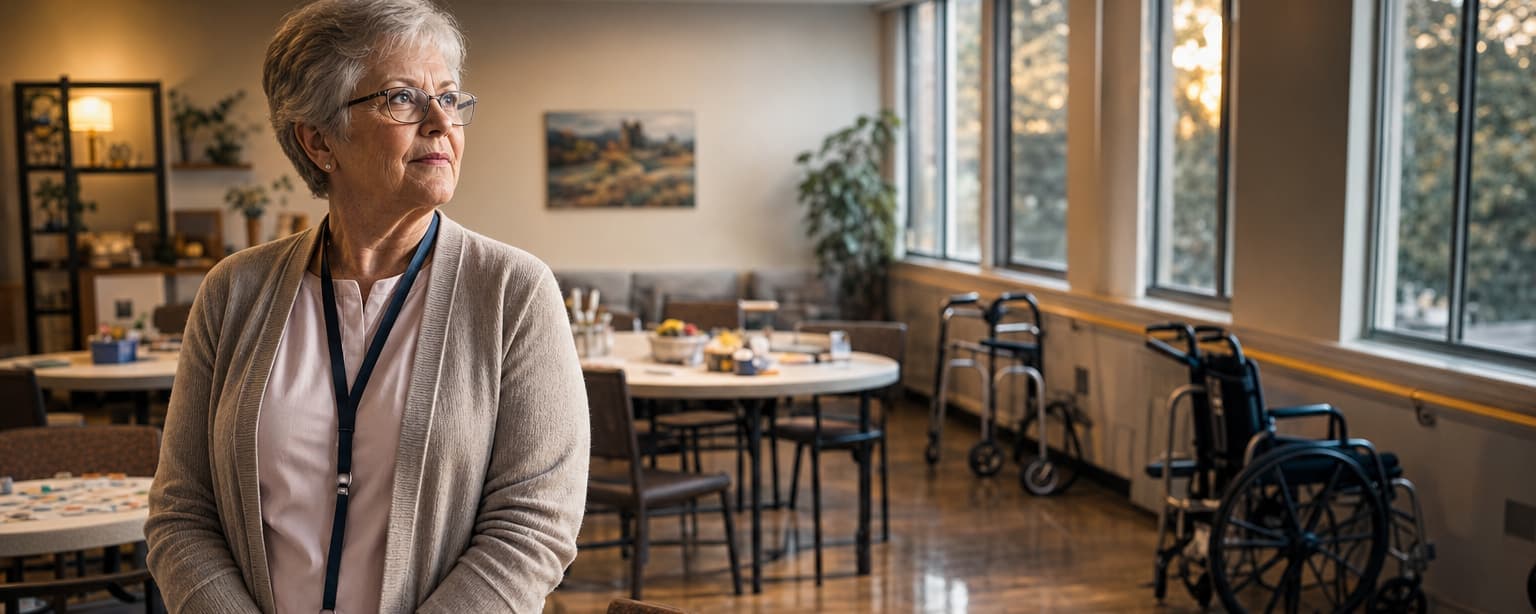
Thirty dependent adults, a van and a kitchen, five days a week.
We insure adult day programs and adult day health care centers. Participant transport is usually the largest exposure, licensing and funders set the abuse and molestation limit, and your tax status decides which carriers will even quote.
Tell us the situation.
One licensed human replies the same business day — not five agents, not an auto-responder. If the policy you have is already the right one, we will tell you.
We use this to quote and service your insurance, and we do not sell it or pass it to lead networks. Privacy policy.
Send us what you have. We’ll tell you if it’s right.
Your current policy paperwork, a renewal notice, or nothing at all. A licensed agent reads it and replies the same business day.
What adult day program businesses actually need.
Abuse and molestation
Allegations involving participants who are elderly, cognitively impaired or developmentally disabled, which makes them dependent adults in every legal sense.
Without it — Excluded from general liability, and required by name by licensing bodies, regional centers and managed-care contracts.
Professional liability
Care plans, supervision ratios, medication assistance and, at a health center, nursing and therapy services.
Without it — A participant who wanders off site or falls during an activity is a supervision claim, which general liability does not answer.
General liability
The premises, visitors and family members, food service, and the additional insured wording every funder wants.
Without it — A day center is a public building full of people with mobility limits; falls are the daily exposure.
Commercial auto
The vans that collect participants each morning and return them each afternoon, often wheelchair-equipped and always full.
Without it — Transport is the highest-severity thing a day program does, and it does it twice a day.
Workers compensation
Program aides, drivers, nurses and kitchen staff, with transfers, lifting and participant aggression included.
Without it — Lifting injuries during transfers are the commonest claim in the class and the rate already assumes them.
Property
The building or your improvements to it, the kitchen, the equipment, and the income lost while a damaged center is closed.
Without it — Funding follows attendance; a closed center earns nothing while it still pays staff.
The nonprofit liability package
For nonprofit programs: general, professional, abuse and molestation and board coverage on one policy, with volunteers covered as insureds.
Without it — The nonprofit form is what opens the human-services carriers to a day program; a for-profit center is quoted in a different, smaller market.
The claims we actually see.
Ordered by how often we see them, not by how dramatic they are. Each one names the coverage that answers it — and the policy people wrongly assume already does.
Most common
A participant falls
Covered by General liability, or professional liability if a staff member was assisting
The commonest claim in the class, and whether it is a premises claim or a care claim depends on what staff were doing at the moment. One carrier holding both coverages means nobody argues about it while the participant’s family waits.
Most common
A participant is injured on the van, or during loading
Covered by Commercial auto
Injuries during wheelchair lift operation and securement are auto claims, not premises claims. A general liability policy excludes them, and a personal auto policy on a program-owned van is not a policy at all.
Common
A participant with dementia leaves the building unnoticed
Covered by Professional liability
Elopement is the claim families fear most and the one licensing investigates hardest. It is a supervision failure, so it is professional, and the incident log and the staffing ratio that day are the whole case.
Common
A staff member is hurt transferring a participant
Covered by Workers compensation
Expected, rated and usually under-trained for. A documented transfer-training program is one of the few things that moves the workers compensation price in this class.
Less common, severe
An abuse or neglect allegation
Covered by Abuse and molestation
Excluded from general liability, usually claims-made, and the allegation often comes from a family member long after the day in question. Funders name this limit in their contracts, and a lapse between policies destroys it.
What our adult day program clients ask us.
Which carriers write adult day care?
Philadelphia Insurance Companies — PHLY, part of Tokio Marine, rated A++ by AM Best — is the carrier that has told us in writing it wants nonprofit adult day care, and it is where most of our human-services submissions go first. PHLY does not sell to organizations directly: it works only through appointed agents, and we hold that appointment, so your file reaches their underwriter with our name on it rather than through a second intermediary. What their underwriter wants to see is specific and we assemble it before anything is sent — their supplemental application for your class, the standard applications, three years of valued loss runs (a report from each prior insurer showing every claim and its reserve), photographs of the premises, and your brochure or website. Payment plans are available once the annual price reaches $2,000. None of that is a promise to bind — every quote is subject to their underwriting review — but a complete file is the difference between a quote and a list of questions. One condition that decides everything for this class: PHLY’s appetite is for nonprofit programs. If your center is for-profit, PHLY will write the vehicles but not the liability, and the liability goes to a different, smaller market. Tell us your tax status in the first conversation.
Our funder requires abuse and molestation coverage at limits we have never seen. What can we actually buy?
Read the number carefully, because it decides your price. PHLY’s primary abuse and molestation limit is $1,000,000 per occurrence with a $1,000,000, $2,000,000 or — on occasion — $3,000,000 aggregate. Anything above that has to come from an umbrella, and their umbrella capacity is smaller in Los Angeles County than elsewhere, needs every control in place (screening, supervision, training, reporting) and is decided case by case. So a funder or landlord asking for $3,000,000 per occurrence and $6,000,000 aggregate is not asking for a bigger policy; they are asking for a tower — a primary plus one or more excess layers — and excess abuse coverage bought through the wholesale market runs roughly $15,000 per $1,000,000 of limit, often more than the underlying policy itself. Before you buy that, let us read the requirement. Many are boilerplate copied from a construction contract, and a sourced request to the funder explaining what the market actually offers gets them reduced more often than people expect. We quote the primary first, and build the tower only when the requirement genuinely will not move.
Stand-alone abuse and molestation: when it is the right route, and what it costs
Adult day program or adult day health care: does the difference matter to the insurance?
Yes, because one of them is a health provider. A social-model adult day program offers supervision, activities and meals; in California it is licensed by Community Care Licensing. An adult day health care center adds nursing, therapy and often a physician’s oversight, is licensed by the Department of Public Health and, where it bills Medi-Cal, is certified as a community-based adult services provider. The health center carries medical professional liability, nurses making clinical decisions, on top of everything the social program carries, and its price reflects that. Both are target classes for the human-services carriers; the application just has to say which one you are.
How is an adult day program priced?
On daily attendance and revenue first. Then the questions that move the number: whether you transport participants and in how many vehicles, whether you serve people with dementia and how the building is secured for it, the staff-to-participant ratio, whether you serve developmentally disabled adults under a regional center contract, and whether you prepare food on site. Three years of loss runs matter more than any single answer. Expect the vehicles to be a large share of the total: a fleet of wheelchair vans carrying dependent adults is rated as exactly what it is.
We are a regional center vendor. What do they require?
General liability with the regional center as additional insured, abuse and molestation, auto coverage where you transport consumers, and a certificate that matches the vendor application line for line. The certificate is the easy part. What slows new vendors down is that a program with no history is underwritten on its people — the underwriter wants the founders’ experience with the population written up, and the regional center wants the same thing in a different form. Prepare it once and use it twice.
Commercial insurance is 96% of what we do — it is not a department here, it is the whole business. Not ready to talk? The guides answer the questions this page raises in more depth. Already insured with us and need a certificate or a policy change? Ask the service team rather than starting a quote — it is faster and it goes to the people whose job it is. We also write home and auto, which is usually cheaper alongside the business policy than apart from it.
Handed a lease, a vendor packet or a client contract with insurance requirements? Paste it into the COI Requirements Decoder to see what each one means for your business, or read what the requirements mean.