
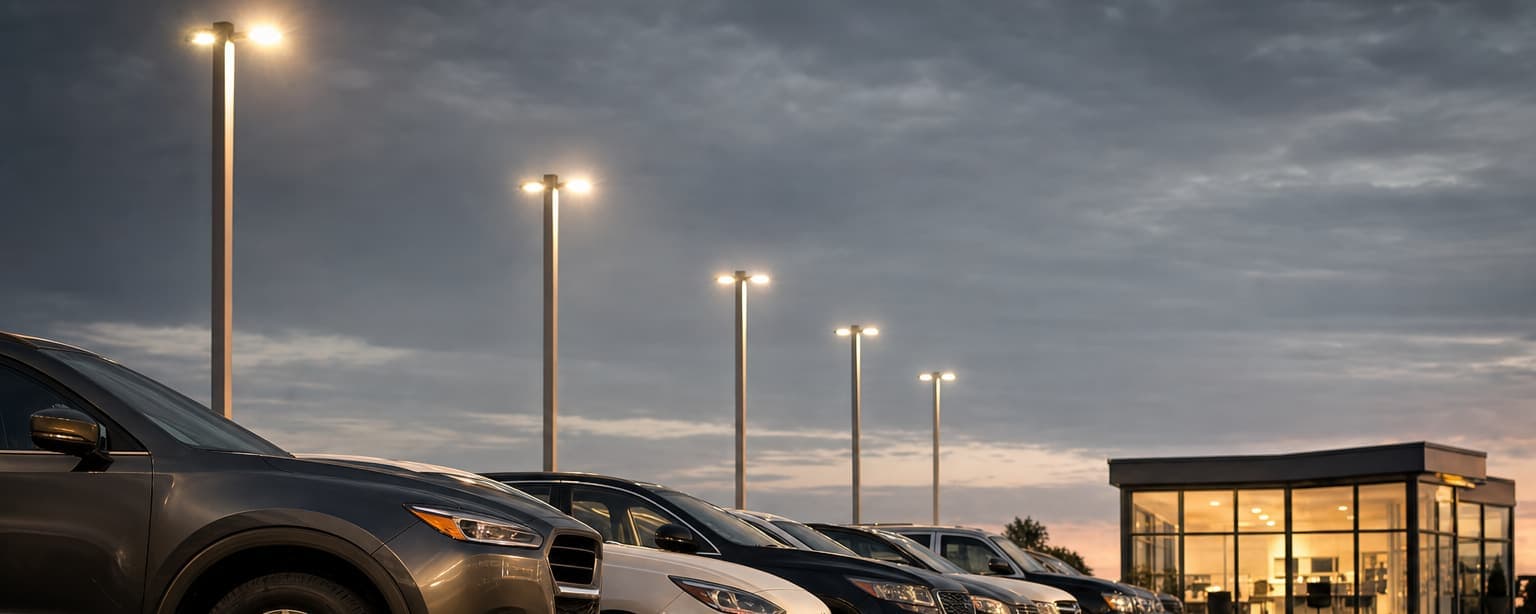
Most of the value on your lot belongs to a floorplan lender, and some of it belongs to customers.
We cover franchise and independent dealers: garage liability, the inventory on open lot, customer vehicles in for service, and the finance-office exposure nobody quotes for.
Tell us the situation.
One licensed human replies the same business day — not five agents, not an auto-responder. If the policy you have is already the right one, we will tell you.
We use this to quote and service your insurance, and we do not sell it or pass it to lead networks. Privacy policy.
Send us what you have. We’ll tell you if it’s right.
Your current policy paperwork, a renewal notice, or nothing at all. A licensed agent reads it and replies the same business day.
What auto dealer businesses actually need.
Garage liability
The liability form written for dealers, covering operations and the vehicles you sell.
Without it — A standard general liability policy is not written for this trade.
Garagekeepers
Damage to a customer’s vehicle while it sits in your care for service, storage or appraisal, meaning their car rather than your inventory.
Without it — General liability excludes property in your care, custody or control.
Dealers open lot
Your own inventory against hail, theft, vandalism, flood and fire.
Without it — A single hailstorm can damage every unit on the lot at once.
Drive-away and demonstration
Test drives, dealer plates and vehicles moved between locations.
Without it — A customer crashing on a test drive is your liability, not theirs.
Finance and insurance E&O
Claims over F&I products, disclosure, title and contract errors.
Without it — The finance office is a regulated sales process and it generates claims.
Employment practices
Claims by sales and service staff.
Without it — Commission disputes and turnover make this a frequent claim in the trade.
Crime and social engineering
Employee dishonesty, and funds sent because an email or a call looked genuine.
Without it — The commonest large loss in a small office is internal or invited, and neither property nor cyber reliably answers a transfer somebody authorized.
Group health and benefits
Technicians and finance staff, both of whom are being recruited by the dealership down the road.
Without it — Master techs are scarce and know their value. Benefits are what stops a competitor buying one away mid-quarter.
A used car dealer in Pennsylvania lost his garage liability when his carrier changed its appetite and stopped writing independent dealers. Without the policy he could not keep his dealer tags, and he had spent weeks calling local brokers who came back with nothing.
We placed the garage liability, he kept his tags, and the price came in below what he had been paying the admitted carriers. When a whole class falls out of appetite, the brokers who only have admitted markets are all calling the same closed doors. The dealers who get placed are the ones whose broker has somewhere else to go.
What our auto dealer clients ask us.
My carrier stopped writing used car dealers. Where does garage liability come from now?
From the markets that specialize in the class rather than the admitted carriers that write it when they feel like it. Appetite for independent dealers swings, and when a carrier leaves, every local broker with the same three admitted markets gets the same declinations. We placed garage liability for a Pennsylvania used car dealer after weeks of that, at a better price than he had been paying, and he kept his dealer tags. Bring the non-renewal notice, the inventory count and the loss runs, and say plainly what the state needs to see for the tags. The placement is routine for a market that writes dealers every day.
What is the difference between garage liability and garagekeepers?
Garage liability covers your operations: injury and damage arising from running the dealership, including the vehicles you sell. Garagekeepers covers customers’ vehicles while they are in your care, which garage liability specifically excludes. A dealership with a service department needs both, and the second one comes in different forms: legal liability pays only when you were at fault, while direct primary or direct excess pay regardless. The cheaper form is the one that leaves you arguing with a customer about whether the hail on their car was your fault.
How should the open lot limit be set?
Against your peak inventory value, not your average, and reviewed as the lot fills. The loss that decides this is hail: it damages every unit simultaneously, so the exposure is the whole lot rather than one car. Check the deductible structure too — open lot policies commonly carry a per-unit deductible with an aggregate cap, and a per-unit deductible applied across ninety damaged vehicles is a very different number from one deductible.
Does the floorplan lender have requirements?
Yes, and they are usually specific and non-negotiable. Floorplan financiers require physical damage coverage on financed inventory at stated limits, with themselves named as loss payee, and evidence maintained continuously. A lapse is typically an event of default under the floorplan agreement, which is a much faster problem than an uninsured loss. Send us the floorplan terms rather than a summary; the wording is what the lender checks.
What about test drives and dealer plates?
Both are covered under the garage policy and both need describing accurately. Unaccompanied test drives, extended overnight demos and vehicles loaned to customers during service each rate differently, and some policies restrict unaccompanied drives or require a license check. It is worth having a written test-drive procedure with license verification. It reduces claims and it reads well at renewal.
If a customer crashes on a test drive, whose insurance pays?
It depends on the state, and it is not always the dealer’s. In California, the dealer’s policy is excess over the customer’s own insurance when a customer is driving, and primary when the dealer’s employee is. Georgia’s courts have read its statute the same way for retail dealers. Maine makes the policy on dealer plates primary up to the required limits. Damage to your own car on the drive is dealers physical damage, not the customer’s problem.
What insurance do dealer plates require?
Whatever your state’s dealer license rules say, and most ask for a bond as well as insurance. Florida requires garage liability, or general liability plus business auto, of at least $25,000 combined single limit with $10,000 of personal injury protection, plus a $25,000 bond. California and Texas each require a $50,000 dealer bond. Plate policies are rated per plate, and where a state requires personal injury protection or uninsured motorist coverage it is often charged per plate. The used car dealer in our book runs three plates on its garage policy.
What is false pretense coverage, and do I need it?
It covers losing a car because someone tricked you into handing it over, such as a test driver who never comes back or a buyer whose payment was fraudulent. The Auto Dealers Coverage Form excludes that loss until the False Pretense endorsement, CA 25 03, is added, and even then a check the bank refuses to pay is excluded. The used car dealer we insure carries a $25,000 limit.
Commercial insurance is 96% of what we do — it is not a department here, it is the whole business. Not ready to talk? The guides answer the questions this page raises in more depth. Already insured with us and need a certificate or a policy change? Ask the service team rather than starting a quote — it is faster and it goes to the people whose job it is. We also write home and auto, which is usually cheaper alongside the business policy than apart from it.
Handed a lease, a vendor packet or a client contract with insurance requirements? Paste it into the COI Requirements Decoder to see what each one means for your business, or read what the requirements mean.