
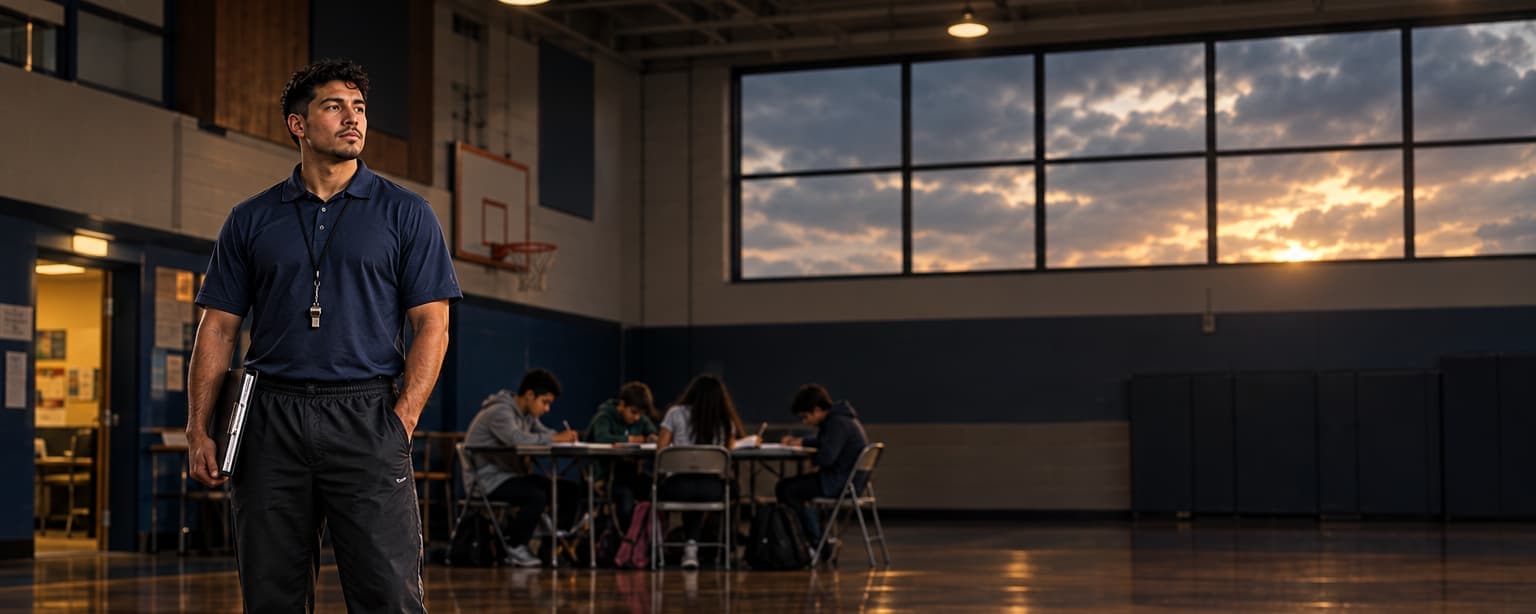
Every hour after school is an hour someone is supervising children.
We insure youth centers, after-school programs, local Boys and Girls Clubs, YMCAs and YWCAs, including abuse and molestation, pools and gyms, vans and field trips, and the board.
Tell us the situation.
One licensed human replies the same business day — not five agents, not an auto-responder. If the policy you have is already the right one, we will tell you.
We use this to quote and service your insurance, and we do not sell it or pass it to lead networks. Privacy policy.
Send us what you have. We’ll tell you if it’s right.
Your current policy paperwork, a renewal notice, or nothing at all. A licensed agent reads it and replies the same business day.
What youth center businesses actually need.
Abuse and molestation
Allegations involving children in your programs, against staff, volunteers, coaches or other children.
Without it — Excluded from standard general liability, and the coverage every school district and funder asks about by name.
General liability
Injury in gyms, game rooms and fields, and the additional insured wording school facility agreements require.
Without it — A program using a school building after hours must show a certificate before the first day.
Participant accident
Medical bills for a child hurt in an activity, paid without anyone proving fault.
Without it — A broken wrist in a pickup game becomes a liability claim when the family has no other way to pay.
Commercial auto and hired auto
Vans picking children up from school, field trips, and staff driving their own cars.
Without it — Pickup runs happen every day, and a crash with children aboard is the most severe claim a youth program faces.
Property
The building, gym equipment, computer labs and kitchens.
Without it — Grant-funded equipment must be insured at least as well as your own, and an uninsured loss cannot be charged back to the grant.
Directors and officers
Claims against the board over employment, governance and how an abuse allegation was handled.
Without it — When an allegation surfaces, the board’s response is often what the second lawsuit is about.
Workers compensation and volunteer accident
Staff injuries, and accident coverage for the volunteers who coach and mentor.
Without it — Volunteers are not employees, so workers compensation will not cover them unless you buy volunteer accident coverage.
What the regulators actually wrote down.
A child care provider receiving federal Child Care and Development Block Grant funds must run each staff member through a state criminal and sex offender registry search, state child abuse registries, the national sex offender registry and an FBI fingerprint check.
42 U.S.C. 9858f(b), Child Care and Development Block Grant Act · checked 2026-10-04
The federal 21st Century Community Learning Centers program funds community learning centers that provide academic enrichment and other activities outside school hours.
20 U.S.C. 7171(a) · checked 2026-10-04
An organization that buys or improves real property or equipment with federal grant funds must insure it at least as well as the property and equipment it owns outright.
2 CFR 200.310, Uniform Guidance · checked 2026-10-04
A loss that permissible insurance could have covered cannot be charged to a federal award unless the award expressly allows it, so a grant does not pay for an uninsured loss.
2 CFR 200.447(c), Uniform Guidance · checked 2026-10-04
The claims we actually see.
Ordered by how often we see them, not by how dramatic they are. Each one names the coverage that answers it — and the policy people wrongly assume already does.
Most common
A child is hurt in the gym or on the field
Covered by Participant accident, then general liability
Accident coverage pays the medical bills first and often keeps the claim from becoming a lawsuit.
Less common, severe
An abuse allegation against a staff member or volunteer
Covered by Abuse and molestation
Claims are often reported years later. A lapse between policies or a change of carrier can leave old years uninsured.
Rare, catastrophic
A drowning or near drowning in the pool
Covered by General liability
Many forms limit or exclude pools. Lifeguard certification and swim testing are what underwriters ask to see.
Less common, severe
A van crash on the school pickup run
Covered by Commercial auto
Staff using their own cars need hired and non-owned coverage. Their personal policy may exclude carrying children for work.
What the insurance company will ask about your youth center business
We read 1 application the markets use for this kind of business and pulled out what they actually ask. Have these answers ready and a quote takes a day instead of a week, because nobody has to come back to you for the missing piece.
About the business
- Is your primary focus to serve children with special needs?
- Do you have more than 300 volunteers?
How you operate
- What activities do you offer (such as bicycling, go-karts, ice hockey, inline skating, motorbikes, minibikes, motorcycles, ATVs, paintball, skateboarding, or scuba diving)?
- Do you provide overnight trips?
- Do you provide overnight living arrangements?
- Do you sponsor trips outside the U.S., U.S. Territories, or Canada?
Safety and controls
- Do you have a formal procedure to report accidents or incidents involving participants?
- Do you have a procedure in place to make sure you have the right number of staff for the number of children?
- Do you restrict access to only authorized people?
- Do you require all participants in organized sports to have accident and health or medical insurance?
Health and medical services
- Do you offer health screenings or other medical services?
- If yes, do people who receive health screenings or medical services sign a form releasing the organization from liability?
- If you contract with physicians and nurses, do they provide you with certificates showing they have general liability and medical malpractice insurance?
Facilities
- Do you have a swimming pool on your premises?
Have these ready
- A copy of your procedures for reporting accidents and incidents
- A copy of your staff-to-child ratio procedures
- A copy of your access control procedures
- Certificates of insurance from any contracted physicians or nurses
You answer what you can; a licensed agent fills the rest with you.
What our youth center clients ask us.
Who writes youth center insurance, and can we go to them directly?
Philadelphia Insurance Companies — PHLY, part of Tokio Marine, rated A++ by AM Best — is the carrier that has told us in writing it wants Boys and Girls Clubs, YWCAs and youth centers, and it is where most of our human-services submissions go first. PHLY does not sell to organizations directly: it works only through appointed agents, and we hold that appointment, so your file reaches their underwriter with our name on it rather than through a second intermediary. What their underwriter wants to see is specific and we assemble it before anything is sent — their supplemental application for your class, the standard applications, three years of valued loss runs (a report from each prior insurer showing every claim and its reserve), photographs of the premises, and your brochure or website. Payment plans are available once the annual price reaches $2,000. None of that is a promise to bind — every quote is subject to their underwriting review — but a complete file is the difference between a quote and a list of questions.
We are a local Club or Y. Don’t we get insurance through the national organization?
Ask before you assume. Many local Clubs and Ys are independent nonprofits that buy their own insurance, and whether a national program is open to you depends on your membership and its terms. If you are already in one, read what it covers and what it leaves to you, such as auto, a pool, a new site or a higher abuse limit. If you are not, we can quote the full package. Either way, send us what you have before renewal.
The school district wants a certificate before we can use the building. What does it need?
Usually general liability with the district named as an additional insured, abuse and molestation coverage, and sometimes auto and workers compensation. The facility use agreement lists the exact limits and wording, so send it to us before you sign. Some districts also require their own forms or a waiver of subrogation, which means your insurer will not pursue the district after paying a claim. We issue the certificate once the policy matches the agreement.
Our funder wants abuse and molestation at $1M/$3M or higher. What is realistic?
Read the number carefully, because it decides your price. PHLY’s primary abuse and molestation limit is $1,000,000 per occurrence with a $1,000,000, $2,000,000 or — on occasion — $3,000,000 aggregate. Anything above that has to come from an umbrella, and their umbrella capacity is smaller in Los Angeles County than elsewhere, needs every control in place (screening, supervision, training, reporting) and is decided case by case. So a funder or landlord asking for $3,000,000 per occurrence and $6,000,000 aggregate is not asking for a bigger policy; they are asking for a tower — a primary plus one or more excess layers — and excess abuse coverage bought through the wholesale market runs roughly $15,000 per $1,000,000 of limit, often more than the underlying policy itself. Before you buy that, let us read the requirement. Many are boilerplate copied from a construction contract, and a sourced request to the funder explaining what the market actually offers gets them reduced more often than people expect. We quote the primary first, and build the tower only when the requirement genuinely will not move.
We also run a summer camp and youth sports. One policy or several?
Usually one package with every program listed. A summer camp, an overnight trip, a sports league and a licensed child care program are each rated differently, and some need their own coverage. Licensed child care is underwritten like daycare. Overnight camps carry more exposure than day programs. Tell us everything you run, by season, so the policy covers what actually happens in July as well as in October.
Is scouting covered by the same market?
Not at PHLY. PHLY lists Boys and Girls Clubs and YWCAs as classes it wants, but it treats Boy Scouts and Girl Scouts as property and auto only, which means it will insure buildings and vehicles but not the liability. A scouting group, or a youth center that charters one, needs the liability placed elsewhere. Tell us about any scouting program at the start so the quote is built on the right markets.
How is the price set?
On the number of children served, the operating budget and payroll, and what you offer. A pool, overnight programs, transportation and contact sports move the price most. Underwriters ask about background checks, staff-to-child ratios, two-adult rules, abuse prevention training and how incidents are reported. Three years of loss runs (a report from each prior insurer listing every claim) complete the file. PHLY offers payment plans once the annual price reaches $2,000.
What does a youth center insurance application ask for?
The applications for youth center businesses ask about 4 things above all: is your primary focus to serve children with special needs; what activities do you offer (such as bicycling, go-karts, ice hockey, inline skating, motorbikes, minibikes, motorcycles, atvs, paintball, skateboarding, or scuba diving); do you have a formal procedure to report accidents or incidents involving participants; do you offer health screenings or other medical services. Have a copy of your procedures for reporting accidents and incidents and a copy of your staff-to-child ratio procedures ready and a quote takes a day instead of a week.
Commercial insurance is 96% of what we do — it is not a department here, it is the whole business. Not ready to talk? The guides answer the questions this page raises in more depth. Already insured with us and need a certificate or a policy change? Ask the service team rather than starting a quote — it is faster and it goes to the people whose job it is. We also write home and auto, which is usually cheaper alongside the business policy than apart from it.
Handed a lease, a vendor packet or a client contract with insurance requirements? Paste it into the COI Requirements Decoder to see what each one means for your business, or read what the requirements mean.