
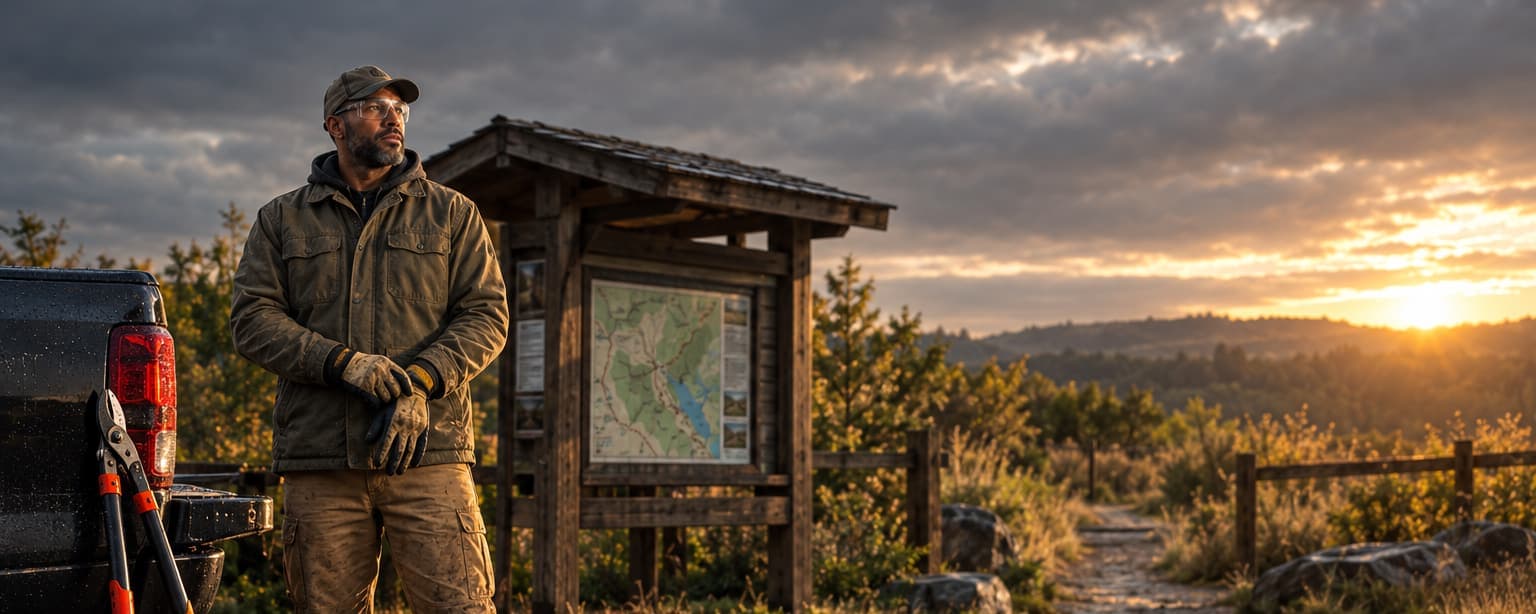
Easement defense stops at the easement. The trail is still yours to insure.
We insure land trusts and conservancies for the risks easement defense coverage leaves out: visitors on your preserves, volunteers with chainsaws, prescribed burns, property and the board.
Tell us the situation.
One licensed human replies the same business day — not five agents, not an auto-responder. If the policy you have is already the right one, we will tell you.
We use this to quote and service your insurance, and we do not sell it or pass it to lead networks. Privacy policy.
Send us what you have. We’ll tell you if it’s right.
Your current policy paperwork, a renewal notice, or nothing at all. A licensed agent reads it and replies the same business day.
What a land trust actually needs.
General liability
Injury to visitors, hikers and neighbors on preserves you own, with volunteers and easement monitors named as insureds.
Without it — Terrafirma will not enroll you, and recreational use statutes fall away the moment you charge a fee or ignore a known hazard.
Vacant land
Liability on undeveloped parcels you hold in fee, priced by acreage, often scheduled under the main policy.
Without it — A parcel left off the schedule can be uninsured land with your name on the deed.
Nonprofit directors and officers
Claims against the board over acquisitions, easement amendments, employment and donor disputes.
Without it — Terrafirma excludes claims a D&O policy would cover, so the board has nothing answering without one.
Commercial property
Offices, barns, visitor centers, trail structures and stewardship equipment at replacement cost.
Without it — Property is one of the three coverages Practice 6E2 names, and land trust structures are often remote and unprotected.
Volunteer accident
Medical bills for volunteers hurt on trail work, invasive removal or monitoring visits, regardless of fault.
Without it — Workers compensation rarely extends to unpaid volunteers, and an injured volunteer’s only route to payment becomes a lawsuit.
Workers compensation
Injury to paid stewardship staff and seasonal crews, from chainsaws, brush cutters and uneven ground.
Without it — Required with employees in nearly every state, and stewardship work is rated as outdoor labor, not office work.
Commercial auto
Trucks, UTVs on public roads, and trailers hauling equipment between preserves.
Without it — A personal auto policy on a staff member’s truck rarely answers when it is used for land trust work.
Pollution liability
Contamination you inherit or disturb on acquired land, herbicide drift, and fuel spills from equipment.
Without it — General liability excludes pollution almost entirely, and a donated parcel can carry a history nobody disclosed.
What the regulators actually wrote down.
Land Trust Standards and Practices, Practice 6E, asks a land trust to carry general liability, directors and officers liability, property and other insurance as appropriate to its risk exposure or as required by law.
Land Trust Alliance, Land Trust Standards and Practices (revised 2017), Practice 6E2 · checked 2026-10-04
The Land Trust Alliance requires every member land trust to adopt the Standards and Practices, most recently revised effective February 3, 2017, as its guiding principles.
Land Trust Alliance, Land Trust Standards and Practices, Board Adoption Resolution · checked 2026-10-04
The Standards also ask land trusts to give volunteers training, supervision and recognition.
Land Trust Alliance, Land Trust Standards and Practices, Practice 7B1 · checked 2026-10-04
Terrafirma Risk Retention Group was formed by the Land Trust Alliance in 2011 to help land trusts defend conserved land from legal challenge, and the insured land trusts are its exclusive owners.
Terrafirma Risk Retention Group, home page · checked 2026-10-04
Terrafirma’s basic limit is $500,000 per claim including defense costs, with a basic deductible of $5,000 per claim.
Terrafirma Risk Retention Group, How It Works · checked 2026-10-04
Terrafirma requires general liability insurance for eligibility and excludes anything general liability, directors and officers or other commercial insurance covers.
Terrafirma Risk Retention Group, How It Works · checked 2026-10-04
For Policy Year 2023 Terrafirma published a basic premium of $67 per conserved parcel per year, with discounts for accredited land trusts.
Terrafirma Risk Retention Group, How It Works · checked 2026-10-04
Washington shields landowners who let the public use land for outdoor recreation without charging a fee from liability for unintentional injuries, except for a known dangerous artificial latent condition without conspicuous warning signs.
RCW 4.24.210(1) and (4) · checked 2026-10-04
New York’s recreational use law gives no protection for a willful or malicious failure to guard or warn against a dangerous condition, or where permission was granted for a consideration.
N.Y. General Obligations Law 9-103(2) · checked 2026-10-04
Florida holds a landowner liable for damage from a prescribed burn conducted under its certified burn rules only if gross negligence is proven.
Fla. Stat. 590.125(3)(c) · checked 2026-10-04
The claims we actually see.
Ordered by how often we see them, not by how dramatic they are. Each one names the coverage that answers it — and the policy people wrongly assume already does.
Most common
A hiker is hurt on a preserve trail
Covered by General liability
Recreational use statutes help, but defense costs still arrive, and a parking fee or a known hazard can remove the protection.
Common
A volunteer is injured on a work day
Covered by Volunteer accident, then general liability
Without accident coverage the volunteer’s medical bills become a claim against the land trust.
Less common, severe
A prescribed burn escapes onto a neighbor’s land
Covered by General liability, if burns are not excluded
Many general liability forms exclude or limit prescribed fire. The wording has to be confirmed before the burn, not after.
Less common, severe
A new owner challenges an easement in court
Covered by Terrafirma, for members who enroll
Commercial policies do not pay to defend or enforce an easement. A counterclaim against the board may fall to D&O.
What the insurance company will ask about your land trust business
We read the applications the markets use for businesses in this field and pulled out what they actually ask. Have these answers ready and a quote takes a day instead of a week, because nobody has to come back to you for the missing piece.
About the business
- What is your organization's main purpose?
- How many members does your organization have?
- How long has your organization been operating?
- What is your annual gross revenue?
How you operate
- Do you offer counseling services for a fee?
- Do you operate a school?
- Do you regularly transport people or deliver goods?
- How many employees and volunteers use their own vehicles for your work?
- Do your staff or volunteers work on drop-in center activities, and if so, where and how often?
Safety and controls
- Are there at least two accessible exits from your main building?
- Do you have policies for supervising employees and volunteers who work with minors?
- Do you verify employment and personal references for all new employees?
- Has your organization ever been involved in a lawsuit or claim related to abuse or misconduct?
- What kind of counseling services, if any, does clergy provide?
Your history
- What year was your main building constructed?
- What type of plumbing does your building have (copper or PVC)?
- Describe your building's cooling system
- Do you own your building or lease it?
- Have you had any insurance claims or losses in the past five years?
Money and people
- What is your total building value?
- What is your total fund balance (assets minus liabilities)?
- Do you currently have general liability insurance, and if so, with whom?
- Why are you looking for new or different insurance coverage?
Have these ready
- Your loss history for the last five years, including details of any claims or losses
- Information about your current insurance coverage: company name, types of coverage, limits, and annual premium
- A list and description of all property you want insured
- Proof that employees and volunteers have liability insurance before using their personal vehicles for your work
- Names of your pastor or executive leadership
You answer what you can; a licensed agent fills the rest with you.
What our land trust clients ask us.
We are insured with Terrafirma. Do we still need commercial insurance?
Yes. Terrafirma insures the legal cost of defending and enforcing conservation easements and conserved land, and it excludes anything general liability, D&O or other commercial insurance would cover. It also requires general liability before it will enroll you. So a visitor injury, a volunteer accident, a board dispute or a damaged barn all sit with your commercial policies. The two are designed to fit together, and we place the commercial half.
What does Practice 6E in the Standards and Practices ask for?
Practice 6E2 asks a land trust to carry general liability, directors and officers liability, property and other insurance as appropriate to its risk exposure or as required by law. It sets no dollar amounts. Practice 6E1 adds that risks should be routinely assessed and managed so they do not threaten the trust’s finances or mission. Accreditation reviewers look for evidence that you did that analysis, so a short written summary of your coverages and why is worth keeping.
Does the recreational use statute mean we cannot be sued?
No, it limits liability but does not stop lawsuits. Washington’s statute, for example, protects landowners who allow free outdoor recreation from liability for unintentional injuries, but not for a known dangerous artificial condition without warning signs. New York’s law gives no protection where access was granted for a consideration. Charging for parking, a guided walk or an event can change your position. You still need a policy to pay for the defense that proves the statute applies.
Do we need different coverage for preserves we own than for easements?
Yes, mostly. On land you own in fee, you are the landowner, so visitor injuries, hazards and structures are yours to insure, usually parcel by parcel. On an easement, the landowner keeps possession and most premises liability, and your exposure is mainly monitoring visits and the legal fight over enforcement. Underwriters will ask for a list of fee parcels with acreage, public access and improvements, and a separate count of easements.
Does our general liability cover prescribed burns?
Not always, so it has to be checked before the burn season. Some forms exclude prescribed fire outright, and others cover it only when burns follow a written plan with certified burners. State law varies too: Florida protects landowners from liability for certified burns unless gross negligence is proven, but that rule depends on following its process. Tell us how often you burn, who leads the burns and what acreage, and we will confirm the wording in writing.
Are volunteers covered when they work on trails?
They can be, in two separate ways. Listing volunteers as insureds on general liability protects them when a hiker blames their work. Volunteer accident coverage pays a volunteer’s own medical bills if they are hurt, without anyone suing. The federal Volunteer Protection Act shields volunteers in some cases but expressly leaves the nonprofit’s own liability untouched. Chainsaw work and heavy tools are the questions underwriters ask about first.
What is the price based on?
It depends on what you own and what people do on it. General liability is rated on acreage held in fee, public access, structures and the activities you run, such as guided hikes or events. Property is rated on replacement values. D&O is rated on budget and staff. Prescribed fire, chainsaw work and water access move it most. Loss runs, a report from each prior insurer listing every claim, matter too, and a clean history helps.
Who writes land trust insurance, and can we go to them directly?
Philadelphia Insurance Companies — PHLY, part of Tokio Marine, rated A++ by AM Best — is the carrier that has told us in writing it wants land conservation organizations, and it is where we send these submissions first. PHLY does not sell to organizations directly: it works only through appointed agents, and we hold that appointment, so your file reaches their underwriter with our name on it rather than through a second intermediary. What their underwriter wants to see is specific and we assemble it before anything is sent — their supplemental application for your class, the standard applications, three years of valued loss runs (a report from each prior insurer showing every claim and its reserve), photographs of the premises, and your brochure or website. Payment plans are available once the annual price reaches $2,000. None of that is a promise to bind — every quote is subject to their underwriting review — but a complete file is the difference between a quote and a list of questions.
What does a land trust insurance application ask for?
The applications for land trust businesses ask about 4 things above all: what is your organization's main purpose; do you offer counseling services for a fee; are there at least two accessible exits from your main building; what year was your main building constructed. Have your loss history for the last five years, including details of any claims or losses and information about your current insurance coverage: company name, types of coverage, limits, and annual premium ready and a quote takes a day instead of a week.
Commercial insurance is 96% of what we do — it is not a department here, it is the whole business. Not ready to talk? The guides answer the questions this page raises in more depth. Already insured with us and need a certificate or a policy change? Ask the service team rather than starting a quote — it is faster and it goes to the people whose job it is. We also write home and auto, which is usually cheaper alongside the business policy than apart from it.
Handed a lease, a vendor packet or a client contract with insurance requirements? Paste it into the COI Requirements Decoder to see what each one means for your business, or read what the requirements mean.