
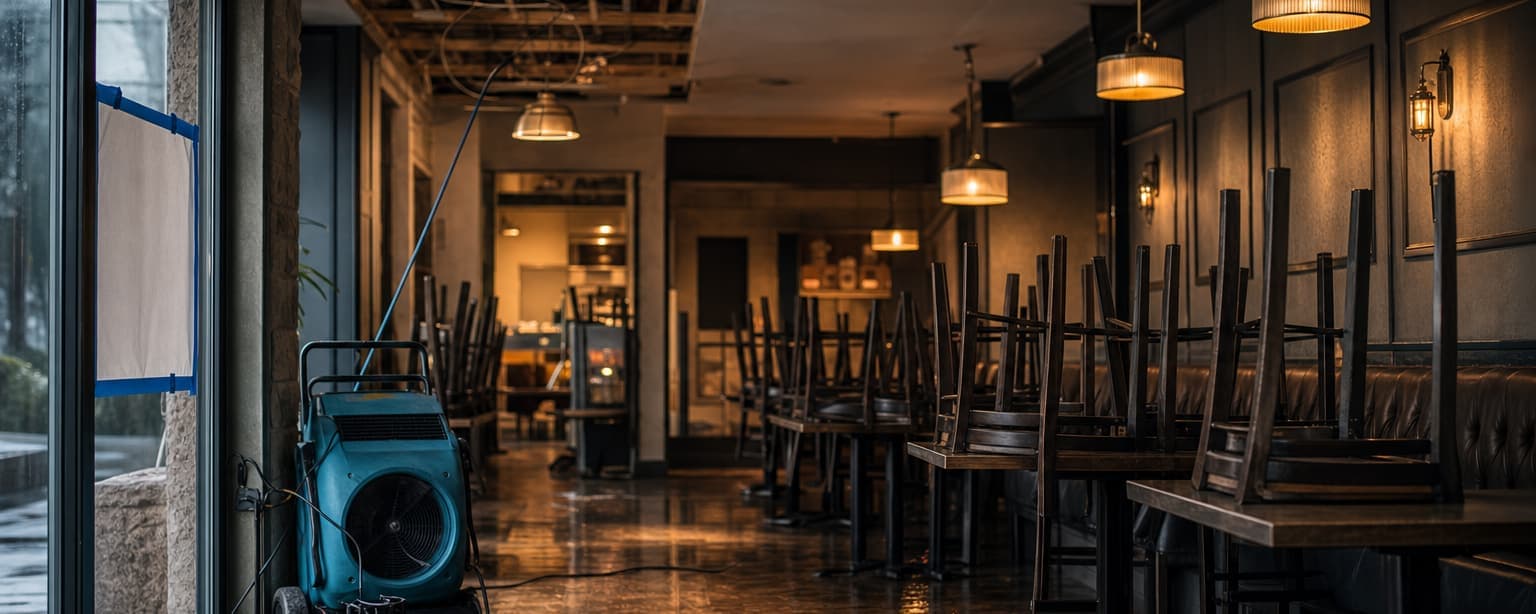
The building is rebuilt in six months. The rent and the payroll do not wait.
Business income covers lost profit and continuing expenses while you cannot operate after a covered property loss, plus the extra cost of operating from somewhere else.
Tell us the situation.
One licensed human replies the same business day — not five agents, not an auto-responder. If the policy you have is already the right one, we will tell you.
We use this to quote and service your insurance, and we do not sell it or pass it to lead networks. Privacy policy.
Send us what you have. We’ll tell you if it’s right.
Your current policy paperwork, a renewal notice, or nothing at all. A licensed agent reads it and replies the same business day.
What business income actually covers.
Lost profit
The income the business would have earned during the interruption.
Without it — A three-month closure removes a quarter of the year’s earnings.
Continuing expenses
Rent, loan payments and payroll that carry on while revenue does not.
Without it — Fixed costs run through the closure and are funded from reserves.
Extra expense
The cost of operating temporarily from another location.
Without it — Customers go elsewhere during the rebuild and do not all come back.
Where business income shows up.
- Restaurant
A kitchen fire closes you for months, and the rent, the payroll and the profit carry on without the revenue behind them.
- Bar
A fire or a burst pipe closes you for a season while the rent and the payroll carry on.
- Tavern
A fryer fire closes the room for months while the rent and the payroll carry on without the revenue.
- Nightclub
A closure order or a fire stops the revenue while the rent, the payroll and the license carry on.
- Physical Therapy Practices
A clinic that cannot open is a clinic with no revenue and the same lease.
- Chiropractic Practices
A closed clinic still pays rent and staff.
- HVAC Contractors
A fire or loss at the shop stops the trucks going out, and the payroll continues while the revenue does not.
- Crane & Rigging Contractors
One crane out of service is one crew idle and a schedule of lifts that has to be re-booked.
- Moving & Storage Companies
A fire at the warehouse stops every job on the schedule while the payroll continues.
- Flooring Contractors
A fire in a warehouse of flammable stock stops every job on the schedule at once.
- Welding & Fabrication
A shop fire stops fabrication and delivery while payroll and lease continue.
- Convenience Stores
A fire, a flood or a forced closure stops all revenue while rent and payroll continue.
- Recording Studios
A studio out of action loses booked sessions that cannot be moved, and the artists rebook elsewhere permanently.
- Equipment Rental Companies
A fire in the warehouse takes the inventory and every booking that inventory was carrying.
- Auto Body & Collision Shops
A booth fire stops the paint side completely, and the insurer referral programs do not wait for you to reopen.
- Sports Facilities & Venues
A closed floor loses the leagues, the camps and the memberships at once.
- Family Entertainment Centers
A closure in the school holidays costs a disproportionate share of the year.
- Trampoline Parks
Closure in a school holiday removes a disproportionate share of annual revenue.
- Bowling Centers
League nights are contracted revenue that does not reschedule.
- Water Parks
The season is short, so two weeks closed is a large share of annual revenue.
- Amusement & Theme Parks
Weather, a closure or an incident removes days that cannot be recovered in a season.
- Zip Lines & Ropes Courses
A course closed for inspection or repair has no alternative revenue.
- Zoos & Aquariums
A closure still costs full care for the collection with no admissions.
- Manufacturing
Rebuilding a plant is survivable; twelve months with no output frequently is not.
- Wineries & Vineyards
There is one harvest a year and it does not wait for a rebuild.
- Commercial Landlords
Twelve months of lost rent on a debt-financed building is the loss that ends ownership.
- Apartment Buildings
A fire in four units stops the income from all of them for a year.
- Short-Term Rentals
A summer of cancelled bookings is the loss. The repair bill is the small part.
- Airbnb Hosts
No platform pays you for the nights you did not host.
- Vacation Rentals
A summer closure on a beach let is most of the year’s revenue.
- Rental Arbitrage & Co-Hosts
Arbitrage is a spread between a monthly lease and nightly bookings. A closed unit still costs the lease.
- Self Storage
A roof loss can take a whole building of units offline at once.
- Warehouses
Relocating a distribution operation at short notice is the real cost.
- Mixed-Use Property
A commercial unit can take far longer to re-let than a flat.
- Mobile Home Parks
A tornado or wildfire empties a park faster than it damages the ground.
- Laboratories
Accreditation and validation make a temporary site slow to stand up.
- Food Trucks
One vehicle is the whole business; there is no second location.
- Bakeries
A single oven failure can stop production entirely in a small bakery.
- Juice & Smoothie Bars
A franchise agreement does not pause its royalty because your cooler died.
- Coffee Shops
Fixed rent continues and the trade goes to the shop down the road.
- Car Washes
A single-site operation has nowhere to send the cars.
- Dry Cleaners
An environmental investigation closes a site for far longer than a fire does.
- Private Schools
A closure between enrollment cycles is a whole year of revenue.
- Franchisees
Royalties and rent frequently continue while the unit is shut.
- Hotels, Motels & B&Bs
A floor out of action in high season is the year’s margin.
- Pizza Shops & Delivery
Oven and hood fires are the characteristic total loss in this trade.
- Museums and Cultural Institutions
Fixed costs keep running through a closure, and grant funders rarely pay for lost earned revenue.
What clients with business income ask us.
Is my limit a dollar amount or actual loss sustained?
One or the other, and it is the first thing to check because the two are not comparable on price.
What is the coinsurance percentage on business income?
It is the reason a business income claim gets paid at seventy cents on the dollar, and it catches people who thought they were fully insured.
Can I get business income without coinsurance?
Yes, three ways, and each trades the coinsurance penalty for a different cap. Monthly limit of indemnity caps what you collect in any 30 consecutive days at a third, a quarter or a sixth of the limit. Maximum period of indemnity stops at 120 days or when the limit runs out. Agreed value suspends coinsurance because the figure is agreed in advance, which means filing the Business Income Report each year — the right answer for most established businesses and the one most often skipped. Which one you have is on the declarations.
Is the deductible in dollars or in days?
Usually in time, which surprises people expecting a dollar figure. On the standard commercial form business income begins 72 hours after the physical loss, and those three days are the deductible, and they are not paid back to you later, the clock simply starts late. Extra expense is different and starts immediately, because its whole point is the money you spend on day one to keep going. The 72 hours can be shortened or removed by endorsement, cheaply, and for a restaurant that is usually worth asking for. Some policies carry a dollar deductible as well, so read the declarations.
How long does it keep paying after I reopen?
For a while, and this is the part most people do not know they have. The main coverage runs for the period of restoration, which ends when the property should have been repaired with reasonable speed rather than when it actually was — a slow contractor is your problem, not the insurer’s. Extended business income then picks up, because reopening does not bring revenue back the same day; the standard form gives 60 days. If the authorities close the street instead, civil authority is separate, with its own 72-hour wait.
How long should the indemnity period be?
Long enough to rebuild AND to get back to your previous trading level, which is almost always longer than people estimate. Twelve months is the common default and is frequently too short for anything needing permits, custom equipment or a specialist fit-out. Think in terms of the slowest step, not the average one.
Does it cover a closure with no physical damage?
Generally no. The trigger is a covered physical loss at your premises, which is why pandemic closures were largely not covered and why communicable disease is now excluded explicitly. Civil authority extensions can help when access is blocked by damage nearby, but they are narrow and time-limited.
Commercial insurance is 96% of what we do — it is not a department here, it is the whole business. Not ready to talk? The guides answer the questions this page raises in more depth. Already insured with us and need a certificate or a policy change? Ask the service team rather than starting a quote — it is faster and it goes to the people whose job it is. We also write home and auto, which is usually cheaper alongside the business policy than apart from it.
Handed a lease, a vendor packet or a client contract with insurance requirements? Paste it into the COI Requirements Decoder to see what each one means for your business, or read what the requirements mean.