
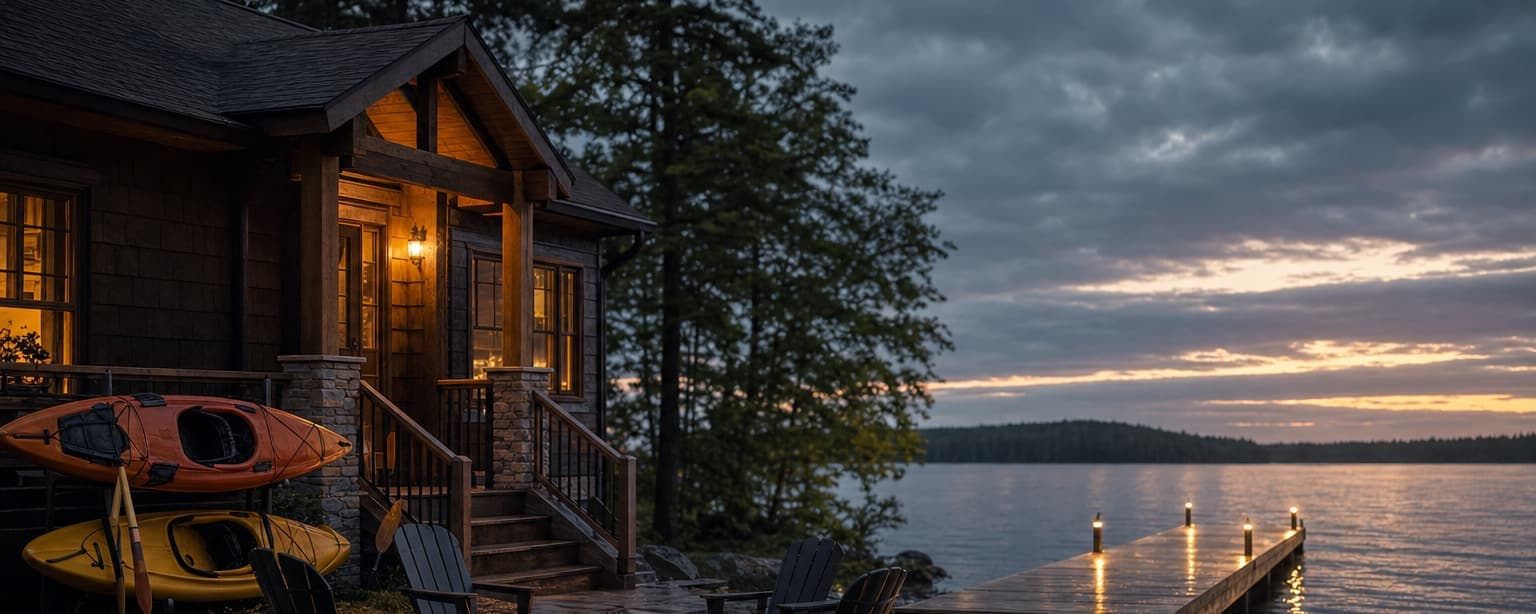
Empty most of the year, full at the worst time of year.Founded by a former Airbnb host.
A vacation property you rent out is empty for long stretches and full in the season the weather is worst, and it sits on the coast, in the mountains or in wildfire country because that is why people book it. We insure it for all three facts at once, and we read the second-home policy it is probably on today before you change anything.
Tell us the situation.
One licensed human replies the same business day — not five agents, not an auto-responder. If the policy you have is already the right one, we will tell you.
We use this to quote and service your insurance, and we do not sell it or pass it to lead networks. Privacy policy.
We ran almost fifty short-term rentals before we insured anybody else’s.

Kevin Kelsey
Founder | Principal Agent
Boring’s founder, Kevin Kelsey, owned four short-term rentals and managed almost fifty for other owners at the peak before he worked in insurance, and he founded Airhost Academy, one of the first blogs written for Airbnb hosts, which he later sold. He has handled the turnovers, the pool questions, the guest who breaks the one thing the platform will not pay for, and the letter from an insurer explaining that a homeowners or dwelling fire policy was never written for nightly guests. So the person building your coverage has hosted, rather than working from a rate manual.
We hold an appointment with Proper Insurance, the short-term rental program underwritten by Lloyd’s of London and Concert Insurance Group and written on a commercial form that replaces the homeowners policy rather than sitting on top of it, and we still place occasional letting on a second-home policy with the right endorsement when that is the cheaper honest answer.
Send us what you have. We’ll tell you if it’s right.
Your current policy paperwork, a renewal notice, or nothing at all. A licensed agent reads it and replies the same business day.
What vacation rental businesses actually need.
General liability
Injury to guests and visitors, damage you cause to a neighboring property, and the defense costs that start the day you are named.
Without it — A homeowners policy will not answer a claim from a paying guest, and the platforms describe their own protection as an addition to your insurance rather than a replacement for it.
Premises liability
The pool, the hot tub, the steps, the deck, the dock and the driveway, which are the parts of the property that hurt people.
Without it — Pool and spa claims are the severe ones in this class, and the mitigation an underwriter asks about is fencing, alarms, a spa shutoff and signage.
Personal and advertising injury
Claims arising from how the property is advertised: the listing copy, the photographs, the description of what is included.
Without it — A short-term rental listing is an advertisement you wrote. This coverage is inside general liability, and it is worth knowing it is there.
The building
The structure at what it costs to rebuild today, with the coinsurance clause understood before a claim rather than after one.
Without it — A limit set on what you paid, or on what it would sell for, is a partial claim paid in part.
Business personal property
Furniture, appliances, linens, electronics and the contents you supply: a separate limit from the building, and the one most often set from memory.
Without it — A furnished rental holds far more replaceable value than owners estimate, and a total loss replaces all of it at once.
Earthquake
Shake damage, written separately, with a deductible expressed as a percentage of the building value rather than a dollar figure.
Without it — Every property form excludes earth movement. On a coastal or mountain rental, the ones that let well, this is bought or it is uninsured.
Flood
Rising water and storm surge, through the NFIP and private or excess flood above its limits.
Without it — Excluded by the property policy, and a lender on a mapped zone requires it whatever you think of the odds.
The property, occupied and not
Coverage written around a property that is empty for long stretches by design.
Without it — Vacancy conditions on a standard form suspend or cut back coverage after a stated number of days.
Wind, hail and wildfire
The named-storm and wildfire perils, usually inside the property policy but carrying their own percentage deductible.
Without it — On the coast wind is often carved out to a separate policy or a state wind pool, and in wildfire states the loss arrives as a non-renewal rather than as a declined claim.
Freeze and water damage
Burst pipes in a property nobody visits for weeks in winter.
Without it — The classic seasonal loss, and often subject to specific heat or shut-off conditions.
Lost bookings
Season income lost when the property is out of action.
Without it — A summer closure on a beach let is most of the year’s revenue.
What our vacation rental clients ask us.
Why does vacancy matter so much on a vacation rental?
Because damage nobody sees keeps going. A leak in an occupied house is noticed in minutes; in a cabin closed for the winter it runs until someone visits. Insurers respond with vacancy conditions, coverage suspended or cut back after a stated period, and with specific requirements: minimum heat maintained, water shut off and drained, or documented periodic inspections. Those are policy conditions, not advice, and a claim can turn on whether you met them.
Is flood or wind included?
Usually not, and on the coast this is the whole conversation. Flood is nearly always a separate policy, and in high-wind regions windstorm is frequently excluded from the main policy and placed separately or through a state wind pool. In wildfire states the same pattern applies from the other direction. Budget for the property as a package of policies rather than one, and get the structure explained before you buy the house, because it is a material carrying cost.
We use it ourselves part of the year. Does that complicate things?
It is normal and it needs stating. Mixed personal and rental use is exactly what a second-home policy with a rental endorsement is for, and it is usually cheaper than a commercial form. What causes trouble is silence: an owner who lets ten weeks a year on an unendorsed second-home policy has an undisclosed use, which is grounds for a denial regardless of how modest the letting is.
Does the platform’s protection cover a vacation rental?
Only for the stays booked through it, and never for the building or the lost season. Airbnb’s Host Damage Protection is not insurance by Airbnb’s own description; Vrbo describes its $1 million liability as additional to your own policy and charges a 25% deductible to a host who has none. On a property that also hosts your family and the odd direct booking, most of the calendar has no platform protection in force at all.
What about a cabin, yurt or anything unconventional?
Placeable, and it depends on construction and access more than on the label. Timber cabins, yurts, park models, domes and converted barns are all written somewhere; what underwriters ask is how it is built, how it is heated, how far it is from a fire station and hydrant, and whether the road is maintained year-round. Wood stoves and off-grid power need documenting. Expect a specialist market rather than a standard one, and expect the questions to be about the access road.
Is a vacation rental host insured differently from an Airbnb host?
Often, and the difference is how much of the year the place earns. A full-time listing with near-continuous bookings is a commercial risk and belongs on a short-term rental program written for that. A vacation home let in season and used by the family the rest of the year is usually better on a second-home policy with a rental endorsement, which costs less and is easier to place. The word host covers both, so the honest answer depends on your calendar rather than on the platform. Tell us the number of nights let last year and we will tell you which side of the line you are on.
Commercial insurance is 96% of what we do — it is not a department here, it is the whole business. Not ready to talk? The guides answer the questions this page raises in more depth. Already insured with us and need a certificate or a policy change? Ask the service team rather than starting a quote — it is faster and it goes to the people whose job it is. We also write home and auto, which is usually cheaper alongside the business policy than apart from it.
Handed a lease, a vendor packet or a client contract with insurance requirements? Paste it into the COI Requirements Decoder to see what each one means for your business, or read what the requirements mean.