
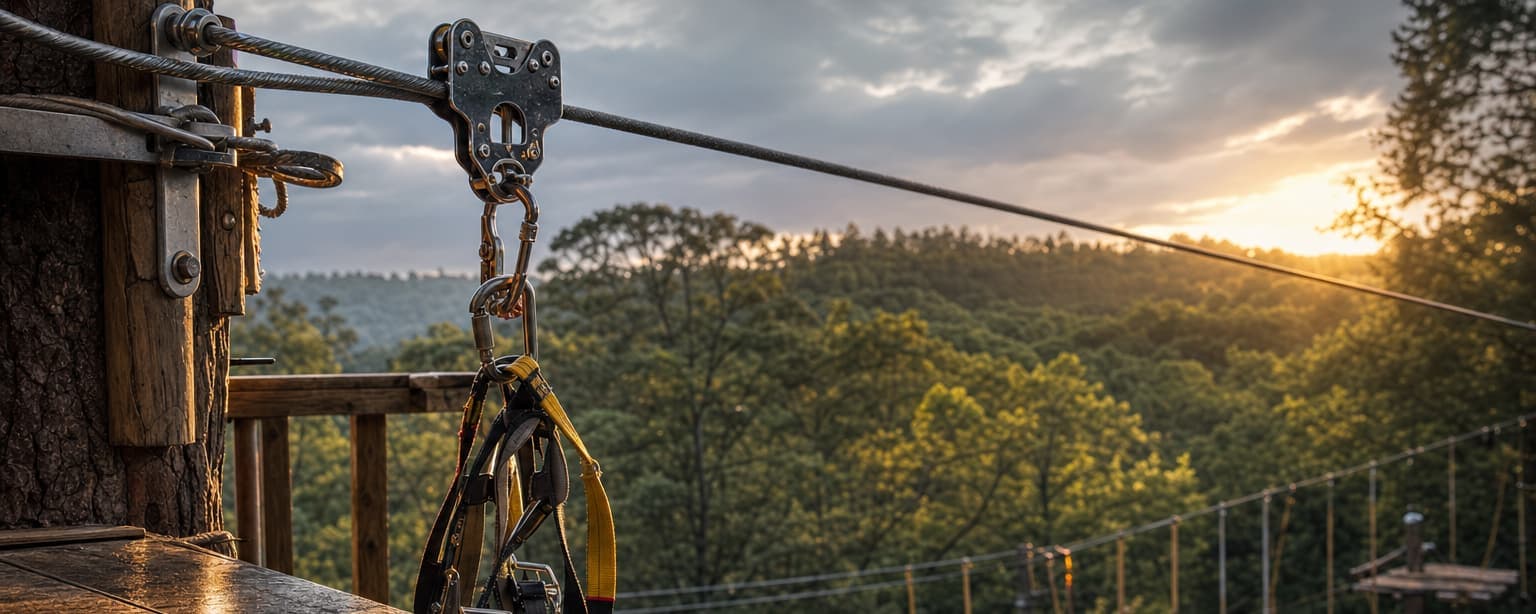
Height, a harness, and a guest who has never worn one.
We insure zip lines, ropes courses and aerial adventure parks. Inspection standards and guide training matter, but the height exposure decides the account.
Tell us the situation.
One licensed human replies the same business day — not five agents, not an auto-responder. If the policy you have is already the right one, we will tell you.
We use this to quote and service your insurance, and we do not sell it or pass it to lead networks. Privacy policy.
Send us what you have. We’ll tell you if it’s right.
Your current policy paperwork, a renewal notice, or nothing at all. A licensed agent reads it and replies the same business day.
What zip line and ropes course businesses actually need.
General liability
Third-party bodily injury and property damage. It is the line nearly every contract names by default.
Without it — Guests at height under your instruction, and everyone below them.
Participant accident
Pays the medical costs of a player, a camper or a rider injured while taking part, without anyone having to establish that the organization was at fault.
Without it — Injuries occurring on a correctly operated course, covered without fault.
Professional liability
Covers the advice, the drawing, the diagnosis. The work itself, rather than someone getting hurt on your premises.
Without it — Guiding and instruction is a service, and an instruction alleged to be wrong is a professional claim.
Commercial property
Buildings and contents, valued at what it costs to rebuild today rather than what you paid.
Without it — Towers, platforms, cable and hardware, outdoors and load-bearing.
Inland marine & equipment
Tools, equipment and property in transit. It picks up exactly where commercial property stops, which is the moment the item leaves the building.
Without it — Harnesses, trolleys, helmets and rescue equipment, inspected and replaced on a schedule.
Workers compensation
Required in almost every state the moment you have employees. Priced on payroll and class code, which is why the class code is worth arguing about.
Without it — Guides work at height every day and perform rescues.
Umbrella & excess liability
Extra limit stacked above general liability, auto and employers liability. Usually the cheapest million dollars on the policy.
Without it — Landowners, resorts and parks specify limits well above primary.
Business income
Replaces the profit and pays the ongoing bills while a covered loss keeps you closed. It is the part of a fire claim that is not the building.
Without it — A course closed for inspection or repair has no alternative revenue.
What the insurance company will ask about your zip line and ropes course business
We read 15 applications the markets use for this kind of business and pulled out what they actually ask. Have these answers ready and a quote takes a day instead of a week, because nobody has to come back to you for the missing piece.
About the business
- What is your facility's name and what other names has it been known by?
- How many years have you been operating?
- How many people do you serve annually?
- What is your annual gross revenue?
- How many square feet is your facility?
How you operate
- What is your instructor-to-student ratio during activities?
- Do participants need to meet eligibility requirements to use your facility?
- How long is your season each year?
- Do you serve alcohol at any events?
- Do you have an emergency evacuation plan for events?
Safety and controls
- How is your walkway and parking area lit?
- What first aid equipment and facilities do you have on site?
- How often do you inspect and maintain your equipment?
- Do you use liability waivers with participants?
- Do you have written procedures for handling abuse or misconduct?
Your history
- Have you ever had a claim filed against you?
- Who was your previous insurance company and what did you pay?
- Do you operate more than one location?
Money and people
- What is your annual payroll?
- Do you hire outside security?
- Do you use independent contractors who work with participants?
- If you hire contractors, do you run background checks on them?
Have these ready
- Your loss runs (claims history for the last five years from your current or previous insurance company)
- Your liability waivers if you use them
- Written procedures for handling abuse or misconduct if you have them
- Resumes of your facility manager or managers
You answer what you can; a licensed agent fills the rest with you.
What our zip line and ropes course clients ask us.
What standards do underwriters expect?
Construction and inspection to a recognized industry standard, annual third-party inspection, documented daily and periodic checks, guide training and certification, and a written rescue plan that has been practised. This class is small enough that underwriters know the standards by name and will ask which one you built to. Being unable to answer is itself the answer.
Does rescue capability really affect the price?
Materially, because the second-worst outcome in this business is a guest stranded mid-line. Documented rescue procedures, trained staff, the equipment on site and evidence of drills change both the likelihood of a claim and its severity. It is one of the few controls that improves the risk and the guest experience at the same time.
We run a course at a camp or resort. Whose insurance responds?
Both, and the contract decides how. The landowner will require you to insure the activity and name them; your policy covers your operation; theirs covers their premises. Where it gets argued is a guest injured on the walk between attractions, or a course operated by their staff under your program. Settle who operates and who supervises in writing, because that is the question a claim will ask first.
What does a zip line and ropes course insurance application ask for?
The applications for zip line and ropes course businesses ask about 4 things above all: what is your facility's name and what other names has it been known by; what is your instructor-to-student ratio during activities; how is your walkway and parking area lit; have you ever had a claim filed against you. Have your loss runs (claims history for the last five years from your current or previous insurance company) and your liability waivers if you use them ready and a quote takes a day instead of a week.
Commercial insurance is 96% of what we do — it is not a department here, it is the whole business. Not ready to talk? The guides answer the questions this page raises in more depth. Already insured with us and need a certificate or a policy change? Ask the service team rather than starting a quote — it is faster and it goes to the people whose job it is. We also write home and auto, which is usually cheaper alongside the business policy than apart from it.
Handed a lease, a vendor packet or a client contract with insurance requirements? Paste it into the COI Requirements Decoder to see what each one means for your business, or read what the requirements mean.