
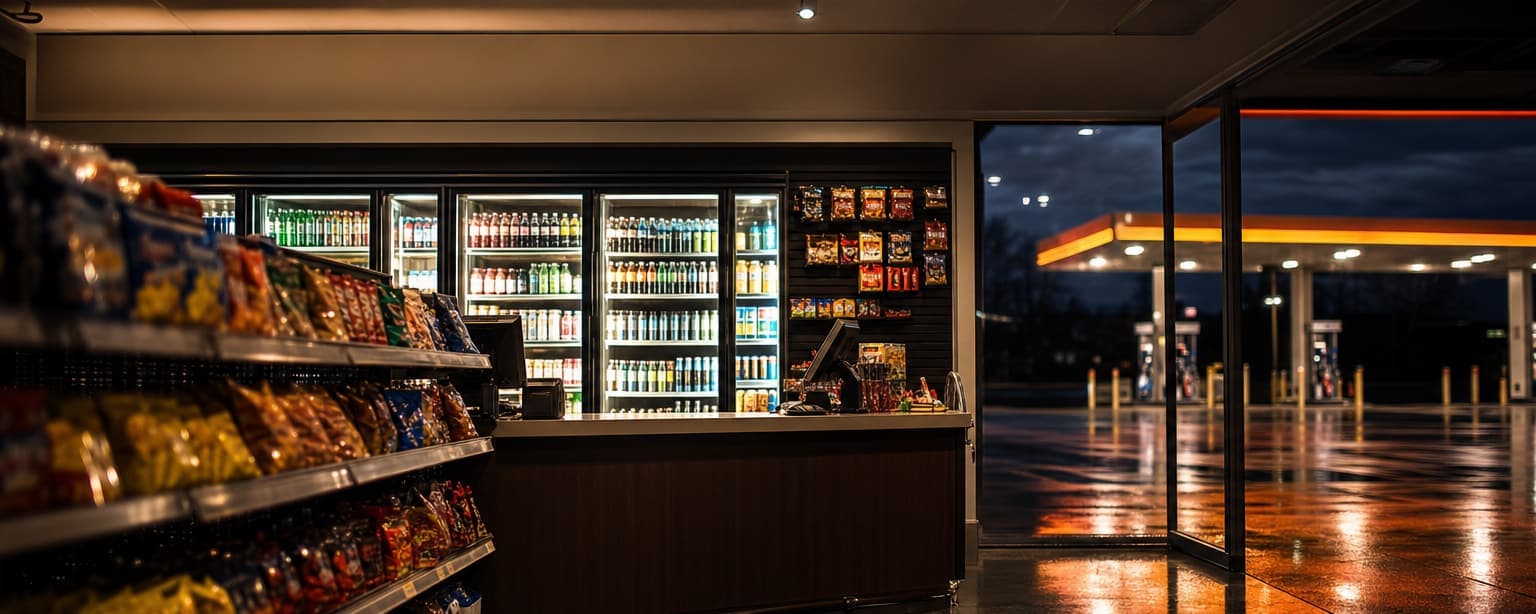
Open late, selling alcohol, with a till. All three are the risk.
Commercial insurance for convenience stores, liquor stores and fuel retailers, written around dram shop, robbery, food and the hours you keep.
Tell us the situation.
One licensed human replies the same business day — not five agents, not an auto-responder. If the policy you have is already the right one, we will tell you.
We use this to quote and service your insurance, and we do not sell it or pass it to lead networks. Privacy policy.
Send us what you have. We’ll tell you if it’s right.
Your current policy paperwork, a renewal notice, or nothing at all. A licensed agent reads it and replies the same business day.
What convenience store businesses actually need.
Liquor liability
If you serve alcohol, your general liability almost certainly excludes what happens after you serve it.
Without it — Selling alcohol creates liability for what a customer does afterwards, and general liability excludes it for anyone in the business of selling it.
Commercial property
Buildings and contents, valued at what it costs to rebuild today rather than what you paid.
Without it — The building, the fixtures, the coolers and the stock are the balance sheet, and fire or vehicle impact takes them together.
General liability
Third-party bodily injury and property damage. It is the line nearly every contract names by default.
Without it — Slips, falls and assaults on the premises are claims from members of the public who were simply present.
Crime & employee dishonesty
Theft by your own staff, funds transfer fraud, and the dishonesty bond a home care contract will ask you for by name.
Without it — Robbery, till shortages and employee theft are frequency losses in a cash business open long hours.
Equipment breakdown & spoilage
Covers the walk-in, the compressor and the line when they fail from the inside. A mechanical or electrical breakdown is excluded by property policies, and the stock that thawed goes with it.
Without it — A compressor failure spoils every cooler and freezer in the store at once.
Food contamination
Pays for the destroyed stock, the deep clean, the lost income and the publicity when a health department closes you or a supplier contaminates a batch.
Without it — Prepared food and hot counters bring spoilage, contamination and a health authority closure.
Business income
Replaces the profit and pays the ongoing bills while a covered loss keeps you closed. It is the part of a fire claim that is not the building.
Without it — A fire, a flood or a forced closure stops all revenue while rent and payroll continue.
Workers compensation
Required in almost every state the moment you have employees. Priced on payroll and class code, which is why the class code is worth arguing about.
Without it — Night shift staff face robbery and assault on top of ordinary lifting and slip injuries.
Umbrella & excess liability
Extra limit stacked above general liability, auto and employers liability. Usually the cheapest million dollars on the policy.
Without it — A dram shop claim following a fatal crash is the largest single exposure a small store carries.
Cyber
Breach response, ransomware and the notification costs that follow, plus the card-brand assessments a business that takes payments gets billed for whoever was at fault. The customer database, the mailing list and the loyalty program are the assets at stake, and general liability excludes all of it by name.
Without it — Card terminals and loyalty systems put payment data in a small business with no security staff.
What the insurance company will ask about your convenience store business
We read the applications the markets use for businesses in this field and pulled out what they actually ask. Have these answers ready and a quote takes a day instead of a week, because nobody has to come back to you for the missing piece.
About the business
- When did your business start?
- What is your business structure (sole owner, partnership, corporation, or LLC)?
- What is your website address?
- Do you have a
- (doing business as) name?
How you operate
- Describe what you do—what products you sell and how you sell them (retail store, online, events, etc.)
- What percentage of your sales comes from different channels like in-store, online, or beverages?
- Do you sell hemp products, and if so, when did you start?
- Do you sell anything other than hemp products?
- Do you check ID when customers buy products at your register?
Safety and controls
- Do you have a written plan for removing products from shelves if there's a problem?
- Do you keep records of what you sell, when you sold it, and to whom?
- Do you offer free samples of any products? If so, what's the largest serving size?
- Do you host events where customers use products on your property?
- Do you ever sell products outside the USA, or import products or ingredients?
Your history
- Have you ever had any lawsuits, claims, or losses in the last three years? If so, tell us the date, what happened, and the amount paid or still reserved.
- Have you had any fines for breaking laws about hemp, alcohol, or other products?
- Are you licensed to sell hemp products with any state agencies?
- Have you declared bankruptcy or had tax liens or credit liens against you in the last five years?
- Do you own, control, or have a stake in any other businesses?
Money and people
- What is your annual revenue?
- What is the maximum amount of THC in each product you make, sell, or serve?
Have these ready
- Your building information: what year it was built, square footage, roof type (flat, wood shake, shingle, metal, tile, slate, or other), and plumbing type (PVC, copper, lead, galvanized, or other)
- Your loss runs—the record of any claims you made to your current insurance company in the last three years
- Any product recall records or procedures you have in place
You answer what you can; a licensed agent fills the rest with you.
What our convenience store clients ask us.
We sell delta-8 or hemp gummies by the register. Does that affect our insurance?
More than almost anything else on your shelves. Preferred general liability carriers routinely non-renew or cancel a store on discovering it sells intoxicating hemp — delta-8, delta-10, THCA — and they do it on the class of product rather than on your claims history or how small a share of sales it is. A single facing beside the register can be enough.
What is dram shop liability and does it apply to a store?
It is liability for harm caused by someone you sold alcohol to, most seriously a drunk driver who injures a third party. Many people assume it only reaches bars, but off-premises retailers are exposed too, particularly on sales to minors or to someone visibly intoxicated. General liability policies exclude liquor liability for any business in the alcohol trade, so it has to be bought as its own coverage. Where your state imposes it, this is the largest number your store can produce, and it is the reason age-verification discipline is an insurance control and not just a licensing one.
Does selling fuel change everything?
It changes a great deal. Fuel brings environmental exposure from tanks and lines, which is its own policy and frequently a state financial-responsibility requirement, plus a fire hazard and a different property valuation. Canopies are also a wind and vehicle-impact exposure that stores without them do not have. A store with fuel and a store without are two different submissions, and should be quoted as such.
How much does staying open overnight matter?
It is one of the first questions asked and it moves both liability and workers compensation. Late-night hours correlate with robbery and assault, which is why underwriters ask about cameras, drop safes, lighting, whether staff work alone, and whether there is a service window. These are cheap controls that materially change the price, and a store that has them should be making sure its broker has said so.
I lease the building. What am I responsible for?
More than most tenants expect, and the lease decides it rather than the policy. Triple-net leases commonly push building insurance, glass, and sometimes the structure itself onto the tenant, and require the landlord to be an additional insured at a stated limit. Improvements you have paid for — coolers, counters, fit-out — are usually yours to insure regardless of who owns the shell. Send the lease when you shop; it changes what you actually need to buy.
What does a convenience store insurance application ask for?
The applications for convenience store businesses ask about 4 things above all: when did your business start; describe what you do—what products you sell and how you sell them (retail store, online, events, etc.); do you have a written plan for removing products from shelves if there's a problem; have you ever had any lawsuits, claims, or losses in the last three years? if so, tell us the date, what happened, and the amount paid or still reserved. Have your building information: what year it was built, square footage, roof type (flat, wood shake, shingle, metal, tile, slate, or other), and plumbing type (pvc, copper, lead, galvanized, or other) and your loss runs—the record of any claims you made to your current insurance company in the last three years ready and a quote takes a day instead of a week.
Commercial insurance is 96% of what we do — it is not a department here, it is the whole business. Not ready to talk? The guides answer the questions this page raises in more depth. Already insured with us and need a certificate or a policy change? Ask the service team rather than starting a quote — it is faster and it goes to the people whose job it is. We also write home and auto, which is usually cheaper alongside the business policy than apart from it.
Handed a lease, a vendor packet or a client contract with insurance requirements? Paste it into the COI Requirements Decoder to see what each one means for your business, or read what the requirements mean.