
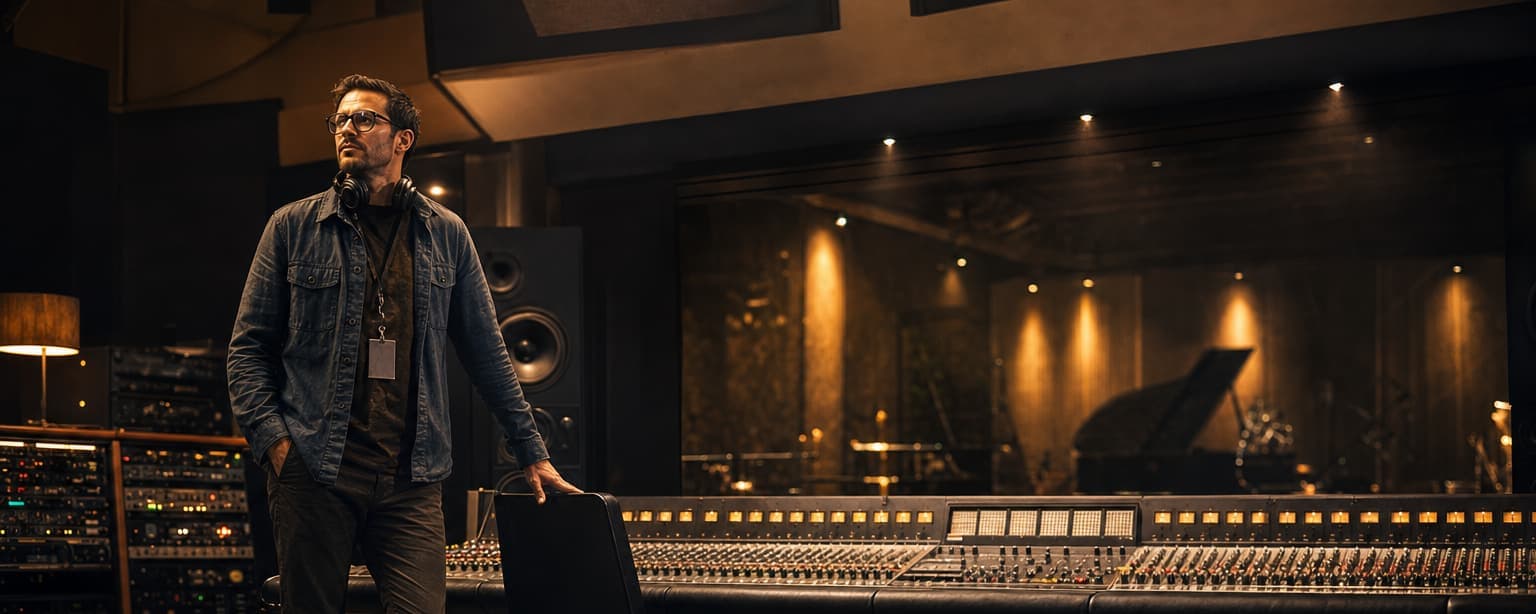
The console is insured. The master nobody backed up is not.Founded by an Emmy-nominated television editor.
We build studio policies around the gear you own, the instruments clients leave in the room, and recordings that have enormous value and no replacement cost.
Tell us the situation.
One licensed human replies the same business day — not five agents, not an auto-responder. If the policy you have is already the right one, we will tell you.
We use this to quote and service your insurance, and we do not sell it or pass it to lead networks. Privacy policy.
We were editing television long before we were insuring it.

Kevin Kelsey
Founder | Principal Agent
IATSE Local 700 member
Boring’s founder, Kevin Kelsey, edited television for fifteen years before he sold a policy. He was Emmy-nominated for The Muppets Mayhem, cut Shark Tank, Big Brother, Dancing with the Stars and Wheel of Fortune, and handled compliance and risk for some of Hollywood’s largest production companies. So the person building your coverage has been on a crew list, dealt with the permit offices, and met network and streamer requirements from the production side, rather than working from a rate manual. He also builds post-production software. Manifest Post is the board episodic post teams use to track every episode, and B/side is a video editor for people who cut together. He holds a number of patents on that software. So he knows the post side of a production as a vendor to it. We insure productions from Los Angeles to Atlanta, New York and Toronto, with worldwide and foreign production coverage.
The work is placed with the markets that actually write film, television and live entertainment — Zurich through ISC Entertainment (formerly Abacus), Philadelphia Insurance Companies, Take1 and Alive Risk — rather than with a general small-business carrier asked to try.
Send us what you have. We’ll tell you if it’s right.
Your current policy paperwork, a renewal notice, or nothing at all. A licensed agent reads it and replies the same business day.
What recording studio businesses actually need.
Commercial property
Buildings and contents, valued at what it costs to rebuild today rather than what you paid.
Without it — Consoles, monitors, outboard and acoustic treatment are the business, and a sprinkler head does not distinguish between them.
Inland marine & equipment
Tools, equipment and property in transit. It picks up exactly where commercial property stops, which is the moment the item leaves the building.
Without it — Microphones, instruments and mobile rigs travel to sessions and leave the building the property policy stops at.
General liability
Third-party bodily injury and property damage. It is the line nearly every contract names by default.
Without it — Clients, guests and delivery crews move through a room full of cable, stands and stairs.
Business income
Replaces the profit and pays the ongoing bills while a covered loss keeps you closed. It is the part of a fire claim that is not the building.
Without it — A studio out of action loses booked sessions that cannot be moved, and the artists rebook elsewhere permanently.
Third party property damage
Damage to property in your care while you are shooting on it, meaning the location itself and the fixtures in it. General liability excludes property in your care, custody and control, which is precisely what a location is.
Without it — A vintage guitar or a hired synth left in your live room is property in your care, and general liability excludes it outright.
Cyber & tech E&O
Breach response, ransomware and the notification costs that follow. Technology errors and omissions sits on the same policy and covers the software or service itself failing a client, which is the half most tech companies find out about too late.
Without it — Sessions, stems and unreleased masters sit on servers, and a leak before release is a commercial catastrophe rather than an IT problem.
Equipment breakdown & spoilage
Covers the walk-in, the compressor and the line when they fail from the inside. A mechanical or electrical breakdown is excluded by property policies, and the stock that thawed goes with it.
Without it — Power events take out consoles and converters, and the repair queue for older gear is long.
Business owners policy
General liability and property packaged together. Cheaper than buying them separately when you qualify, and most small businesses do.
Without it — For most independent studios the property and liability belong in one package rather than three policies.
“Kevin and his team at Boring are amazing! As a small business, having a partner like Boring we can rely on is crucial. We use them for business insurance and I couldn’t recommend them more!”
What the insurance company will ask about your recording studio business
We read the applications the markets use for businesses in this field and pulled out what they actually ask. Have these answers ready and a quote takes a day instead of a week, because nobody has to come back to you for the missing piece.
About the business
- What does your company do?
- How many years has your business been operating?
- How many people work for you?
- Do you have a website, and if so, what is it?
- How many productions do you create or work on each year?
How you operate
- What's the largest production budget you handle for any single project?
- Describe the main type of stunt or production work you perform
- How do you make sure the content you create is accurate and original?
- Do you require your contractors and service providers to carry insurance?
- What's the total value of productions and materials you keep at any one location at one time?
Safety and controls
- What steps do you take to prevent problems or claims?
- Do you have a lawyer on staff or on retainer, and what do they help you with?
- Does a lawyer review the content of all your productions before they go out?
- Do you obtain written releases from people whose names or likenesses appear in your productions?
- Do you have written disclaimers for any financial, legal, or medical advice you give?
Your history
- Has your company changed its name, acquired another business, or merged with another company in the past five years?
- Do you know of any incident where your company suffered a data breach or loss of private information?
- In the past five years, has your company sued any clients for non-payment, and if so, were you countersued?
- In the past five years, has anyone who owns or works for you been investigated, cited, or fined by a government agency?
- Has your company ever been denied, cancelled, or not renewed for insurance like this before?
Money and people
- What are your gross production costs?
- Who are your five largest clients, and how much do you do business with each of them?
- What is your current insurance company and policy number?
Have these ready
- Your last three years of claims history from your current or past insurance company, called loss runs
- A copy of your title and trademark report reviewed by a qualified attorney
- Copies of your contracts with your five largest clients, showing the dollar value, length, and type of services
You answer what you can; a licensed agent fills the rest with you.
What our recording studio clients ask us.
Is a client’s instrument covered while it is in my studio?
Not by your general liability, which excludes damage to property in your care, custody and control, and a guitar left in the live room is exactly that. It needs to be insured deliberately, either on your own policy by endorsement or by the owner. No uninsured loss in the class is more common, and it usually surfaces the first time something expensive and irreplaceable is knocked over.
What happens if a recording is lost?
It depends entirely on how the policy treats media. The physical drive is property and cheap; the session on it is neither, and many property forms limit recovery to the cost of blank media. Coverage for the value of the recording, and for the cost of re-recording it, has to be arranged specifically. Given what a re-shoot of a session with booked musicians costs, it is worth the conversation before it is needed.
Do I need anything different for a podcast or streaming studio?
The property and liability are the same; what changes is the media exposure. Publishing what is recorded introduces defamation, privacy and rights-clearance risk that a music studio hiring out a room does not have. That is media liability, and it is a separate form rather than a feature of the studio policy. If the podcast is the business rather than the room, it has its own page.
We rent the room out unsupervised. Does that matter?
Yes, and it should be declared. Unsupervised hire changes both the liability profile — nobody of yours is present when something goes wrong — and the property one, because your gear is in the hands of people you have not trained. It is entirely writable and it is a different rate, and an undeclared lock-out arrangement is the kind of fact that gets examined after a fire.
What does a recording studio insurance application ask for?
The applications for recording studio businesses ask about 4 things above all: what does your company do; what's the largest production budget you handle for any single project; what steps do you take to prevent problems or claims; has your company changed its name, acquired another business, or merged with another company in the past five years. Have your last three years of claims history from your current or past insurance company, called loss runs and a copy of your title and trademark report reviewed by a qualified attorney ready and a quote takes a day instead of a week.
Commercial insurance is 96% of what we do — it is not a department here, it is the whole business. Not ready to talk? The guides answer the questions this page raises in more depth. Already insured with us and need a certificate or a policy change? Ask the service team rather than starting a quote — it is faster and it goes to the people whose job it is. We also write home and auto, which is usually cheaper alongside the business policy than apart from it.
Handed a lease, a vendor packet or a client contract with insurance requirements? Paste it into the COI Requirements Decoder to see what each one means for your business, or read what the requirements mean.