
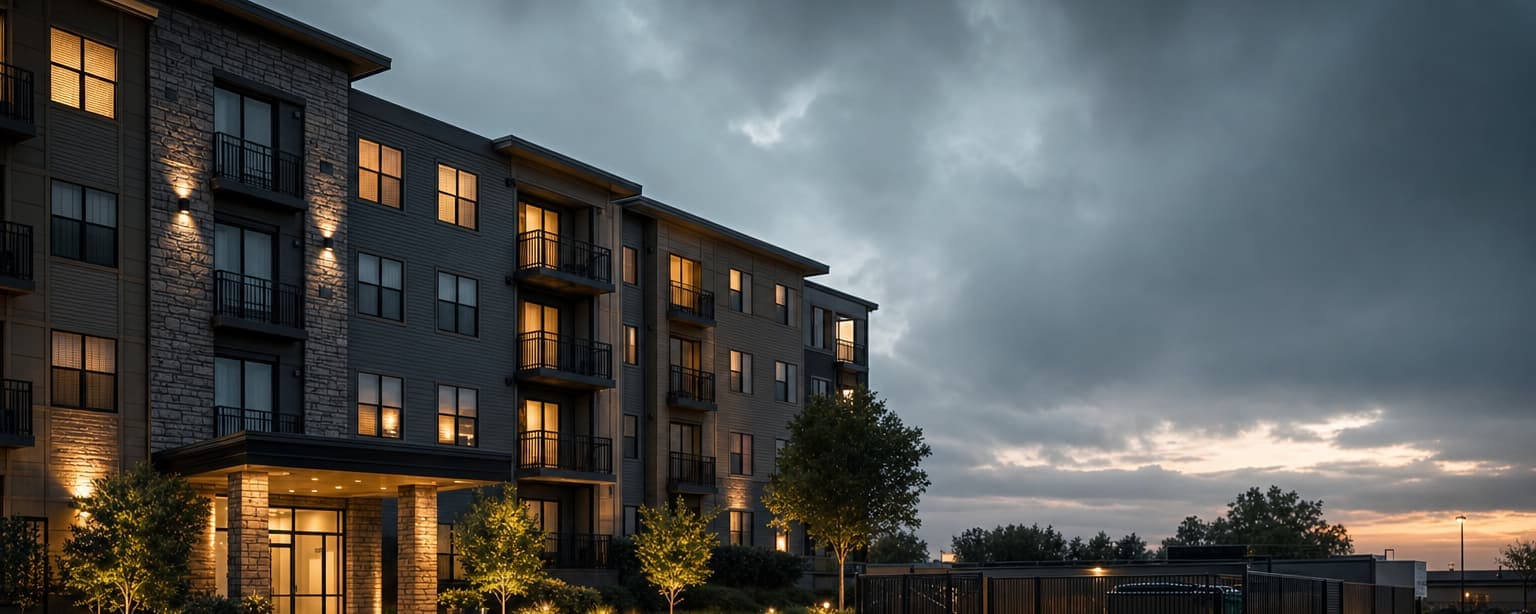
One roof, forty households, and every one of them a potential plaintiff.
We cover apartment and multifamily owners: building, rents, liability across common areas, and the habitability and discrimination exposures that come with being somebody’s landlord.
Tell us the situation.
One licensed human replies the same business day — not five agents, not an auto-responder. If the policy you have is already the right one, we will tell you.
We use this to quote and service your insurance, and we do not sell it or pass it to lead networks. Privacy policy.
Send us what you have. We’ll tell you if it’s right.
Your current policy paperwork, a renewal notice, or nothing at all. A licensed agent reads it and replies the same business day.
What apartment building businesses actually need.
Building and common areas
The structure, common parts, and landlord-owned appliances and fittings.
Without it — Tenant contents are theirs; everything else is yours.
Premises liability
Injury in stairwells, lots, laundries, pools and walkways.
Without it — Common areas produce most apartment claims because that is where everyone is.
Loss of rents
Rental income while units are uninhabitable, across a realistic rebuild.
Without it — A fire in four units stops the income from all of them for a year.
Habitability and discrimination claims
Suits over conditions, mould, notice, deposits, eviction and fair housing.
Without it — The fastest growing claim type against residential landlords, and not a property claim.
Equipment breakdown
Boilers, lifts, HVAC and building systems, plus the resulting damage.
Without it — A burst boiler in winter damages the building and empties it.
Water damage exposure
Escape of water, the most frequent large loss in multifamily by a distance.
Without it — One supply line on a top floor reaches every unit below it.
Businesses like this one, with their own page.
Every one of these is written for that specific operation — the coverages it needs, the questions underwriters ask it, and what it usually gets wrong.
- Student Housing
Student housing is habitational property with a specific tenant: young, transient, often first-time renters, on twelve-month leases that all begin and end in August. The claims are the apartment claims, at higher frequency: water damage from an unattended bath, a balcony overloaded at a party, an assault in a stairwell, a fire from cooking, and the liability that follows alcohol on the premises. Purpose-built student housing adds amenity spaces, shuttle buses and a leasing operation that markets by the bed. The policy is a habitational package with the liability rated for the tenancy and the property rated for the turnover, plus the pieces a campus-adjacent operator needs: assault and battery, liquor where events are hosted, and auto for the shuttle. We place it for individual houses rented by the room through to purpose-built communities.
- Habitational Property
Habitational is the insurance industry's word for buildings people live in that someone else owns: apartment complexes, condominium buildings, rented houses and mixed-use buildings with units upstairs. It has become one of the hardest property classes to place, because water losses in aging buildings, fire, liability for tenants and guests, and weather have pushed many standard carriers out. What is left is a market that asks detailed questions about the building's systems and the owner's management, and rewards good answers. We place habitational accounts from a single rented house to portfolios of buildings, and we start with the plumbing, the roof and the electrical, because the market does.
- Condominium Associations
A condominium association buys insurance on behalf of every owner, and the bylaws and the state condo act say what it has to cover: the building, the common areas, the association's liability, and the board itself. Owners insure the inside of their units and rely on the master policy for the rest, which makes the master policy the most consequential purchase a volunteer board makes. We place master policies, directors and officers coverage and the fidelity bond lenders require, and we read the bylaws first, because the bylaws decide the form.
The owner of an eight-unit apartment building in California was down to the wire. His carrier had tightened its appetite to exclude buildings from the 1970s and older in his zip code, and his was one of them. The renewal was not coming, the lender required continuous coverage, and the deadline was days away.
We placed the building on short notice and reported the new policy to his lender ourselves, so he was never hit with force-placed insurance, the expensive policy a lender buys in your name when it thinks you have none. Appetite changes by age and zip code are routine in California property right now, and they arrive as a non-renewal notice with a date on it. The date is the problem to solve first, and the lender is the second reader of every certificate.
What our apartment building clients ask us.
My carrier is non-renewing older buildings in my zip code. What happens with my lender?
Nothing good if the lender hears about the gap before it hears about the replacement. Most commercial mortgages require continuous coverage with the lender named as mortgagee, and when evidence lapses the servicer buys force-placed insurance in your name, at several times the market price, protecting the lender’s interest and not yours. We placed an eight-unit California building whose carrier had stopped writing 1970s-and-older buildings in its zip code, and sent the evidence of insurance to the lender ourselves, so no force-placed policy was ever issued. Send the non-renewal notice the day it arrives, and tell us who services the loan.
What is the most common large loss in apartments?
Water, not fire, and it is not close. A supply line, a water heater, a failed washing-machine hose or a frozen pipe on an upper floor damages every unit below it, and the claim is the building, the tenants’ belongings, the alternative accommodation and the lost rent at once. It is why insurers ask about the age of supply lines and water heaters, why leak detection earns real credit, and why a policy for a building with a shared laundry looks different from one without.
Do I need employment practices coverage if I have no employees?
Probably yes, for a reason that surprises owners: the third-party extension is the one that matters here. Fair housing, discrimination, harassment and habitability claims from tenants are the growth area for residential landlords, and they are not property claims and not general liability claims. A landlord with no staff can still be sued by an applicant they declined. Ask specifically whether third-party coverage is included, because the employee-facing part alone does not answer this.
Should tenants be required to carry renters insurance?
Yes, in the lease, with evidence and a minimum liability limit, and it is worth enforcing rather than filing. It moves tenant contents and tenant-caused liability off your policy, which keeps your claims record clean. A tenant’s cooking fire recovered from their insurer instead of yours is the difference between one bad year and three years of a loaded renewal.
How does an insurer look at the building itself?
Age and updates, mostly, and they ask about four systems specifically: roof, electrical, plumbing and heating. A 1960s building with a 2020 roof and rewire prices very differently from an identical one with originals. Knob-and-tube and aluminum branch wiring, federal-pacific panels, polybutylene and galvanised supply lines all restrict the market outright. If you have done the work, document it with dates and invoices — undocumented updates are treated as not done.
Commercial insurance is 96% of what we do — it is not a department here, it is the whole business. Not ready to talk? The guides answer the questions this page raises in more depth. Already insured with us and need a certificate or a policy change? Ask the service team rather than starting a quote — it is faster and it goes to the people whose job it is. We also write home and auto, which is usually cheaper alongside the business policy than apart from it.
Handed a lease, a vendor packet or a client contract with insurance requirements? Paste it into the COI Requirements Decoder to see what each one means for your business, or read what the requirements mean.