
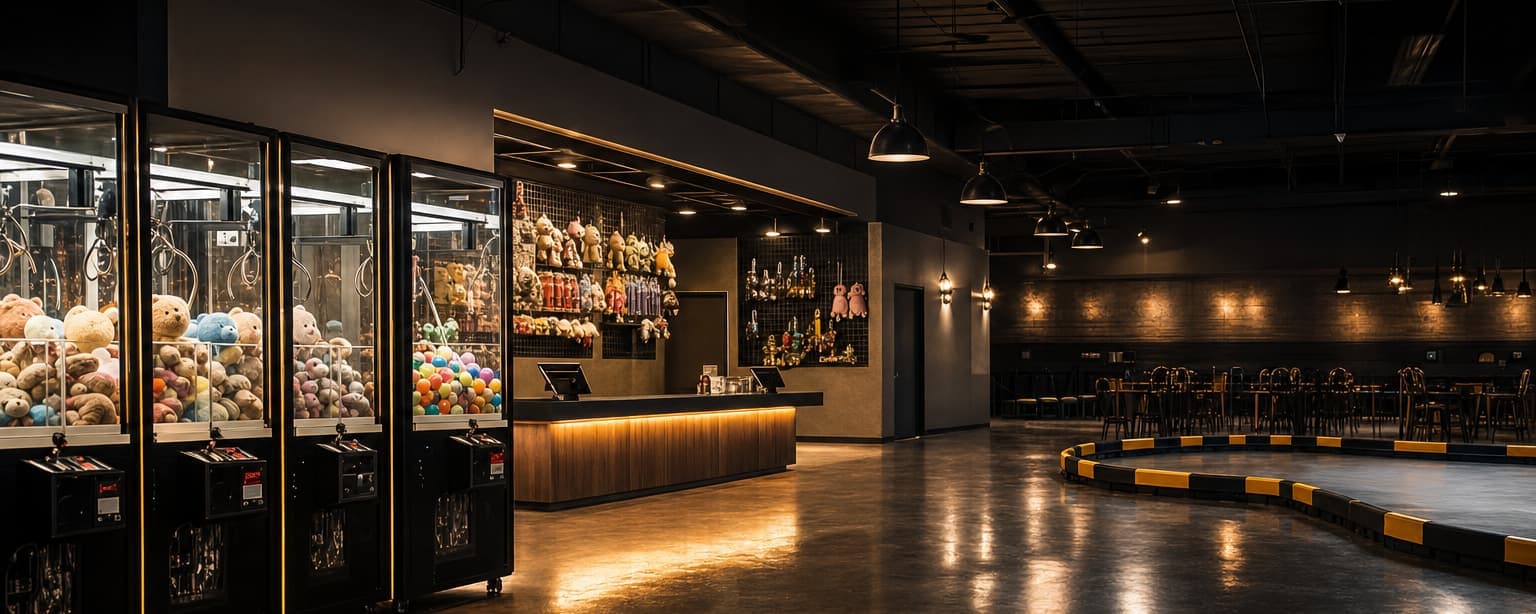
Six attractions under one roof, and each one rates differently.
A family entertainment center is a dozen different risks under one roof. We underwrite go-karts, mini golf, arcade, ropes, climbing, trampolines and laser tag as the separate exposures they actually are.
Tell us the situation.
One licensed human replies the same business day — not five agents, not an auto-responder. If the policy you have is already the right one, we will tell you.
We use this to quote and service your insurance, and we do not sell it or pass it to lead networks. Privacy policy.
Send us what you have. We’ll tell you if it’s right.
Your current policy paperwork, a renewal notice, or nothing at all. A licensed agent reads it and replies the same business day.
What family entertainment center businesses actually need.
General liability
Third-party bodily injury and property damage. It is the line nearly every contract names by default.
Without it — Guests moving between attractions, most of them children, most of them running.
Participant accident
Pays the medical costs of a player, a camper or a rider injured while taking part, without anyone having to establish that the organization was at fault.
Without it — Injuries that happen when everything worked correctly and nobody was at fault.
Commercial property
Buildings and contents, valued at what it costs to rebuild today rather than what you paid.
Without it — The building, the attractions and the fit-out, which is most of the invested capital.
Business income
Replaces the profit and pays the ongoing bills while a covered loss keeps you closed. It is the part of a fire claim that is not the building.
Without it — A closure in the school holidays costs a disproportionate share of the year.
Equipment breakdown & spoilage
Covers the walk-in, the compressor and the line when they fail from the inside. A mechanical or electrical breakdown is excluded by property policies, and the stock that thawed goes with it.
Without it — Karts, compressors, lifts and control systems that stop the attraction when they fail.
Liquor liability
If you serve alcohol, your general liability almost certainly excludes what happens after you serve it.
Without it — Alcohol alongside attractions changes the risk of every one of them.
Umbrella & excess liability
Extra limit stacked above general liability, auto and employers liability. Usually the cheapest million dollars on the policy.
Without it — Leases and franchise agreements specify limits above primary.
Employment practices liability
Wrongful termination, discrimination and harassment claims brought by your own employees. General liability specifically excludes these.
Without it — A young, seasonal, high-turnover workforce is the profile these claims come from.
What the insurance company will ask about your family entertainment center business
We read 1 application the markets use for this kind of business and pulled out what they actually ask. Have these answers ready and a quote takes a day instead of a week, because nobody has to come back to you for the missing piece.
About the business
- How many years have you been operating?
- What is your business structure (corporation, LLC, or other)?
- What is your annual revenue and average number of visitors by attraction type?
- Who are your owners and what is their experience in this business?
How you operate
- What attractions do you have beyond trampolines (such as ninja courses, climbing walls, zip lines, laser tag, inflatables, go-karts, or arcade games)?
- What are your hours and operating season?
- Do you host special events, competitions, or live events?
- Do you allow anyone to jump who is not a paying customer and has not signed a waiver?
- Do you allow overnight stays?
Safety and controls
- Do all attractions and fencing meet ASTM safety standards?
- Which attractions require participants to sign waivers, and do you require parents to sign for minors?
- Who created your waiver and assumption of risk signage, and where are they displayed?
- What formal training do your employees receive and how often?
- How do you prevent double bouncing and unsafe group jumping?
Your history
- What was your prior insurance carrier?
- Has your insurance ever been canceled?
- Have you had any circumstances that may result in a claim against you?
- Have you acquired, sold, or discontinued any operations in the last five years?
Safety and security details
- How many employees are trained in CPR and First Aid, and is at least one present at all times?
- How do you handle injuries and medical emergencies?
- How many surveillance cameras do you have inside and outside, and how long do you keep video?
- Do you have security staff, and if so, are they armed or unarmed?
- Do you own or lease the facility, and what other businesses operate there?
Have these ready
- Current certificates of insurance from your existing insurer
- Your loss runs or claims history from the last five years
- Copies of all waivers and assumption of risk signage (with photos)
- Photographs of your assumption of risk signage showing placement in the facility
- Copies of agreements with any subcontractors, independent contractors, or lessees
You answer what you can; a licensed agent fills the rest with you.
What our family entertainment center clients ask us.
Why does adding one attraction change our whole premium?
Because the rate follows the hardest thing in the building. Adding go-karts, a ropes course or trampolines to an arcade does not add a line item. It can move the account into a different market entirely, since some carriers write amusement and stop at specific attractions. Tell your broker before you install, not at renewal, because the answer occasionally is that the account has to move.
Do waivers protect us?
They help and they are not a substitute. Enforceability varies by state, they are frequently ineffective against a minor’s claim brought by a parent, and they do nothing about a spectator. Underwriters like to see them — a well-drafted waiver, consistently collected, is evidence of a run operation — but they price the activity, not the paperwork.
What do underwriters look at first?
The attraction list, then supervision. Ratios of staff to guests, documented training, inspection logs, height and age rules and how they are enforced, and incident records. A center that can produce daily inspection sheets and a written attraction-by-attraction procedure prices differently from one that cannot, on identical attractions.
What does a family entertainment center insurance application ask for?
The applications for family entertainment center businesses ask about 4 things above all: how many years have you been operating; what attractions do you have beyond trampolines (such as ninja courses, climbing walls, zip lines, laser tag, inflatables, go-karts, or arcade games); do all attractions and fencing meet astm safety standards; what was your prior insurance carrier. Have current certificates of insurance from your existing insurer and your loss runs or claims history from the last five years ready and a quote takes a day instead of a week.
Commercial insurance is 96% of what we do — it is not a department here, it is the whole business. Not ready to talk? The guides answer the questions this page raises in more depth. Already insured with us and need a certificate or a policy change? Ask the service team rather than starting a quote — it is faster and it goes to the people whose job it is. We also write home and auto, which is usually cheaper alongside the business policy than apart from it.
Handed a lease, a vendor packet or a client contract with insurance requirements? Paste it into the COI Requirements Decoder to see what each one means for your business, or read what the requirements mean.