
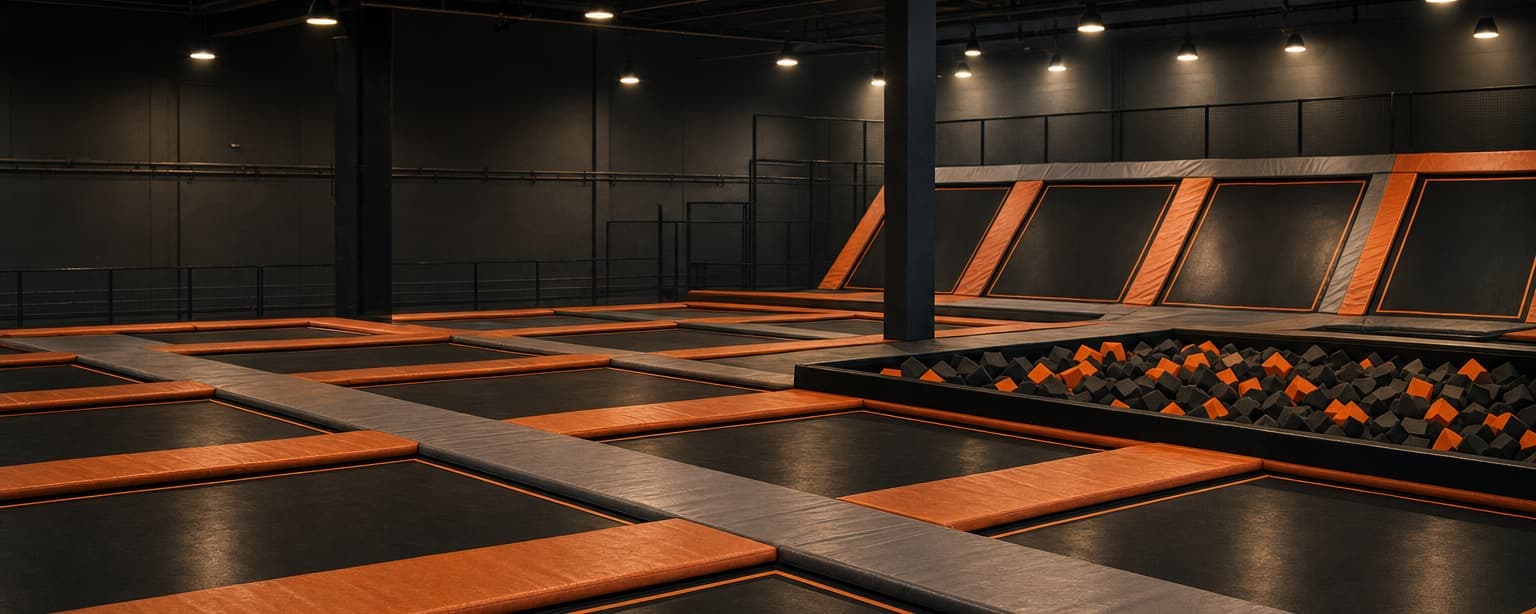
The injuries happen when the equipment works exactly as designed.
The standard market largely abandoned trampoline and adventure parks. We write the class around participant injury rather than premises liability.
Tell us the situation.
One licensed human replies the same business day — not five agents, not an auto-responder. If the policy you have is already the right one, we will tell you.
We use this to quote and service your insurance, and we do not sell it or pass it to lead networks. Privacy policy.
Send us what you have. We’ll tell you if it’s right.
Your current policy paperwork, a renewal notice, or nothing at all. A licensed agent reads it and replies the same business day.
What trampoline park businesses actually need.
Participant accident
Pays the medical costs of a player, a camper or a rider injured while taking part, without anyone having to establish that the organization was at fault.
Without it — A jumper lands badly through nobody’s fault, and this is what pays their medical bills.
General liability
Third-party bodily injury and property damage. It is the line nearly every contract names by default.
Without it — Claims that the park, the layout or the supervision caused the injury.
Commercial property
Buildings and contents, valued at what it costs to rebuild today rather than what you paid.
Without it — The courts, the foam, the structures and the building holding them.
Business income
Replaces the profit and pays the ongoing bills while a covered loss keeps you closed. It is the part of a fire claim that is not the building.
Without it — Closure in a school holiday removes a disproportionate share of annual revenue.
Umbrella & excess liability
Extra limit stacked above general liability, auto and employers liability. Usually the cheapest million dollars on the policy.
Without it — Landlords and franchisors specify limits above primary as a condition of the lease.
Employment practices liability
Wrongful termination, discrimination and harassment claims brought by your own employees. General liability specifically excludes these.
Without it — Young seasonal staff at volume, hired and released quickly.
Workers compensation
Required in almost every state the moment you have employees. Priced on payroll and class code, which is why the class code is worth arguing about.
Without it — Court monitors are on their feet among jumpers all day.
Sexual abuse & molestation
Covers allegations of abuse by staff or volunteers. General liability usually excludes it outright, and any organization working with children, patients or vulnerable adults will be asked to carry it by name.
Without it — Unaccompanied children and parties are part of the business model.
What the insurance company will ask about your trampoline park business
We read 15 applications the markets use for this kind of business and pulled out what they actually ask. Have these answers ready and a quote takes a day instead of a week, because nobody has to come back to you for the missing piece.
About the business
- What is your facility's name and what other names has it been known by?
- How many years have you been operating?
- How many people do you serve annually?
- What is your annual gross revenue?
- How many square feet is your facility?
How you operate
- What is your instructor-to-student ratio during activities?
- Do participants need to meet eligibility requirements to use your facility?
- How long is your season each year?
- Do you serve alcohol at any events?
- Do you have an emergency evacuation plan for events?
Safety and controls
- How is your walkway and parking area lit?
- What first aid equipment and facilities do you have on site?
- How often do you inspect and maintain your equipment?
- Do you use liability waivers with participants?
- Do you have written procedures for handling abuse or misconduct?
Your history
- Have you ever had a claim filed against you?
- Who was your previous insurance company and what did you pay?
- Do you operate more than one location?
Money and people
- What is your annual payroll?
- Do you hire outside security?
- Do you use independent contractors who work with participants?
- If you hire contractors, do you run background checks on them?
Have these ready
- Your loss runs (claims history for the last five years from your current or previous insurance company)
- Your liability waivers if you use them
- Written procedures for handling abuse or misconduct if you have them
- Resumes of your facility manager or managers
You answer what you can; a licensed agent fills the rest with you.
What our trampoline park clients ask us.
Why is this class so hard to insure?
Because the frequency is real and it is nobody’s fault. Trampoline injuries — ankles, knees, occasionally spines — occur at a rate that has nothing to do with negligence, on equipment functioning correctly, and a liability policy is a poor instrument for that. Several carriers entered the class as parks expanded, absorbed the loss experience, and left. What is left underwrites operations closely, which is good news for a well-run park and expensive for one that is not.
What is the single biggest thing we can do about our price?
Court monitoring, documented. Ratio of monitors to jumpers, their training, enforced rules on double-bouncing and flips, separation of ages and sizes, and an incident log that shows the rules are actually applied. Underwriters in this class are pricing supervision more than equipment, because supervision is what changes the injury rate.
Does participant accident coverage reduce our liability claims?
It genuinely does, and that is the commercial argument for it. If an injured jumper’s medical bills are paid promptly without anyone having to establish fault, a large share of what would otherwise become liability claims never becomes one. It is cheaper than the litigation it prevents, and parks that carry it typically show a better liability record for exactly that reason.
What does a trampoline park insurance application ask for?
The applications for trampoline park businesses ask about 4 things above all: what is your facility's name and what other names has it been known by; what is your instructor-to-student ratio during activities; how is your walkway and parking area lit; have you ever had a claim filed against you. Have your loss runs (claims history for the last five years from your current or previous insurance company) and your liability waivers if you use them ready and a quote takes a day instead of a week.
Commercial insurance is 96% of what we do — it is not a department here, it is the whole business. Not ready to talk? The guides answer the questions this page raises in more depth. Already insured with us and need a certificate or a policy change? Ask the service team rather than starting a quote — it is faster and it goes to the people whose job it is. We also write home and auto, which is usually cheaper alongside the business policy than apart from it.
Handed a lease, a vendor packet or a client contract with insurance requirements? Paste it into the COI Requirements Decoder to see what each one means for your business, or read what the requirements mean.