
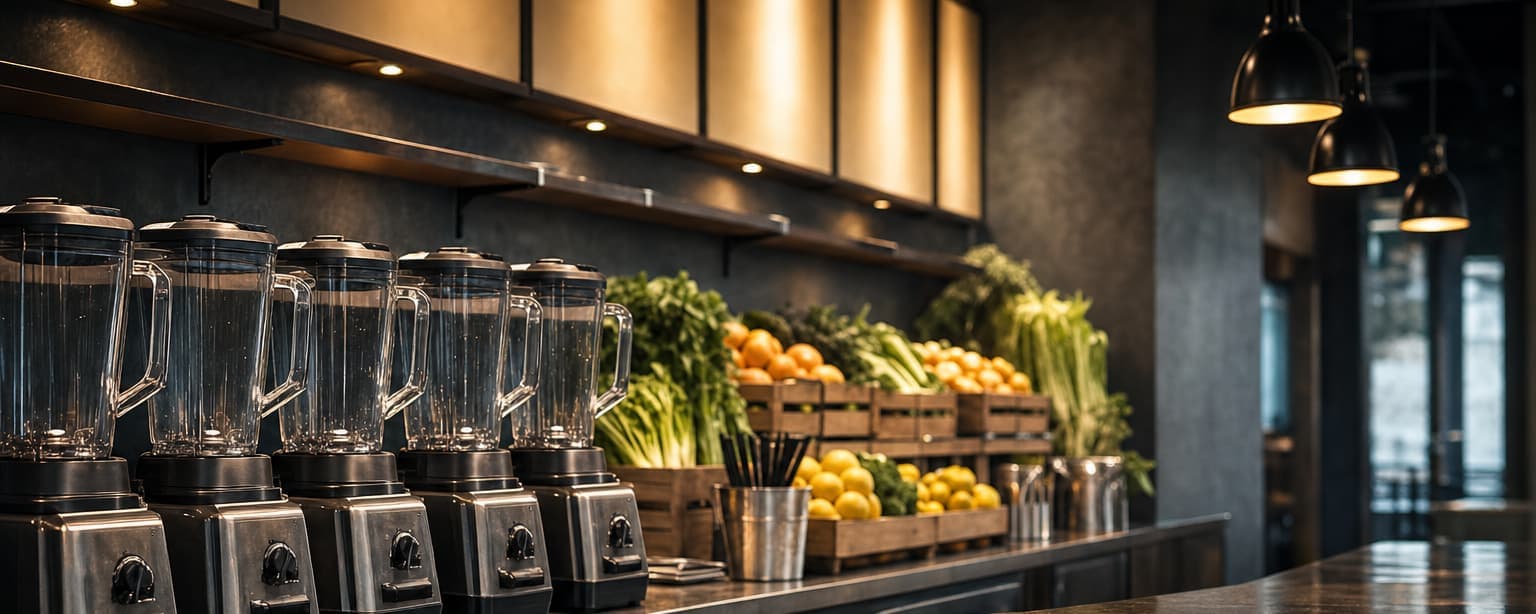
Raw produce, commercial blenders and a franchise agreement that already picked your limits.
We cover juice bars, smoothie shops and açaí bars, franchisees included, where raw unpasteurized product, high-speed equipment and a brand insurance schedule all meet in a small unit.
Tell us the situation.
One licensed human replies the same business day — not five agents, not an auto-responder. If the policy you have is already the right one, we will tell you.
We use this to quote and service your insurance, and we do not sell it or pass it to lead networks. Privacy policy.
Send us what you have. We’ll tell you if it’s right.
Your current policy paperwork, a renewal notice, or nothing at all. A licensed agent reads it and replies the same business day.
What juice bar businesses actually need.
General liability
Customers, the counter and the seating area, and the franchisor named as additional insured where the agreement requires.
Without it — The certificate the landlord and the franchisor both ask for before you open.
Products liability
Illness, allergen and contamination claims from what you served.
Without it — Unpasteurized juice and smoothies are a live product exposure, not an incidental one.
Workers compensation
Blender and press injuries, slips and lifting, across a young and high-turnover crew.
Without it — Required wherever you have staff, and hand injuries here are frequent rather than rare.
Equipment breakdown and spoilage
Blenders, cold presses, coolers and freezers, plus the highly perishable stock inside them.
Without it — Property excludes internal failure, and produce does not survive a night without refrigeration.
Business income
Trade lost while the unit is closed, with rent and franchise fees still running.
Without it — A franchise agreement does not pause its royalty because your cooler died.
Business cyber
The POS, the app orders and the loyalty program that most of these brands run.
Without it — Loyalty balances and stored cards are exactly what an attack is looking for.
Crime and social engineering
Cash and produce shrinkage, and a franchise fee wired on a convincing instruction.
Without it — A franchise fee sent to an account a convincing email supplied is not burglary, and property coverage does not answer it. That loss sits under social engineering, which is a sublimit you request.
Group health and benefits
Staff who can keep the line moving and the equipment sanitary at the same time.
Without it — Turnover is the defining cost in fast casual, and this is the benefit that moves people between two jobs paying the same.
The claims we actually see.
Ordered by how often we see them, not by how dramatic they are. Each one names the coverage that answers it — and the policy people wrongly assume already does.
Most common
A customer becomes ill and blames the product
Covered by Products liability, and product contamination
Raw, unpasteurized juice is the reason this trade rates above a coffee shop. General liability covers the slip; the illness claim runs on the products side.
Most common
A staff injury on a blender, press or cleaning cycle
Covered by Workers compensation
Hand and laceration injuries on commercial blenders and cold-press equipment, in a young, high-turnover workforce.
Common
An allergen or cross-contact incident
Covered by Products liability
Nuts, dairy, soy and protein powders in a small space with shared equipment. The defense is your written procedure, not your memory of it.
Common
A cooler or blender fails and takes the stock with it
Covered by Equipment breakdown, with spoilage
Property excludes failure from an internal cause, and highly perishable stock is gone within hours of a cooler going down.
Common
A customer slips on a wet floor
Covered by General liability
Constant washing-down in a small public space. Ordinary, frequent, and what your lease requires coverage for.
“Kevin and his team have taken excellent care of me, handling the insurance needs for my family and business for about 3 years now.”
What the insurance company will ask about your juice bar business
We read the applications the markets use for businesses in this field and pulled out what they actually ask. Have these answers ready and a quote takes a day instead of a week, because nobody has to come back to you for the missing piece.
About the business
- What type of restaurant are you (quick service, upscale, delivery-only, etc.)?
- How many years have you been in business?
- Are you a sole owner, partnership, LLC, or corporation?
- Do you own any other restaurant businesses?
- Have you previously owned restaurants that are now closed or sold?
How you operate
- Do you make deliveries, and if so to homes, other businesses, or both?
- Who delivers your food - your own employees, drivers using their own cars, third-party delivery services, or some combination?
- What is the minimum age for your drivers?
- How far do you deliver from your location?
- Do you deliver alcohol?
Safety and controls
- Do you have a driver training program in place?
- If employees use their own vehicles for deliveries, how do you verify they have personal auto insurance?
- Do you use GPS, cameras, or other monitoring systems to track and coach your drivers?
- Do you have hold harmless agreements and insurance certificates from any contractors or vendors you work with?
Your history
- What was your total sales last year, and how much of that came from delivery and alcohol?
- Do you currently have delivery insurance, and if so what are your coverage limits and when does it expire?
Money and people
- How many employees do you have at each location?
- Do you own or do your employees use their own vehicles for delivery?
Have these ready
- Your restaurant's current insurance information, including coverage limits, deductible, and when it expires
- List of all your restaurant locations with their addresses
- Information about who delivers for you and what vehicles they use
- Years of restaurant management experience you and your manager have
You answer what you can; a licensed agent fills the rest with you.
What our juice bar clients ask us.
Do you write franchisees, or only independents?
Both, and franchisees are a large part of it. We write Clean Juice locations, and across the wider fast casual space we insure franchisees of the major brands. The work is the same in every case: read the insurance schedule in the franchise agreement and build to exactly what it names, including the limits, the additional insured wording for the franchisor and its affiliates, and the waiver of subrogation. Send us the schedule rather than a summary of it, because franchisors reject certificates on the wording as often as on the number.
Why does raw juice rate differently from coffee?
Because it is not heat-treated. Unpasteurized juice and cold-pressed product carry a genuine microbiological exposure that a brewed drink does not, and underwriters price the products side accordingly. Nothing separates a juice bar from a coffee shop more on an otherwise identical unit. High-pressure processing, if you use it, is worth mentioning: it changes the risk conversation materially. So does whether you make on site or take delivery of finished product, since the second moves part of the exposure to whoever made it.
Do we need product liability if we make everything to order?
Yes, and making to order is not the protection it sounds like. The exposure is not shelf life, it is the produce, the handling and the allergens: an illness claim traces to the ingredient and the process rather than to how long the cup sat. Made-to-order does help with recall exposure, since there is no distributed batch to retrieve, which is a real and worthwhile distinction from a bottled operation. It does not reduce the claim from the customer who drank it.
Should a small unit offer health coverage to staff?
It is worth pricing, and most operators in this trade never have. Fast casual competes for staff on pay and hours against every other unit in the same plaza, and turnover is the cost that does not show up as a line on the P&L: recruiting, training, the mistakes a new person makes, and shifts covered at premium rates while a role sits open. Health coverage is the benefit most likely to decide between two jobs paying the same, and small-group plans cost considerably less than most owners assume. We can quote it alongside the commercial program rather than sending you elsewhere.
What does a juice bar insurance application ask for?
The applications for juice bar businesses ask about 4 things above all: what type of restaurant are you (quick service, upscale, delivery-only, etc.); do you make deliveries, and if so to homes, other businesses, or both; do you have a driver training program in place; what was your total sales last year, and how much of that came from delivery and alcohol. Have your restaurant's current insurance information, including coverage limits, deductible, and when it expires and list of all your restaurant locations with their addresses ready and a quote takes a day instead of a week.
Also in this family
Commercial insurance is 96% of what we do — it is not a department here, it is the whole business. Not ready to talk? The guides answer the questions this page raises in more depth. Already insured with us and need a certificate or a policy change? Ask the service team rather than starting a quote — it is faster and it goes to the people whose job it is. We also write home and auto, which is usually cheaper alongside the business policy than apart from it.
Handed a lease, a vendor packet or a client contract with insurance requirements? Paste it into the COI Requirements Decoder to see what each one means for your business, or read what the requirements mean.