
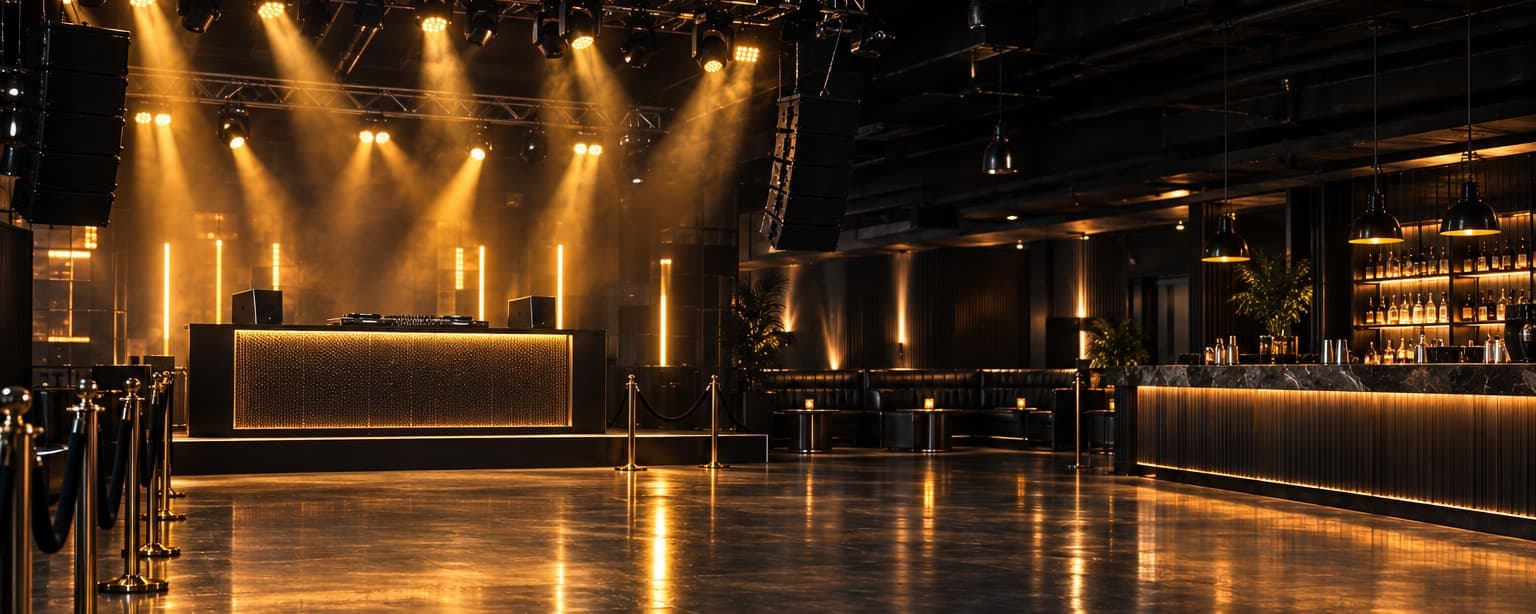
A nightclub is rated on its closing hour, its capacity and its door, in roughly that order.
Late hours, a crowd and a cover charge put a venue at the hard end of the liquor market, where the assault coverage matters more than the price.
Tell us the situation.
One licensed human replies the same business day — not five agents, not an auto-responder. If the policy you have is already the right one, we will tell you.
We use this to quote and service your insurance, and we do not sell it or pass it to lead networks. Privacy policy.
Send us what you have. We’ll tell you if it’s right.
Your current policy paperwork, a renewal notice, or nothing at all. A licensed agent reads it and replies the same business day.
What nightclub businesses actually need.
Assault & battery
A fight in a bar is an intentional act, and general liability excludes intentional acts, so the claim most likely to arrive from a late-night venue is the one most often uninsured.
Without it — A fight is the defining claim of this class, and general liability excludes intentional acts outright.
Liquor liability
If you serve alcohol, your general liability almost certainly excludes what happens after you serve it.
Without it — Serving past midnight is the single strongest predictor a liquor carrier has, and general liability excludes the claim by name.
General liability
Third-party bodily injury and property damage. It is the line nearly every contract names by default.
Without it — A fall in a dense crowd or an injury on the way out is a premises claim and lands on the venue.
Commercial property
Buildings and contents, valued at what it costs to rebuild today rather than what you paid.
Without it — Sound, lighting and bar equipment is the expensive half of a nightclub and replaces at today’s prices.
Business income
Replaces the profit and pays the ongoing bills while a covered loss keeps you closed. It is the part of a fire claim that is not the building.
Without it — A closure order or a fire stops the revenue while the rent, the payroll and the license carry on.
Umbrella & excess liability
Extra limit stacked above general liability, auto and employers liability. Usually the cheapest million dollars on the policy.
Without it — A serious assault or liquor claim runs past a primary limit quickly, and landlords and licensing bodies ask for the excess regardless.
Workers compensation
Required in almost every state the moment you have employees. Priced on payroll and class code, which is why the class code is worth arguing about.
Without it — Door staff, bartenders and stage crew are three different injury profiles under one roof and all of them are uncapped uninsured.
Employment practices liability
Wrongful termination, discrimination and harassment claims brought by your own employees. General liability specifically excludes these.
Without it — Harassment and wrongful termination claims are common in late-night venues and sit entirely outside general liability.
Crime & employee dishonesty
Theft by your own staff, funds transfer fraud, and the dishonesty bond a home care contract will ask you for by name.
Without it — A cash door and a cash bar with seasonal staff is the employee dishonesty exposure, which the property policy excludes.
Equipment breakdown & spoilage
Covers the walk-in, the compressor and the line when they fail from the inside. A mechanical or electrical breakdown is excluded by property policies, and the stock that thawed goes with it.
Without it — Compressors and electrical plant fail from the inside, and the property policy will not respond to it.
Cyber
Breach response, ransomware and the notification costs that follow, plus the card-brand assessments a business that takes payments gets billed for whoever was at fault. The customer database, the mailing list and the loyalty program are the assets at stake, and general liability excludes all of it by name.
Without it — Ticketing and the point of sale hold card data, and the card brands assess the merchant whoever was at fault.
The claims we actually see.
Ordered by how often we see them, not by how dramatic they are. Each one names the coverage that answers it — and the policy people wrongly assume already does.
Most common
A fight on or near the dance floor puts someone in hospital
Covered by Assault and battery
This is the defining claim of the class and the one general liability excludes outright. Where the coverage exists it often carries a lower limit than the policy it sits inside, which nobody reads until the demand arrives.
Common
A guest served late causes harm after leaving
Covered by Liquor liability
A venue serving until two or later is rated at the top of the liquor market, because the hour of the last drink predicts the claim better than any other fact about the room.
Common
Door staff restrain someone and get sued for how they did it
Covered by Assault and battery, and general liability for the premises half
A claim against your own security is brought against you, and it turns on training records and the incident log rather than on what the camera shows.
Less common, severe
A crush or a fall in a crowd at capacity
Covered by General liability
Occupancy limits, exit width and how the room empties are what an underwriter asks about, and a venue that cannot answer from records gets priced for the worst version.
Common
Sound, lighting and DJ equipment is stolen overnight
Covered by Property, and crime where staff were involved
Hired-in equipment for a promoter night is usually not yours and usually not scheduled, so it falls between the venue policy and the promoter who never bought one.

Brian Victores
Commercial Insurance Advisor
Licensed in nearly every state, working contractors and small commercial, writing general liability, workers comp and commercial auto. Runs on the principle that the best insurance experience is a boring one: straight answers, fast quotes, no surprises.
What the insurance company will ask about your nightclub business
We read the applications the markets use for businesses in this field and pulled out what they actually ask. Have these answers ready and a quote takes a day instead of a week, because nobody has to come back to you for the missing piece.
About the business
- What is your business name and address?
- When did you start this business?
- What are your annual receipts?
- Has the business ever filed for bankruptcy?
- Is this a franchise?
How you operate
- What hours are you open, and how late do you stay open?
- Which months of the year are you open?
- What is the square footage of your space?
- Do you own the building or rent it?
- What types of live entertainment do you offer (DJ, band, karaoke, or none)?
Safety and controls
- Do you check IDs at the door?
- Do you have bouncers or security staff?
- Are hot surface warning signs posted?
- Do you serve or allow drinking games?
- Do you offer drink specials after 9 PM?
Your history
- Have you ever had a liquor license suspended or revoked?
- Have you ever been fined or cited for a health code violation?
- Have you ever had any violations from the liquor board?
- Has your liquor liability insurance ever been cancelled or not renewed in the past five years?
Money and people
- How many years have you owned or managed a bar or nightclub?
- Are all employees who serve alcohol certified?
- Is your liquor license currently active?
Have these ready
- Your last three to five years of claims history from your current or recent insurers, called loss runs
- A copy of your active liquor license
- A copy of your active food service permit or license
- Details about any outside inspections or certifications your business has (local, state, federal, or private)
- Information about whether you have a formal safety program in place
You answer what you can; a licensed agent fills the rest with you.
What our nightclub clients ask us.
Why is assault and battery coverage so hard to get?
Because it is the claim carriers lose money on, so they ration it. General liability excludes intentional acts, which means a fight is uncovered unless the coverage is bought back by endorsement. When it is offered it often comes with a sublimit well under the policy limit, a separate deductible, and sometimes a condition that licensed door staff were working. Read the endorsement rather than the certificate. A certificate showing a $1,000,000 general liability limit tells you nothing about what the assault sublimit is.
Do we insure comedy clubs and live music rooms here too?
Yes, and they belong on this page rather than a quiet bar page. A room with a stage, a ticket and an act sells drinks to a crowd that arrives together and stays for a set, which is closer to a nightclub than to a neighborhood tavern in every way an underwriter measures. Comedy clubs in particular are often written as restaurants by an agent who took the food sales at face value, and then the assault sublimit turns out to be $25,000.
What does an underwriter want to see before quoting us?
Last call, stated as a time rather than as "late". Legal occupancy and how you count toward it. Whether door staff are employed or contracted, and whether they are licensed where your state licenses them. Camera coverage of the bar, the door and the floor. Server training certificates with dates on them. A venue that supplies all of it gets terms from more than one market, and that competition is worth more than any negotiation on the first quote.
Does a promoter renting the room need their own policy?
They should have one and you should see it before the night, naming you as an additional insured. What usually happens instead is that the promoter carries nothing, brings in hired sound and lighting, and the venue discovers after the incident that it is the only party with a policy. Make the certificate a condition of the booking. It costs the promoter very little and it is the difference between their claim and yours.
Our closing time is 4am. Is that insurable?
Yes, in a narrower market and at a higher price. A four in the morning close is the top of the liquor rating scale and a handful of carriers will not quote it at all. What moves the number is everything that shows the hour is managed: a last-call procedure, a drink cutoff before close, transport arrangements, and door staff rostered through to the clear-out rather than to closing. New York venues serving until four are placeable and we place them.
What limits do promoters, landlords and festivals ask a nightclub for?
Usually $1,000,000 per occurrence and $2,000,000 aggregate for general liability and liquor liability, with the landlord or promoter as an additional insured, and an umbrella for larger rooms. The number that decides a nightclub claim is the assault and battery sublimit, which many policies cap at $50,000 or $100,000. If a contract names an assault and battery limit, send it with the submission, because only some markets will write it at the full figure.
Do you insure hookah lounges?
Yes, and expect fewer markets and higher minimums than a bar of the same size, because the coals add a fire exposure to the liquor and late-night exposure. On our calls in 2026 one underwriter would quote a new hookah lounge only as a combined general liability and liquor package at a $20,000 minimum, a second came in at $12,500, and a market that had written the class at $7,500 the year before had repriced it. Send the hours, the alcohol share of sales and how the coals are handled with the first submission.
What does a nightclub insurance application ask for?
The applications for nightclub businesses ask about 4 things above all: what is your business name and address; what hours are you open, and how late do you stay open; do you check ids at the door; have you ever had a liquor license suspended or revoked. Have your last three to five years of claims history from your current or recent insurers, called loss runs and a copy of your active liquor license ready and a quote takes a day instead of a week.
Guides on nightclub.
- Hookah Lounge InsuranceHookah lounges are written mainly in the surplus lines market. The coal and indoor smoking questions decide whether a carrier quotes, and the alcohol share decides what it charges.
- General liability without liquor liabilityGeneral liability excludes alcohol claims for any business that sells or serves drinks. What the exclusion says, what a BYOB room and a license held by someone else change, and why liquor is usually cheapest bought with the general liability rather than after it.
- Does a liquor license require liquor liability insurance?Thirteen states condition an on-premises liquor license on liquor liability or dram shop financial responsibility. Each state’s minimum, read on its legislature’s site, and why a state that requires nothing still leaves most bars buying it.
- Lease Requires $2M or $3M Liquor LiabilityA lease that names a liquor limit above $1,000,000 is usually met with a liquor policy plus an umbrella that genuinely sits over it. The umbrella wording decides whether it works, and the lease wording decides how much you need.
- Why Restaurant Insurance Went Up at RenewalA restaurant or bar renewal rises with sales, alcohol sales, property values and the surplus lines market, with or without claims. Which one moved decides whether shopping helps.
- Who Insures Hard-to-Place BarsA bar that standard carriers decline goes to the surplus lines market through a licensed agent and a wholesaler. Here is how that market works, and the submission that gets a quote.
Commercial insurance is 96% of what we do — it is not a department here, it is the whole business. Not ready to talk? The guides answer the questions this page raises in more depth. Already insured with us and need a certificate or a policy change? Ask the service team rather than starting a quote — it is faster and it goes to the people whose job it is. We also write home and auto, which is usually cheaper alongside the business policy than apart from it.
Handed a lease, a vendor packet or a client contract with insurance requirements? Paste it into the COI Requirements Decoder to see what each one means for your business, or read what the requirements mean.