
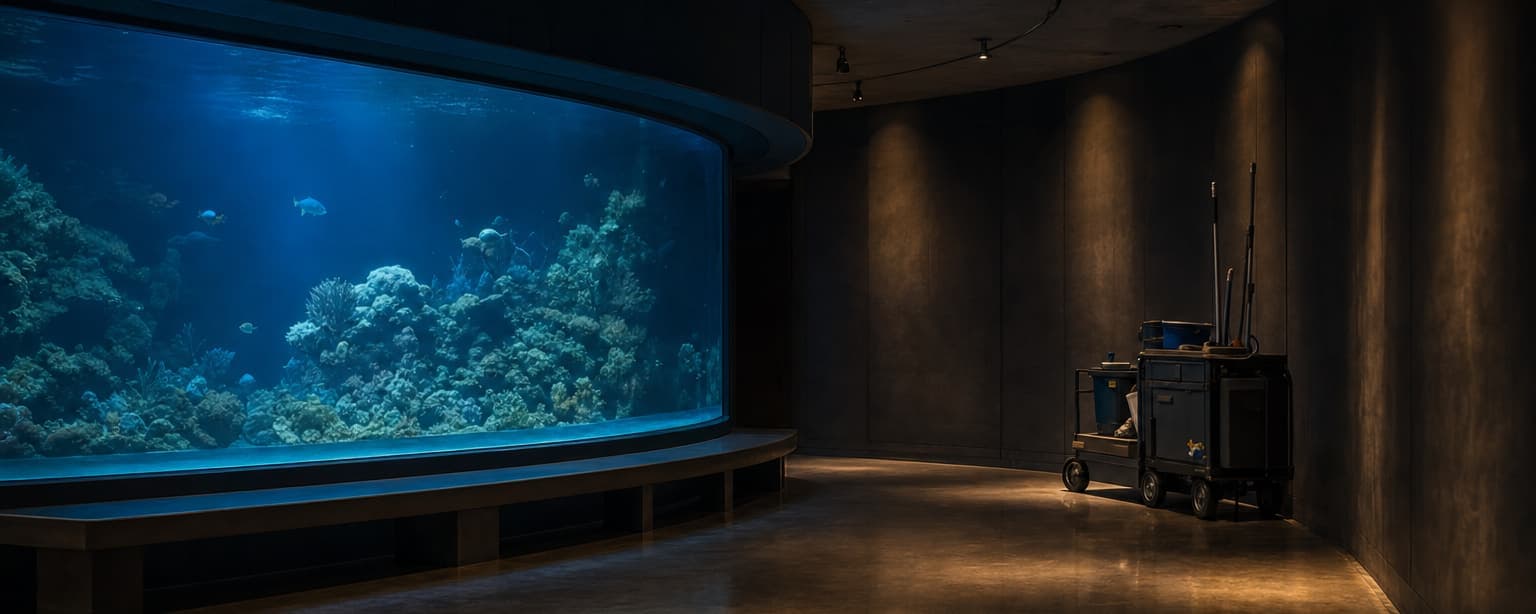
An animal is property and exhibit at once, and it can still injure a guest.
We insure zoos, aquariums and wildlife attractions, where animal mortality and keeper injury sit alongside public contact and life support that cannot go down.
Tell us the situation.
One licensed human replies the same business day — not five agents, not an auto-responder. If the policy you have is already the right one, we will tell you.
We use this to quote and service your insurance, and we do not sell it or pass it to lead networks. Privacy policy.
Send us what you have. We’ll tell you if it’s right.
Your current policy paperwork, a renewal notice, or nothing at all. A licensed agent reads it and replies the same business day.
What zoo and aquarium businesses actually need.
Animal mortality & injury
Death, illness or injury to animals working on a production, and the extra expense of shooting around one that cannot perform. Excluded by name on a standard production form alongside stunts and pyrotechnics, and scheduled the same way.
Without it — Collection animals are valuable property and are not replaceable in any ordinary sense.
General liability
Third-party bodily injury and property damage. It is the line nearly every contract names by default.
Without it — Public access to animals, including deliberate contact experiences.
Equipment breakdown & spoilage
Covers the walk-in, the compressor and the line when they fail from the inside. A mechanical or electrical breakdown is excluded by property policies, and the stock that thawed goes with it.
Without it — Life support, filtration and climate control failing is an animal welfare emergency within hours.
Commercial property
Buildings and contents, valued at what it costs to rebuild today rather than what you paid.
Without it — Enclosures, habitats, tanks and the plant that keeps them alive.
Workers compensation
Required in almost every state the moment you have employees. Priced on payroll and class code, which is why the class code is worth arguing about.
Without it — Keepers work with animals that can injure them, which is a severity exposure.
Business income
Replaces the profit and pays the ongoing bills while a covered loss keeps you closed. It is the part of a fire claim that is not the building.
Without it — A closure still costs full care for the collection with no admissions.
Participant accident
Pays the medical costs of a player, a camper or a rider injured while taking part, without anyone having to establish that the organization was at fault.
Without it — Encounters, feeds and behind-the-scenes experiences put guests in contact.
Umbrella & excess liability
Extra limit stacked above general liability, auto and employers liability. Usually the cheapest million dollars on the policy.
Without it — An animal-related injury to a member of the public reaches numbers primary limits do not.
What the insurance company will ask about your zoo and aquarium business
We read 1 application the markets use for this kind of business and pulled out what they actually ask. Have these answers ready and a quote takes a day instead of a week, because nobody has to come back to you for the missing piece.
About the business
- Do you have more than 1,000 members?
- Do you operate a food service or gift shop for visitors?
How you operate
- Do you conduct boat tours or operate an aquarium?
- Do you operate as a wildlife habitat?
- Do you permit camping or hunting on your grounds?
Safety and controls
- Do you have written policies for storing chemicals, herbicides, and pesticides safely?
- Have you ever been cited for violating EPA standards?
Your history
- Do you get involved with natural disaster restoration, construction, land renovation, water or soil testing, or logging and mining operations?
- Do you have research laboratory operations or sell products developed from research?
Have these ready
- Last year's receipts from your food service and gift shop, if you have them
You answer what you can; a licensed agent fills the rest with you.
What our zoo and aquarium clients ask us.
How is animal mortality actually underwritten?
By collection, with values agreed rather than assessed after a loss, and with veterinary care standards forming much of the underwriting. Coverage distinguishes mortality from theft and from loss of use, and the definition of covered causes matters: illness, injury, escape and humane destruction are separate questions. Rare and breeding animals are frequently scheduled individually rather than blanketed.
Does public contact change the account?
It is the single largest factor after the species list. Petting areas, feeding experiences, walk-through aviaries and behind-the-scenes encounters put guests within reach of animals, and each is underwritten specifically. Barrier design, supervision ratios, hand-washing provision and signage are all real controls with real effect on price, and the rise of paid encounters has moved a lot of attractions into a harder tier than they were in ten years ago.
What about life support failure?
It is the exposure aquariums lose sleep over and the one most often underinsured. A filtration or chiller failure can kill a collection in hours, and the loss is both the animals and the closure that follows. Equipment breakdown coverage needs to be written knowing that, with the redundancy, alarms and back-up power documented: the difference between a system with monitored alarms and one without is the difference between an incident and a catastrophe.
What does a zoo and aquarium insurance application ask for?
The applications for zoo and aquarium businesses ask about 4 things above all: do you have more than 1,000 members; do you conduct boat tours or operate an aquarium; do you have written policies for storing chemicals, herbicides, and pesticides safely; do you get involved with natural disaster restoration, construction, land renovation, water or soil testing, or logging and mining operations. Have last year's receipts from your food service and gift shop, if you have them ready and a quote takes a day instead of a week.
Commercial insurance is 96% of what we do — it is not a department here, it is the whole business. Not ready to talk? The guides answer the questions this page raises in more depth. Already insured with us and need a certificate or a policy change? Ask the service team rather than starting a quote — it is faster and it goes to the people whose job it is. We also write home and auto, which is usually cheaper alongside the business policy than apart from it.
Handed a lease, a vendor packet or a client contract with insurance requirements? Paste it into the COI Requirements Decoder to see what each one means for your business, or read what the requirements mean.