
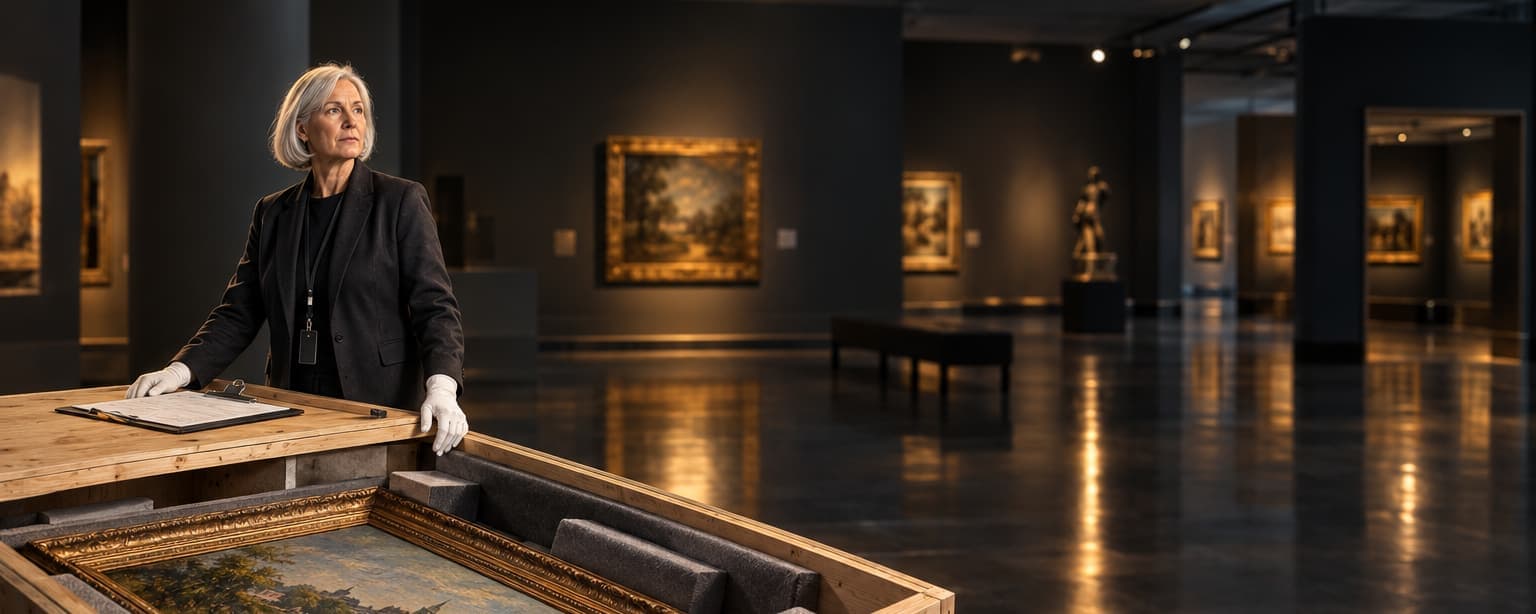
The lender’s loan agreement sets your insurance before the crate arrives.
We insure museums, historical societies and cultural institutions, including the borrowed objects on your walls, the historic building around them and the board that decides what stays in the collection.
Tell us the situation.
One licensed human replies the same business day — not five agents, not an auto-responder. If the policy you have is already the right one, we will tell you.
We use this to quote and service your insurance, and we do not sell it or pass it to lead networks. Privacy policy.
Send us what you have. We’ll tell you if it’s right.
Your current policy paperwork, a renewal notice, or nothing at all. A licensed agent reads it and replies the same business day.
What a museum actually needs.
Fine art and collections
Your permanent collection and objects on loan to you, on the wall, in storage and in transit, written on a fine arts form with values agreed in advance.
Without it — A commercial property policy usually treats a collection as contents at cost, or excludes it, and a lender will not accept that wording.
Commercial property
The building, galleries, storage and equipment, at replacement cost, including anything bought or improved with a federal grant.
Without it — 2 CFR 200.310 requires grant-funded property to be insured like your own, and an uninsured loss cannot be charged back to the award.
Ordinance or law
The extra cost of rebuilding a historic or older building to current code after a loss, including demolition of the undamaged part.
Without it — A replacement cost policy pays to rebuild what stood. Code upgrades in an old building can add a large share on top.
General liability
Visitor injuries, school groups, tours and the public areas of the building, with volunteers and docents named as insureds.
Without it — The federal Volunteer Protection Act protects the volunteer in some cases, not the museum, which is named in the suit regardless.
Nonprofit directors and officers
Claims against the board and officers over decisions: a disputed deaccession, a donor’s restricted gift, a dismissed director.
Without it — Trustees’ personal assets answer for defense costs, and a deaccession fight can run for years before any finding.
Event liability
Galas, openings and facility rentals, plus a requirement that renters bring their own liability policy naming the museum.
Without it — A wedding guest injured on your terrace becomes your claim when the renter has no policy of its own.
Crime
Theft of money or objects by an employee or volunteer, and funds taken by impersonation or a faked invoice.
Without it — Most property and fine arts forms exclude theft by your own people, which is the theft collections lose most often.
Business income
Lost admissions, rental income and event revenue while a damaged building or gallery is closed.
Without it — Fixed costs keep running through a closure, and grant funders rarely pay for lost earned revenue.
What the regulators actually wrote down.
Under the federal Arts and Artifacts Indemnity Act, an object counts as on exhibition from the day it leaves the lender’s premises until the day it is returned there, which is the wall to wall period lenders expect covered.
20 U.S.C. 972(b)(2) · checked 2026-10-04
A single federal indemnity agreement covers no more than $1,800,000,000 of loss for an international exhibition, or $1,000,000,000 for a domestic exhibition.
20 U.S.C. 974(c) · checked 2026-10-04
Federal indemnity carries a deductible on a sliding scale, starting at the first $15,000 of loss for an exhibition valued at $2,000,000 or less and rising to $500,000 for one valued at $500,000,000 or more.
20 U.S.C. 974(d) · checked 2026-10-04
Indemnity agreements are made by the Federal Council on the Arts and the Humanities, and any person, nonprofit agency, institution or government may apply by describing each object, its estimated value, and the plans for exhibiting and transporting it.
20 U.S.C. 971 and 973 · checked 2026-10-04
The American Alliance of Museums groups its Core Standards into seven categories, one of which is Facilities and Risk Management.
American Alliance of Museums, Core Standards for Museums · checked 2026-10-04
AAM’s Facilities and Risk Management standards expect a museum to show that appropriate methods are employed to avoid, block, mitigate, share and assume or insure against risk, and they name no dollar limit.
American Alliance of Museums, Facilities and Risk Management Standards · checked 2026-10-04
AAM’s Collections Stewardship standards expect documented care policies and procedures for collections on exhibition, in storage, on loan and during travel.
American Alliance of Museums, Collections Stewardship Standards · checked 2026-10-04
The Institute of Museum and Library Services adopts the federal Uniform Guidance in 2 CFR part 200, so its grant recipients follow that part’s insurance rules.
2 CFR 3187.1 · checked 2026-10-04
A federal grant recipient must insure real property and equipment bought or improved with federal funds at least as well as it insures its own property.
2 CFR 200.310 · checked 2026-10-04
Losses that permissible insurance could have covered cannot be charged to a federal award unless the award expressly allows it.
2 CFR 200.447(c) · checked 2026-10-04
The claims we actually see.
Ordered by how often we see them, not by how dramatic they are. Each one names the coverage that answers it — and the policy people wrongly assume already does.
Most common
A visitor trips on a gallery step or an outdoor path
Covered by General liability
Historic buildings carry uneven floors and narrow stairs that cannot always be changed, and underwriters ask how they are marked.
Common
A borrowed object is damaged in transit or during installation
Covered by Fine arts coverage on an inland marine form
If the policy does not cover the object from the lender’s door back to the lender’s door, the loan agreement makes the gap yours.
Less common, severe
A water leak or fire damages the building and the collection
Covered by Commercial property, fine arts and business income
Building, collection and lost revenue sit on three different coverage parts, and code upgrades on an old building need ordinance or law.
Less common, severe
A donor or member sues the board over a deaccession
Covered by Nonprofit directors and officers
Some D&O forms exclude claims about restricted gifts or property, so the wording matters more than the limit.
What the insurance company will ask about your museum business
We read the applications the markets use for businesses in this field and pulled out what they actually ask. Have these answers ready and a quote takes a day instead of a week, because nobody has to come back to you for the missing piece.
About the business
- Do you have more than 1,000 members?
- Do you operate a food service or gift shop for visitors?
How you operate
- Do you conduct boat tours or operate an aquarium?
- Do you operate as a wildlife habitat?
- Do you permit camping or hunting on your grounds?
Safety and controls
- Do you have written policies for storing chemicals, herbicides, and pesticides safely?
- Have you ever been cited for violating EPA standards?
Your history
- Do you get involved with natural disaster restoration, construction, land renovation, water or soil testing, or logging and mining operations?
- Do you have research laboratory operations or sell products developed from research?
Have these ready
- Last year's receipts from your food service and gift shop, if you have them
You answer what you can; a licensed agent fills the rest with you.
What our museum clients ask us.
A lender wants wall to wall coverage on a loan. What does that mean?
It means the object is covered from the moment it leaves the lender’s premises until it is back on them, including packing, transit, installation and the return trip. The federal indemnity statute defines its own coverage period the same way. Most loan agreements also name the value, who is insured, and whether the lender must be named as loss payee. Send us the agreement before you sign it, and we will match the fine arts policy to its wording rather than to a standard form.
Can the federal Arts and Artifacts Indemnity Program replace our insurance?
No, it sits beside your insurance and does not replace it. The federal indemnity covers eligible objects in a qualifying exhibition, up to $1 billion for a domestic exhibition and $1.8 billion for an international one, but it carries a deductible starting at $15,000 and rising with the exhibition’s value. That deductible, the objects outside the agreement, and everything else in the building still need commercial coverage. Ask the program office about current thresholds and deadlines, since those sit in its guidelines rather than in the statute.
Does AAM accreditation require a specific amount of insurance?
No, the AAM standards we read set no dollar figure. They expect a museum to identify its risks and to use appropriate methods to avoid, mitigate, share or insure against them, and to document how collections are cared for on loan and in travel. In practice, the accreditation review looks for a reasoned program: the right coverages, values that match the collection, and an emergency plan. We can document how your policies line up with those expectations.
Our IMLS grant paid for new climate control. Does that change our insurance?
Yes, it can. IMLS adopts the federal Uniform Guidance, and 2 CFR 200.310 requires equipment bought or improved with federal funds to be insured at least as well as your own property. A separate rule, 2 CFR 200.447, says a loss that insurance could have covered cannot be charged to the award. So an uninsured HVAC failure lands on your budget, not the grant’s. Tell us what the grant funded and we will confirm it is on the schedule at the right value.
We rent the building for weddings and events. What should we require from renters?
Require each renter to carry its own general liability policy that names the museum as an additional insured, and get the certificate before the event date. Where alcohol is served, ask for liquor liability too. Your own policy should still cover the museum for events it hosts. A short rental agreement with an indemnity clause and a certificate requirement does most of the work, and we can review the wording you use now.
Our museum is in a historic building. What changes?
The rebuilding cost changes most. A historic or older building may need code upgrades, specialist trades and matching materials after a loss, and a standard replacement cost policy pays only to rebuild what stood. Ordinance or law coverage pays the code-driven extra cost, including demolishing the undamaged part when the law requires it. Underwriters will also ask about wiring, sprinklers, the roof and who maintains them, so having that list ready speeds the quote.
Are our docents and volunteers covered?
They can be, if the policy lists volunteers as insureds, and that wording is worth checking. The federal Volunteer Protection Act shields a volunteer from liability in some circumstances, but it states plainly that it does not change the liability of the nonprofit itself. So the museum is still named when a docent’s tour ends in an injury. Volunteer accident coverage can also pay medical bills if a volunteer is hurt, without a lawsuit.
What is the price based on?
Each part is priced on its own basis. Liability is rated mostly on attendance or revenue and the activities you run. Property is rated on the building’s replacement value, construction and protection. Fine arts coverage is rated on the collection’s value, how it is stored and secured, and how often objects travel. Loss runs, a report from each prior insurer listing every claim, also move the price, as do sprinklers, alarms and a written emergency plan.
Who writes museum insurance, and can we go to them directly?
Philadelphia Insurance Companies — PHLY, part of Tokio Marine, rated A++ by AM Best — is the carrier that has told us in writing it wants museums and cultural institutions, and it is where we send these submissions first. PHLY does not sell to organizations directly: it works only through appointed agents, and we hold that appointment, so your file reaches their underwriter with our name on it rather than through a second intermediary. What their underwriter wants to see is specific and we assemble it before anything is sent — their supplemental application for your class, the standard applications, three years of valued loss runs (a report from each prior insurer showing every claim and its reserve), photographs of the premises, and your brochure or website. Payment plans are available once the annual price reaches $2,000. None of that is a promise to bind — every quote is subject to their underwriting review — but a complete file is the difference between a quote and a list of questions.
What does a museum insurance application ask for?
The applications for museum businesses ask about 4 things above all: do you have more than 1,000 members; do you conduct boat tours or operate an aquarium; do you have written policies for storing chemicals, herbicides, and pesticides safely; do you get involved with natural disaster restoration, construction, land renovation, water or soil testing, or logging and mining operations. Have last year's receipts from your food service and gift shop, if you have them ready and a quote takes a day instead of a week.
Commercial insurance is 96% of what we do — it is not a department here, it is the whole business. Not ready to talk? The guides answer the questions this page raises in more depth. Already insured with us and need a certificate or a policy change? Ask the service team rather than starting a quote — it is faster and it goes to the people whose job it is. We also write home and auto, which is usually cheaper alongside the business policy than apart from it.
Handed a lease, a vendor packet or a client contract with insurance requirements? Paste it into the COI Requirements Decoder to see what each one means for your business, or read what the requirements mean.