
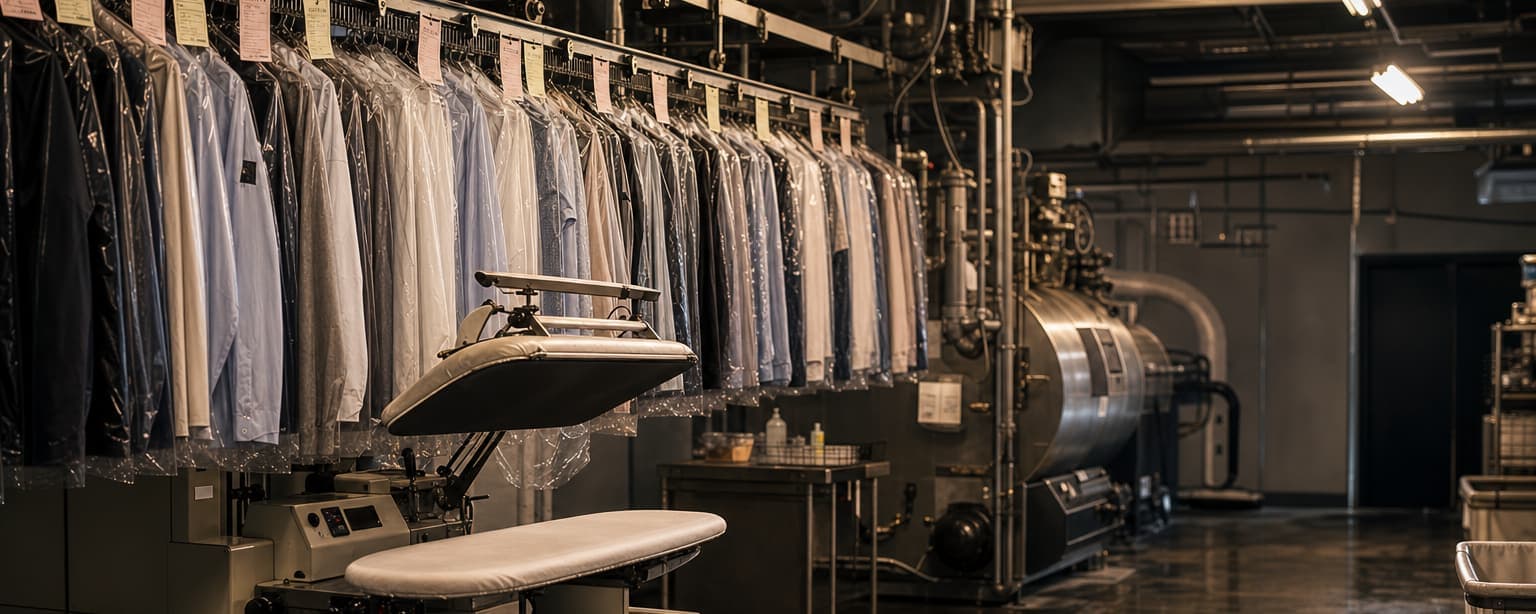
A small chemical plant that happens to have a shop counter.
Solvent and pollution liability can outlive the business itself. We cover that, the boilers and presses, and the rail of other people’s clothes your property policy does not.
Tell us the situation.
One licensed human replies the same business day — not five agents, not an auto-responder. If the policy you have is already the right one, we will tell you.
We use this to quote and service your insurance, and we do not sell it or pass it to lead networks. Privacy policy.
Send us what you have. We’ll tell you if it’s right.
Your current policy paperwork, a renewal notice, or nothing at all. A licensed agent reads it and replies the same business day.
What dry cleaner businesses actually need.
Pollution and environmental liability
Solvent contamination of soil, groundwater, the building and neighboring properties, plus clean-up.
Without it — Excluded from property and general liability alike, and the largest liability in the sector by a wide margin.
Customers’ goods (bailee)
Garments in your care at every stage: on the rail, in process, out for finishing, awaiting collection.
Without it — A fire destroys hundreds of customers’ wardrobes at once, and none of them are your property.
Equipment breakdown
Boilers, presses, dry cleaning machines and air systems, including the income lost while down.
Without it — Property excludes failure from an internal cause, which is how this equipment actually fails.
Workers compensation
Steam burns, press injuries, lifting, and long-term chemical exposure.
Without it — Heavy machinery and hot processes in a small space is a heavier comp class than the storefront suggests.
General liability and property
The counter, the customers, the premises and the fit-out.
Without it — Every lease requires it, and it will not answer a solvent claim or a lost garment.
Business income
Trade lost while the plant is out, including during an environmental investigation.
Without it — An environmental investigation closes a site for far longer than a fire does.
Crime and social engineering
Customer garments and cash going missing, and a solvent supplier invoice redirected by email.
Without it — Paying a solvent supplier whose bank details changed by email is not burglary, and property coverage does not answer it. Social engineering is a separate sublimit and it is easy to leave off.
Group health and benefits
Pressers and spotters, whose skill is the whole product.
Without it — Spotting is years of experience and cannot be hired quickly. Losing a spotter shows up as damaged-garment claims within weeks.
The claims we actually see.
Ordered by how often we see them, not by how dramatic they are. Each one names the coverage that answers it — and the policy people wrongly assume already does.
Most common
A garment is damaged, discoloured or lost
Covered by Bailee / customers’ goods
Your property policy covers what you own, and the clothes on the rail are not yours. Check how the form values a garment. Replacement cost and depreciated value settle very differently.
Common
A press, boiler or machine injures an employee
Covered by Workers compensation
Steam burns and crush injuries from presses are the characteristic claims, and both are severe rather than trivial. They move the experience modifier for three years.
Common
The boiler or press fails from the inside
Covered by Equipment breakdown
Property excludes internal failure, which is exactly how boilers and presses fail. Without the boiler there is no business that day.
Rare, catastrophic
Solvent contamination is found in the soil or groundwater
Covered by Pollution liability
Excluded by both property and general liability. Contamination usually predates the current owner, and the clean-up obligation can exceed what the business is worth.
Less common, severe
A customer or employee reacts to chemical exposure
Covered by Pollution liability and workers comp
General liability carries a pollution exclusion broad enough to catch solvent fumes, which is not what most owners expect it to mean.
What our dry cleaner clients ask us.
What is the solvent problem, exactly?
Perchloroethylene and similar solvents are a serious and long-lived environmental liability, and contamination very frequently predates the current owner. Pollution is excluded from both property and general liability, so it needs its own coverage, and buying a dry cleaning business without an environmental site assessment can mean inheriting a clean-up obligation worth more than the business.
Does general liability cover chemical exposure?
Generally not. The pollution exclusion on a standard general liability form is drafted broadly enough to catch solvent vapor and chemical release, not just a tanker spilling into a river, which is not what most owners take it to mean. That leaves exposure claims by customers, neighbors and passers-by sitting outside the policy people assume covers everything, and employee exposure over to workers compensation. If a market offers you a limited pollution buy-back on the liability policy, read what it actually grants; on this class it is often narrow.
How should I set the bailee limit?
Against your peak holding, not an average, and remember the peak is not on the shop floor. Count what is on the rail awaiting collection, what is in process, and anything out at a third party for specialist finishing: a fire or a flood takes all of it at once.
We have a drop store with no plant. Is that different?
Substantially, and it is worth telling us. A drop store that collects garments and sends them to a plant elsewhere has no solvent exposure, no boiler and no heavy machinery, so the pollution and equipment questions largely fall away, and it prices much closer to ordinary retail. What it still has, in full, is the bailee exposure: you are responsible for the garments from the moment they cross your counter, including while they are in transit and at the plant. Make sure the bailee limit reflects everything you are responsible for rather than everything on your own premises.
Commercial insurance is 96% of what we do — it is not a department here, it is the whole business. Not ready to talk? The guides answer the questions this page raises in more depth. Already insured with us and need a certificate or a policy change? Ask the service team rather than starting a quote — it is faster and it goes to the people whose job it is. We also write home and auto, which is usually cheaper alongside the business policy than apart from it.
Handed a lease, a vendor packet or a client contract with insurance requirements? Paste it into the COI Requirements Decoder to see what each one means for your business, or read what the requirements mean.