
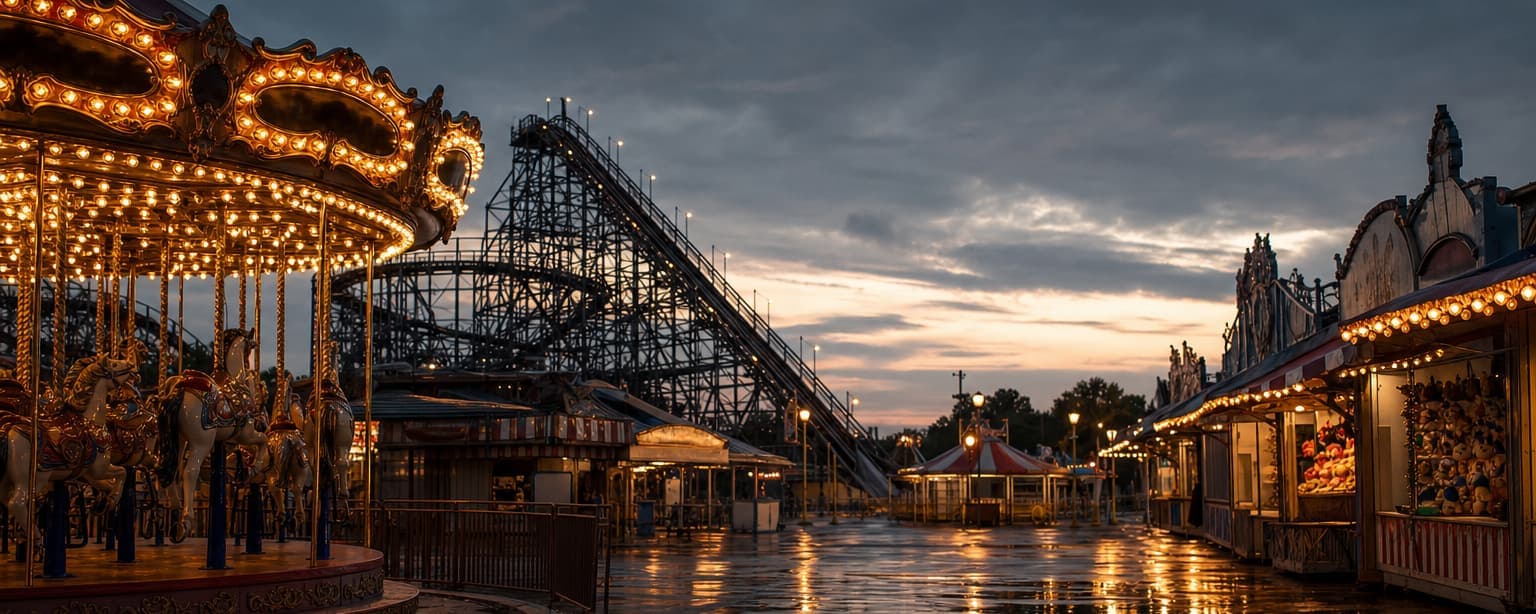
A state inspector can close a ride on any day you are open.
Ride liability and the catastrophic exposure behind it keep most of the standard market out of amusement, theme and adventure parks. We write them.
Tell us the situation.
One licensed human replies the same business day — not five agents, not an auto-responder. If the policy you have is already the right one, we will tell you.
We use this to quote and service your insurance, and we do not sell it or pass it to lead networks. Privacy policy.
Send us what you have. We’ll tell you if it’s right.
Your current policy paperwork, a renewal notice, or nothing at all. A licensed agent reads it and replies the same business day.
What amusement park businesses actually need.
General liability
Third-party bodily injury and property damage. It is the line nearly every contract names by default.
Without it — Every guest on the site, on and off the rides.
Participant accident
Pays the medical costs of a player, a camper or a rider injured while taking part, without anyone having to establish that the organization was at fault.
Without it — Injuries on functioning attractions, without requiring a negligence finding.
Commercial property
Buildings and contents, valued at what it costs to rebuild today rather than what you paid.
Without it — Rides are the capital of the business and are outdoors in all weather.
Equipment breakdown & spoilage
Covers the walk-in, the compressor and the line when they fail from the inside. A mechanical or electrical breakdown is excluded by property policies, and the stock that thawed goes with it.
Without it — A ride out of service is closed revenue and a repair with a long lead time.
Business income
Replaces the profit and pays the ongoing bills while a covered loss keeps you closed. It is the part of a fire claim that is not the building.
Without it — Weather, a closure or an incident removes days that cannot be recovered in a season.
Umbrella & excess liability
Extra limit stacked above general liability, auto and employers liability. Usually the cheapest million dollars on the policy.
Without it — A ride incident reaches numbers no primary limit contemplates.
Liquor liability
If you serve alcohol, your general liability almost certainly excludes what happens after you serve it.
Without it — Alcohol on a site full of rides changes every other exposure.
Workers compensation
Required in almost every state the moment you have employees. Priced on payroll and class code, which is why the class code is worth arguing about.
Without it — Ride operators, maintenance and a large seasonal staff.
What the insurance company will ask about your amusement park business
We read 4 applications the markets use for this kind of business and pulled out what they actually ask. Have these answers ready and a quote takes a day instead of a week, because nobody has to come back to you for the missing piece.
About the business
- How many years have you been in business?
- What is your business structure (corporation, LLC, or other)?
- Do you own or lease your facility?
How you operate
- Describe your employee training procedures
- What attractions do you operate (rock walls, escape rooms, arcade games, inflatables, laser tag, etc.)?
- Do you host special events or live entertainment?
- Do any of your programs allow overnight stays?
- Have you made any changes to your operations in the last five years (sold, acquired, or discontinued anything)?
Safety and controls
- How do you handle injuries and emergencies at your facility?
- Describe your security measures (parking, facility entrance, etc.)
- Are all your attractions and equipment meeting current safety standards?
- Do you have waivers signed by guests for any attractions?
- Have you consulted with an amusement facility safety expert?
Your history
- What was your prior insurance company?
- Has your insurance ever been canceled?
- How much video footage do you keep on file?
Money and people
- What are your total yearly revenues and average annual number of visitors?
- How many employees and volunteers do you have?
- Are you meeting ADA accessibility requirements?
Have these ready
- Your last four years of claims history from your current or most recent insurer (called loss runs)
- Copy of any state certifications and inspections for your facility
- Certificates of Insurance from any contractors or independent contractors you work with
- Photos of any assumption of risk or warning signs posted at your attractions
- Your employee training records
You answer what you can; a licensed agent fills the rest with you.
What our amusement park clients ask us.
What does an underwriter want to see?
Inspection and maintenance, in documents. State inspection certificates, manufacturer maintenance schedules and evidence they are followed, daily pre-opening checks signed off, operator training records, and a ride-by-ride incident history. This class is underwritten on paper trails because the alternative is guessing, and a park with complete records is a materially different risk from one with the same rides and none.
We are a traveling carnival rather than a fixed park. Different?
Yes, and it is a distinct market. Set-up and tear-down at a new site every week is its own exposure, the ground is different each time, the inspection regime varies by jurisdiction, and transit damage becomes real. Fixed-site and mobile amusement are underwritten separately, so describe which you are plainly, because an application that reads as fixed when the operation travels is a coverage argument waiting to happen.
Do inflatables and portable attractions count?
They do, and they are frequently the gap. Bounce houses, inflatable slides and portable climbing walls have their own loss history — wind is the classic — and many policies either exclude them or require specific anchoring and wind-speed procedures. If you own or hire them in, declare them by name rather than as part of the general attraction list.
What does a amusement park insurance application ask for?
The applications for amusement park businesses ask about 4 things above all: how many years have you been in business; describe your employee training procedures; how do you handle injuries and emergencies at your facility; what was your prior insurance company. Have your last four years of claims history from your current or most recent insurer (called loss runs) and copy of any state certifications and inspections for your facility ready and a quote takes a day instead of a week.
Commercial insurance is 96% of what we do — it is not a department here, it is the whole business. Not ready to talk? The guides answer the questions this page raises in more depth. Already insured with us and need a certificate or a policy change? Ask the service team rather than starting a quote — it is faster and it goes to the people whose job it is. We also write home and auto, which is usually cheaper alongside the business policy than apart from it.
Handed a lease, a vendor packet or a client contract with insurance requirements? Paste it into the COI Requirements Decoder to see what each one means for your business, or read what the requirements mean.