
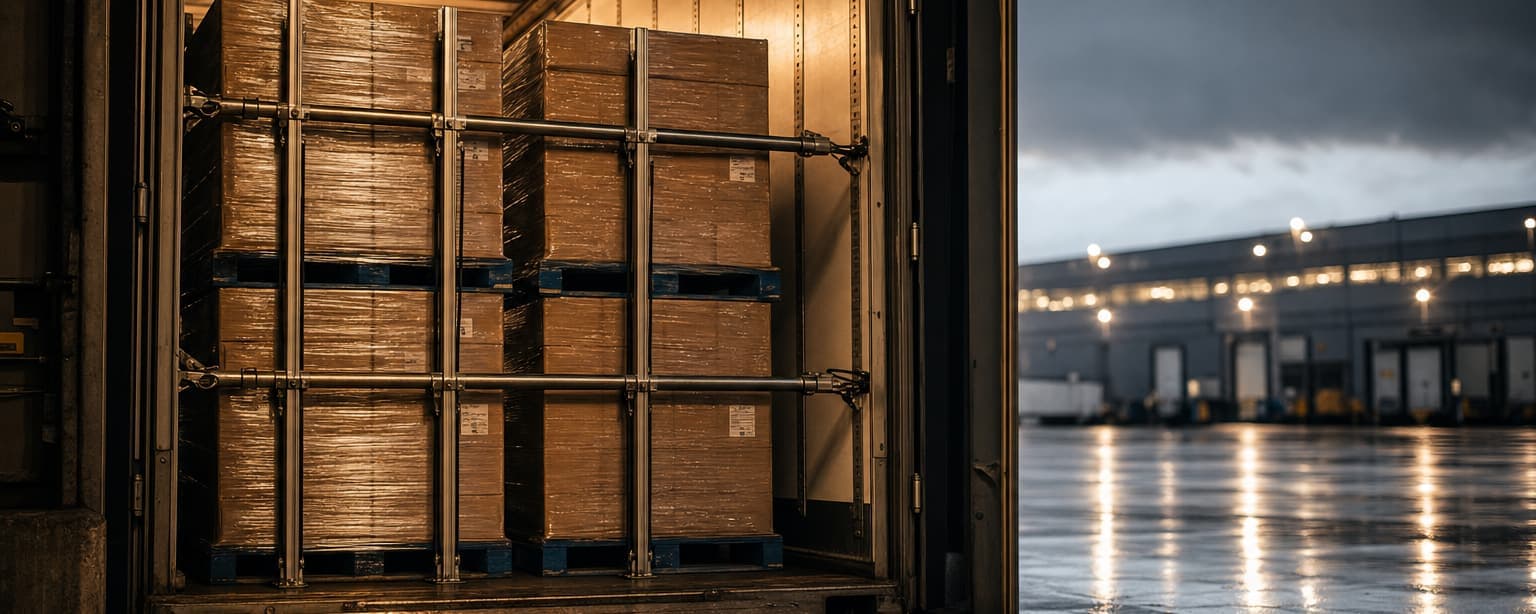
The freight is not your property, and that is exactly why the loss is yours.
Motor truck cargo covers the freight you are hauling while it is in your care. Shippers and brokers require it before they will tender a load, and the limit has to match what you actually carry.
Tell us the situation.
One licensed human replies the same business day — not five agents, not an auto-responder. If the policy you have is already the right one, we will tell you.
We use this to quote and service your insurance, and we do not sell it or pass it to lead networks. Privacy policy.
Send us what you have. We’ll tell you if it’s right.
Your current policy paperwork, a renewal notice, or nothing at all. A licensed agent reads it and replies the same business day.
What motor truck cargo actually covers.
Freight in transit
Loss or damage to the cargo while it is on the truck, from collision, fire or theft.
Without it — You owe the shipper for the value of the load directly, with nothing behind you.
Refrigeration breakdown
Spoilage when a reefer unit fails, usually as a scheduled add-on with its own conditions.
Without it — A failed reefer on a produce load is a total loss the base form excludes.
Debris removal and cleanup
The cost of clearing a spilled load from the roadway.
Without it — The cleanup bill after a spill can rival the value of the freight itself.
Where motor truck cargo shows up.
- Trucking
A damaged or stolen load is money you owe the shipper directly, with nothing behind you.
- Tow Truck & Recovery
On-hook coverage is what pays when the vehicle you are towing is damaged in transit. It is not part of your liability policy and it is the claim you will actually have.
- Tanker & Hazmat
A load of product lost in an incident is money owed to the shipper immediately.
- Refrigerated Freight
A spoiled load is the claim in this class, and without a reefer breakdown endorsement the cargo policy declines it as mechanical failure.
- Livestock Hauling
Standard cargo forms commonly exclude death of livestock except from named perils, so the loss you are most likely to have is the one written out.
- Farm Truck
Your own grain in your own truck is your own loss until the elevator signs for it. Cargo coverage on a farm truck is optional in a way it never is for hire, and the value of a full load is the way to decide.
- Auto Transport
A general freight cargo limit does not come close to a loaded stinger, and the shortfall is owed by you.
- Hot Shot Trucking
Brokers routinely require $100,000 of cargo before they will tender a load, regardless of your equipment.
- Box Truck & Straight Truck
Freight in the box is owed to the shipper if it is damaged or stolen.
- Last Mile & Delivery Contractors
Packages in the van are somebody else’s property until they are delivered.
- Dump Truck & Aggregate Hauling
Material lost or contaminated in transit is still owed to whoever bought it.
- Local & Short-Haul Trucking
Local freight is still owed to whoever shipped it.
- Regional & Intermediate Radius
Longer lanes mean more time in transit and more chances to lose a load.
- Long Haul Trucking
Loads are larger, longer in transit and further from anyone who can respond to a problem.
- Freight Brokers
Contingent cargo responds when the carrier you hired turns out to have no cargo coverage, or has it and it does not pay.
- Freight Forwarders
A forwarder issues its own bill of lading and takes on the goods, so this is primary coverage rather than the contingent kind a broker buys.
- Single Truck & Owner-Operator
Brokers filter loads on the cargo limit before they look at anything else about you.
- Fleet
One cargo limit has to satisfy the most demanding broker on your busiest lane, not the average one.
- Commercial truck
The freight itself, at a limit the broker on your lane will accept before releasing the load.
- UIIA & Intermodal
A sealed container you never loaded is still your cargo exposure while it is on your chassis.
- Mobile Mechanics & Heavy Truck Repair
On-hook and in-tow coverage, where you recover or move vehicles as part of the service, because the vehicle you are towing is not covered by liability.
- Moving & Storage Companies
The customer's property in your truck is excluded from general liability the moment it is in your care, and this is the policy that covers it.
- Heavy Truck & Diesel Repair Shops
On-hook coverage if you tow disabled trucks into the shop. The towed tractor is not covered by your liability policy.
- Couriers & Last-Mile Delivery
You are a bailee of everything on board.

Lori Adams, TRS
Commercial Trucking Insurance Advisor
Twenty-five years in trucking insurance. Knows the filings, the radius rules and the carriers that will actually take the risk.
Transportation Risk Specialist (TRS)
What clients with motor truck cargo ask us.
Can I buy cargo on its own, without the liability?
Yes, and it is a genuinely useful structure when liability is hard to place: a financed truck and a broker’s freight stay insured while liability sits wherever it can be written. Monoline cargo is a real segment: IAT Specialty writes it on the Occidental Fire & Casualty and Wilshire paper, Northland offers monoline physical damage and cargo in most states, and Canopius writes monoline cargo and physical damage for operators with three or more years in business. It is not free — two policies mean two renewals and two claims contacts — but it beats leaving the equipment and the freight bare.
What limit do I need?
Enough for the most valuable load you will ever carry, not the average one. $100,000 is the common default because it satisfies most broker requirements, but a single load of electronics or pharmaceuticals can exceed it comfortably. Brokers check the certificate before tendering, so an inadequate limit costs you the load as well as the claim.
Does it cover theft of the whole trailer?
Usually yes, though this is where the exclusions live and they are worth reading. Many forms restrict coverage for unattended vehicles, or require specific security measures, and some exclude particular commodities outright: tobacco, alcohol, electronics and pharmaceuticals are the usual list. If you haul any of those, the schedule matters more than the limit.
Is cargo the same as the shipper’s insurance?
No. A shipper may insure their own goods, and their insurer can still come after you for causing the loss. Carrier liability for freight is set by the bill of lading and by federal law, and cargo coverage is what answers that liability. Do not assume someone else’s policy protects you.
Guides on motor truck cargo.
Commercial insurance is 96% of what we do — it is not a department here, it is the whole business. Not ready to talk? The guides answer the questions this page raises in more depth. Already insured with us and need a certificate or a policy change? Ask the service team rather than starting a quote — it is faster and it goes to the people whose job it is. We also write home and auto, which is usually cheaper alongside the business policy than apart from it.
Handed a lease, a vendor packet or a client contract with insurance requirements? Paste it into the COI Requirements Decoder to see what each one means for your business, or read what the requirements mean.