
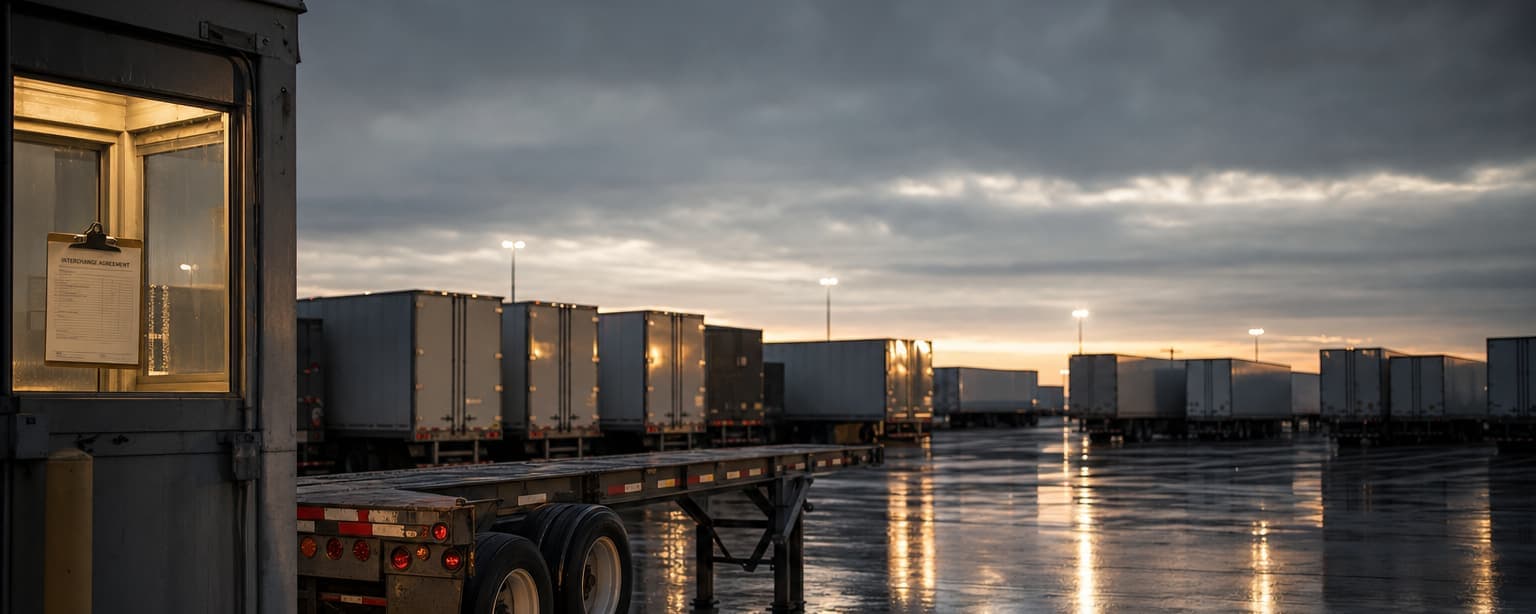
Your physical damage coverage follows equipment you own. An interchanged trailer is not it.
Trailer interchange covers damage to a trailer you are pulling but do not own, while it is in your possession under a written interchange agreement.
Tell us the situation.
One licensed human replies the same business day — not five agents, not an auto-responder. If the policy you have is already the right one, we will tell you.
We use this to quote and service your insurance, and we do not sell it or pass it to lead networks. Privacy policy.
Send us what you have. We’ll tell you if it’s right.
Your current policy paperwork, a renewal notice, or nothing at all. A licensed agent reads it and replies the same business day.
What trailer interchange actually covers.
Damage in your possession
Collision, fire, theft and vandalism to the interchanged trailer while you have it.
Without it — The trailer’s owner bills you for the repair, and your own physical damage policy is not written to respond for equipment you do not own.
The interchange agreement
Coverage triggered by a written agreement between carriers to swap trailers, which is what the form requires to exist.
Without it — Pulling someone’s trailer on a handshake can leave the loss outside both policies, because the agreement the form asks for was never written.
Non-owned trailer physical damage
The broader alternative, which does not require an interchange agreement, for a rented or borrowed trailer.
Without it — A trailer rented for a single job falls outside a strict trailer interchange form.
Where trailer interchange shows up.
- Trucking
A trailer you pulled under an interchange agreement is not your equipment, so your own physical damage coverage does not follow it.
- Refrigerated Freight
Pulling somebody else’s reefer under an interchange agreement puts a trailer you do not own behind your truck.
- Auto Transport
Equipment pulled under an interchange agreement is not covered by your own physical damage.
- Long Haul Trucking
Interchanged trailers behind your tractor are not your equipment and not on your physical damage.
- Fleet
A fleet that drops and hooks other people’s trailers carries a damage exposure the auto policy does not.
- UIIA & Intermodal
The chassis belongs to the equipment provider, and damage to it is what the interchange agreement exists around.

Lori Adams, TRS
Commercial Trucking Insurance Advisor
Twenty-five years in trucking insurance. Knows the filings, the radius rules and the carriers that will actually take the risk.
Transportation Risk Specialist (TRS)
What clients with trailer interchange ask us.
Do I need a written interchange agreement?
For trailer interchange coverage as such, yes. The coverage is defined around it, and a claim on a trailer swapped informally can be denied on that basis alone. If you regularly pull trailers you do not own without a formal interchange agreement, non-owned trailer physical damage is the form you want instead. Tell us which situation you are actually in and we will match the form to it rather than the other way round.
Is this the same as motor truck cargo?
No, and they are commonly confused because both involve something that is not yours. Cargo covers the freight inside the trailer. Trailer interchange covers the trailer itself. A load destroyed in a fire that also burned the borrowed trailer is two claims on two different coverages.
Why is it written as liability rather than physical damage?
Because the trailer is not yours, so the loss is your legal responsibility to its owner rather than damage to your own property. The motor carrier form excludes any trailer in your possession under an interchange agreement from ordinary physical damage coverage, and trailer interchange coverage buys it back as "all sums you legally must pay as damages" to the trailer’s owner. Two consequences follow: the owner has to be able to hold you responsible, which is what the written agreement establishes, and a container counts as a trailer for this coverage, which is why the intermodal pools ask for it by name.
What does the UIIA actually require?
A written interchange agreement with the equipment providers, general liability and auto liability at $1,000,000 each, cargo (typically $100,000) and trailer interchange at whatever each provider sets: the schedule attached to the agreement runs from $15,000 to $35,000 per unit, most of it at $20,000 to $25,000. One line in that packet does more damage than any limit: the association will not accept a scheduled-only auto policy — in its own words, "we cannot accept just a ‘ALL OWNED AUTO’ or a ‘SCHEDULED ONLY’ auto policy" — so a policy that lists your tractors and nothing else fails before the limits are even read.
Commercial insurance is 96% of what we do — it is not a department here, it is the whole business. Not ready to talk? The guides answer the questions this page raises in more depth. Already insured with us and need a certificate or a policy change? Ask the service team rather than starting a quote — it is faster and it goes to the people whose job it is. We also write home and auto, which is usually cheaper alongside the business policy than apart from it.
Handed a lease, a vendor packet or a client contract with insurance requirements? Paste it into the COI Requirements Decoder to see what each one means for your business, or read what the requirements mean.