
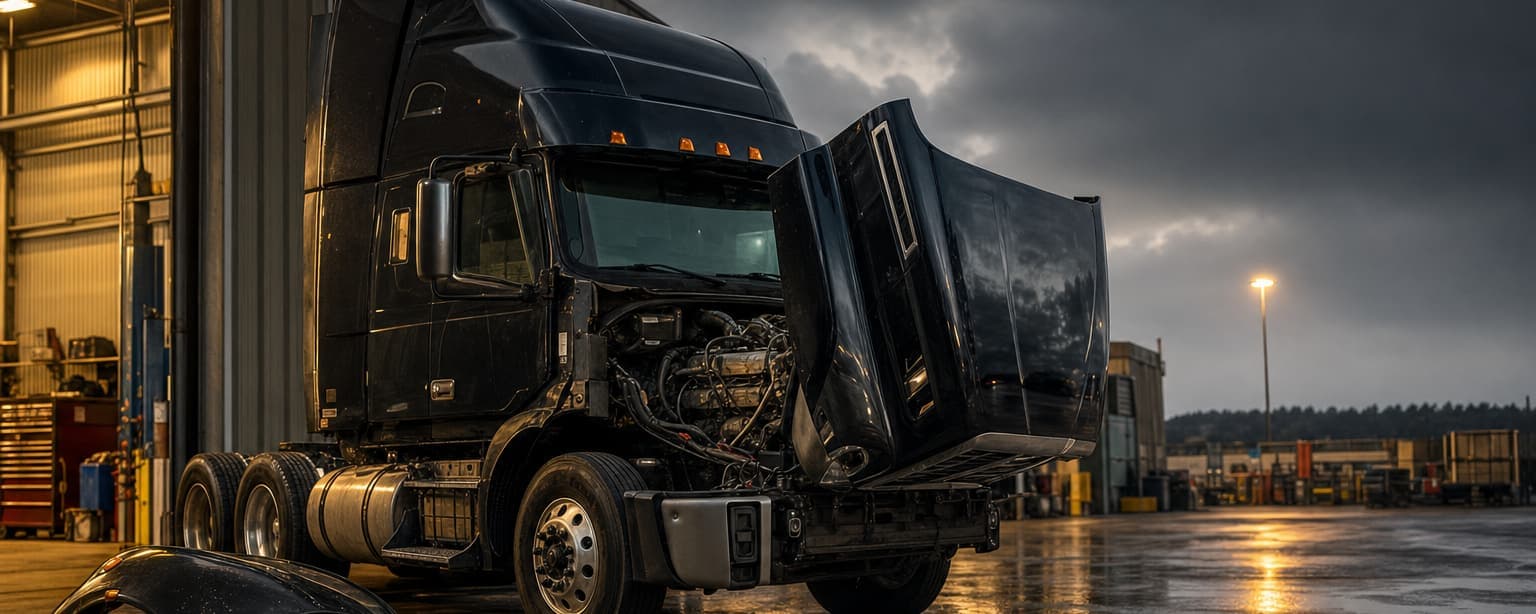
Primary liability pays for their truck. It is the one that pays for yours.
Auto physical damage covers your own tractor and trailer against collision, fire, theft and vandalism. Liability covers the damage you do to everyone else and nothing at all for your equipment.
Tell us the situation.
One licensed human replies the same business day — not five agents, not an auto-responder. If the policy you have is already the right one, we will tell you.
We use this to quote and service your insurance, and we do not sell it or pass it to lead networks. Privacy policy.
Send us what you have. We’ll tell you if it’s right.
Your current policy paperwork, a renewal notice, or nothing at all. A licensed agent reads it and replies the same business day.
What auto physical damage actually covers.
Collision
Damage to your truck from an impact, whoever was at fault.
Without it — A rollover you caused is entirely yours, and the finance company still expects the payment.
Comprehensive
Fire, theft, vandalism, weather and animal strikes: the losses that happen while nobody is driving.
Without it — A truck stolen from a yard overnight is a total loss with nothing behind it.
Gap and loan payoff
The difference between what the truck is worth and what you still owe on it.
Without it — A total loss on a newer tractor can settle for thousands less than the balance, and the shortfall is yours.
Where auto physical damage shows up.
- Trucking
Primary liability pays for the damage you do to everyone else and nothing for your own truck. A rollover you caused leaves you still owing the finance company.
- Tow Truck & Recovery
A wrecker is expensive, specialized and slow to replace, and liability pays nothing toward your own truck.
- Tanker & Hazmat
Tank trailers are expensive and a rollover usually totals one.
- Refrigerated Freight
A reefer trailer with a working unit is one of the most expensive trailers on the road.
- Livestock Hauling
Livestock trailers are specialized and a rollover is a total loss on both the trailer and the load.
- Farm Truck
A grain truck that works six weeks a year and sits the rest can be written on a seasonal or stated-value basis. Tell the underwriter how it is actually used.
- Auto Transport
The rig itself is specialized, expensive and slow to replace.
- Hot Shot Trucking
The truck and the gooseneck are financed and liability pays nothing toward either.
- Box Truck & Straight Truck
Box trucks are financed and liability contributes nothing toward your own vehicle.
- Dump Truck & Aggregate Hauling
Dump bodies, hoists and trailers are expensive and are damaged on site rather than on the road.
- Local & Short-Haul Trucking
Low-speed damage is constant in tight yards, docks and city streets.
- Regional & Intermediate Radius
Equipment is working harder and further from the yard than it was.
- Long Haul Trucking
Equipment running continuously across the country wears and is damaged far from your own shop.
- Single Truck & Owner-Operator
On one truck the tractor is the whole business, and a lender will require it anyway.
- Fleet
On a schedule of tractors and trailers the equipment is most of the balance sheet, and every lienholder requires it.
- Commercial truck
The truck and trailer, which is most of what a lienholder is protecting and most of your balance sheet.
- UIIA & Intermodal
Your own tractor, which nothing in the interchange agreement covers.
- Public Auto & Passenger Transport
Coaches, stretch vehicles and wheelchair-converted vans are expensive and slow to replace.
- Bus, Limo & Charter
Coaches and stretch vehicles are expensive and slow to replace.
- Non-Emergency Medical Transport
A wheelchair conversion costs far more than the van it is built on.
- Taxi & Rideshare Fleets
A fleet vehicle off the road earns nothing and still carries its finance.
- Limousine Service
A policy that values the vehicle as the sedan it was built on pays for the sedan. The conversion, which is most of the cost, is your loss.
- Party Bus Operators
A fire from a lighting circuit destroys the interior and leaves the chassis. A policy valuing the chassis pays for the chassis.
- Black Car & Chauffeur Service
A financed vehicle without physical damage coverage is a loan you keep paying on a car you no longer have.
- Charter Bus & Motorcoach
A coach fire or rollover with no physical damage coverage is a loan you keep paying and a route you can no longer run.
- Auto Dealers
A single hailstorm can damage every unit on the lot at once.

Lori Adams, TRS
Commercial Trucking Insurance Advisor
Twenty-five years in trucking insurance. Knows the filings, the radius rules and the carriers that will actually take the risk.
Transportation Risk Specialist (TRS)
What clients with auto physical damage ask us.
Is APD required?
Not by FMCSA. Federal rules require liability, not physical damage, but almost every lender and lessor requires it as a condition of financing, so if the truck is not paid off, it is effectively mandatory anyway. Owner-operators running a paid-off truck are the ones with a real choice, and it comes down to whether you could replace the tractor out of cash.
How is the limit set?
On the stated value of each unit, which you declare and which drives the premium. Understating it to save money is a false economy that surfaces at exactly the wrong moment: the settlement is capped at the value you stated, not what the truck was worth. Keep the schedule current as you buy and sell equipment.
Does it cover the trailer as well as the tractor?
It covers the units on the schedule, so yes if the trailer is listed. A trailer you do not own is a different question. That is trailer interchange or non-owned trailer physical damage, because your own coverage follows equipment you own.
Commercial insurance is 96% of what we do — it is not a department here, it is the whole business. Not ready to talk? The guides answer the questions this page raises in more depth. Already insured with us and need a certificate or a policy change? Ask the service team rather than starting a quote — it is faster and it goes to the people whose job it is. We also write home and auto, which is usually cheaper alongside the business policy than apart from it.
Handed a lease, a vendor packet or a client contract with insurance requirements? Paste it into the COI Requirements Decoder to see what each one means for your business, or read what the requirements mean.