
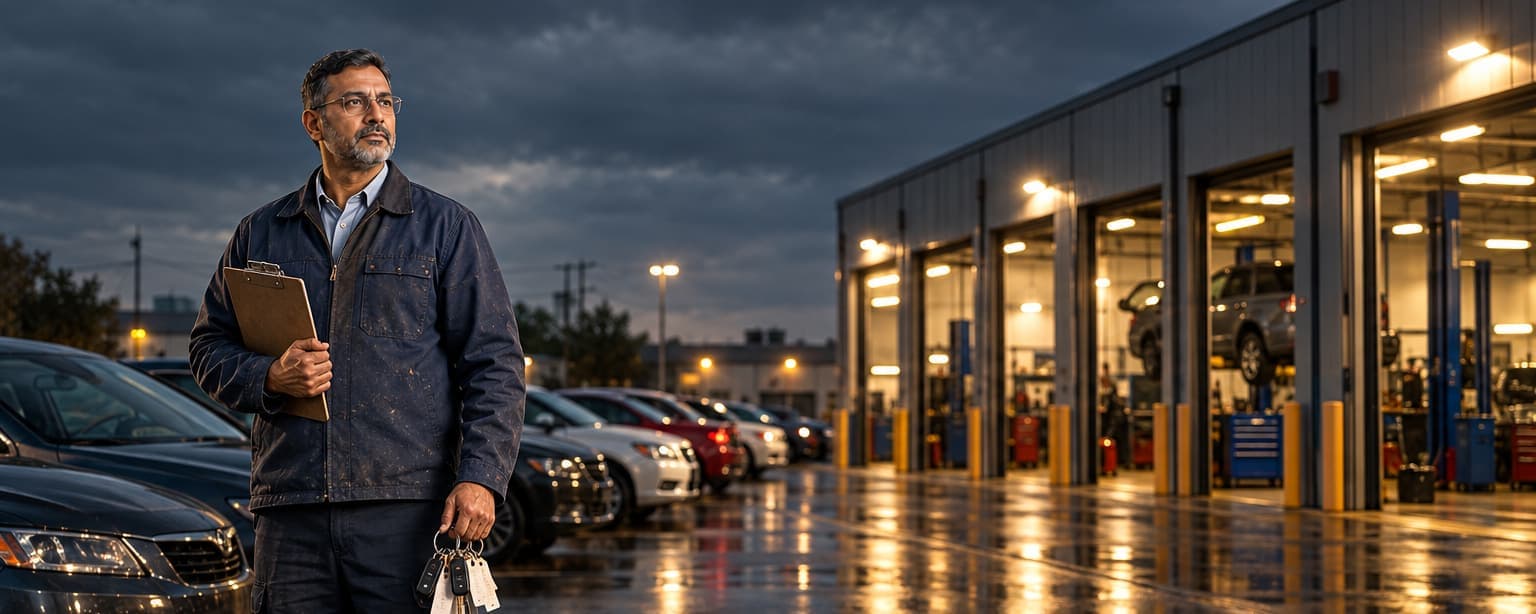
Garagekeepers vs garage liability vs general liability: which one covers the customer’s car?
Garagekeepers is the only one that covers the customer’s car while it is in your care. General liability excludes property in your care, custody or control and anything involving an auto, and garage liability is the liability coverage for running an auto business, which still leaves the customer’s car out. Garagekeepers comes on a legal liability basis, which pays only when you were at fault, or on a direct basis, which pays regardless of fault. A dealer’s own inventory needs dealers physical damage, and a test drive is an auto liability question that state law often decides.
Tell us the situation.
One licensed human replies the same business day — not five agents, not an auto-responder. If the policy you have is already the right one, we will tell you.
We use this to quote and service your insurance, and we do not sell it or pass it to lead networks. Privacy policy.

Joe Gorman
Co-Founder | President of Commercial Lines
Has placed hundreds of auto service businesses: repair shops, mobile mechanics, heavy truck garages and the roadside operators most carriers will not look at. He knows which markets still take a garage risk and what garagekeepers limit a full lot actually needs. A mobile operation described the wrong way gets declined on sight, so he describes it the right way.
Send us what you have. We’ll tell you if it’s right.
Your current policy paperwork, a renewal notice, or nothing at all. A licensed agent reads it and replies the same business day.
Five coverages, five different jobs
Almost every garage claim turns on one question: whose vehicle was damaged, and was it in your care when it happened. The coverages divide along that line. General liability answers for injuries and damage to other people’s property that is not in your hands. Garage liability, where a carrier still sells it, answers for running an auto business, including driving customers’ cars. Garagekeepers answers for the customer’s car while you have it. Dealers physical damage answers for vehicles you own and sell. Auto liability, from whichever policy is primary, answers for a crash on a road test or a test drive.
The gaps sit between them. A shop with a $1,000,000 general liability policy and nothing else is uninsured for every customer car on its lot, because the policy excludes them on purpose. A shop with garagekeepers on the default legal liability basis is uninsured for a fire nobody caused. A dealer with open lot coverage but no false pretense coverage is uninsured for a car driven away by a buyer who was never going to pay. None of these are unusual claims, and none of them are covered by the policy most owners think they bought.
Form numbers below are the Insurance Services Office (ISO) forms most carriers start from. Many garage policies are a carrier’s own wording, and the policy in front of you governs. Where a rule changes by state, it is cited to the state.
General liability (CG 00 01) and the two exclusions that matter
The ISO commercial general liability form, CG 00 01, covers bodily injury and property damage your business causes to others: a customer who trips in the waiting room, a neighbor’s fence your tow driver clips while backing out, or a car that crashes because of a repair you finished last week. For a garage, that last one is the products-completed operations hazard, and it carries its own aggregate limit.
Two exclusions take the customer’s car out of it. Exclusion g removes bodily injury and property damage arising from any auto owned or operated by, or rented or loaned to, any insured. A technician driving a customer’s car is operating it, so a road test crash is not a general liability claim. Exclusion j.(4) removes damage to personal property in the care, custody or control of the insured, which is exactly what a customer’s car is from the moment the keys are handed over.
There is one narrow give-back worth knowing. Exception g.(3) restores liability for parking a customer’s auto on or next to premises you own or rent, so injury to a passer-by while a valet or a porter parks a car can still be a general liability claim. Damage to the parked car itself is still excluded by j.(4). The give-back covers the people and property the car hits, never the car.
The same form also excludes the cost of redoing your own work. Exclusion j.(6) removes that particular part of any property that must be repaired or replaced because your work was incorrectly performed on it, and exclusion l removes damage to your work once it is completed. What survives is the consequence: if a failed repair causes a crash, the injuries and the other car are covered under products-completed operations.
Garage liability: the old garage form and the Auto Dealers Coverage Form (CA 00 25)
For decades the answer for every garage was one policy, ISO’s Garage Coverage Form, CA 00 05. It put liability for garage operations, garagekeepers and physical damage in a single form, and it defined garage operations broadly: the ownership, maintenance or use of locations for a garage business, the roads next to them, the autos covered by the policy, and all operations necessary or incidental to a garage business.
ISO withdrew that form in its October 2013 commercial auto revision. Dealers moved to the Auto Dealers Coverage Form, CA 00 25, which covers a dealer’s auto liability and general liability exposures together, including premises, products and completed operations, plus physical damage on the dealer’s vehicles, garagekeepers, and acts, errors or omissions coverage for things like title and paperwork mistakes. It is written for franchised and non-franchised auto dealers, trailer dealers and equipment dealers.
Repair shops, body shops, tire shops and quick lubes, which are not dealers, are now usually insured on a general liability policy plus a business auto policy, with garagekeepers added by endorsement (CA 99 37). ISO also opened its businessowners program to auto service risks, through the Auto Service Risks endorsement BP 15 98, with customers’ autos covered on a legal liability basis by companion endorsements. Some specialty carriers still write their own garage policy that combines these pieces, and that is what most owners mean when they say "garage liability".
So "garage liability" no longer names one form. What matters is whether your liability covers three things: your premises and operations, your completed work, and autos your people drive, including customers’ cars. If the general liability excludes autos and the business auto policy only covers the shop truck, a road test falls between them.
Garagekeepers: legal liability, direct excess and direct primary
Garagekeepers covers loss to a customer’s auto left in your care while you are attending, servicing, repairing, parking or storing it. ISO’s endorsement, CA 99 37, attaches to the business auto and motor carrier coverage forms in its current 10 13 edition, and the same section sits inside the Auto Dealers Coverage Form. It offers three causes-of-loss choices. Comprehensive covers any cause except collision or overturn. Specified causes of loss covers only fire, lightning, explosion, theft, and mischief or vandalism. Collision covers collision with another object and overturn.
Legal liability is the default. With no other option chosen, the endorsement pays only what you are legally obligated to pay, so it responds when you were negligent and not otherwise. A bay fire with no proven cause, a break-in at a locked and lit lot, or a hailstorm are usually nobody’s fault, and on a legal liability form the customer’s own insurer pays and then decides whether to pursue you.
Direct excess keeps the legal liability coverage and adds coverage regardless of fault, but only in excess of any other collectible insurance. In practice the customer’s own comprehensive or collision pays first, less their deductible, and your policy picks up what is left. Direct primary pays regardless of fault and makes your garagekeepers the first policy to respond, ahead of the customer’s own coverage. It costs more. One underwriter’s commentary puts the difference at roughly 30%, though it varies by carrier and account.
In our own garage book, every garagekeepers binder we reviewed for this guide was written on legal liability. Direct primary was offered on the forms and nobody had bought it. That is the norm, and it is the reason a customer who assumes "the shop is insured" can still end up claiming on their own policy.
What the customer’s own auto policy does
The customer’s physical damage coverage still applies to their car. Under the ISO personal auto policy, PP 00 01, the coverage for damage to the customer’s own car pays for direct and accidental loss less the deductible, with no fault condition. So when a car is damaged at a shop on a legal liability garagekeepers form, the customer’s insurer can pay its own customer and then use its right to recover payment, which is subrogation, to pursue the shop. The shop’s garagekeepers insurer defends that claim.
Liability is a different story. Exclusion A.6 of the personal auto policy removes liability coverage for anyone employed or otherwise engaged in the business of selling, repairing, servicing, storing or parking vehicles, and it says expressly that this includes road testing and delivery. The customer’s policy does not stand behind your technician on a road test. It also excludes, in its physical damage part, damage to a non-owned auto used by someone in that business. The vehicle business is expected to insure its own people.
Limits, deductibles and the exclusions inside garagekeepers
Garagekeepers limits are scheduled per location: the most it pays for all loss at one location in one event is that location’s limit, after the deductible has been taken off the damages. Set it for a full lot on a busy day, including cars waiting on parts and the abandoned ones nobody has collected. Collision deductibles apply per customer auto. Comprehensive and specified causes deductibles also apply per auto, up to a scheduled maximum for all loss in one event, which is what keeps a hailstorm across thirty cars from becoming thirty deductibles. A common structure in our book is $1,000 per auto with a $5,000 maximum per event.
Many garage programs also cap what they pay for any one vehicle, whatever the location limit says. In our book we have seen caps of $10,000 per vehicle on a used car dealer, $50,000 on a mobile mechanic and on a detailer, and $300,000 on a heavy truck shop with a $1,000,000 location limit. Garage and general liability limits were $1,000,000 per occurrence and $2,000,000 aggregate on every garage quote we read, and garagekeepers requests ran from $60,000 to $450,000 per location, with $100,000 and $300,000 the most common.
The standard exclusions are where claims fail. CA 99 37 excludes liability you accepted by contract, unless you would have been liable anyway, theft or conversion caused in any way by you, your employees or your stockholders, defective parts or materials, and faulty work you performed. It also excludes sound equipment that is not permanently installed, CB and two-way radios, phones and scanners not installed in the dash, radar and laser detectors, and loss caused by war. Employee theft of a customer’s car is a crime insurance question, not a garagekeepers one. A comeback for a bad repair is a warranty cost, not a garagekeepers claim. Specialty programs add their own conditions, such as excluding theft from a lot that is not fenced or locked unless that coverage is bought.
Heavy trucks and high-value vehicles
Per-vehicle caps are built around passenger cars. A cap of $50,000 replaces a typical sedan and does not come close to a late-model Class 8 tractor, an exotic in for paint protection film, or a loaded car hauler. Check the cap against the most valuable vehicle you actually take in, and if you work on heavy trucks, confirm the liability side covers that work at all. Many mechanic general liability programs exclude or limit heavy truck repair.
A truck shop’s yard also holds things garagekeepers does not cover. Garagekeepers covers the trailer as a vehicle and not the freight inside it, so a loaded trailer left for repair raises a cargo question for the motor carrier and its cargo insurer.
Dealers physical damage, open lot and false pretense
Garagekeepers covers customers’ cars. A dealer’s own inventory needs dealers physical damage, often called dealers open lot, which in the Auto Dealers Coverage Form is the physical damage coverage on the dealer’s covered autos and is usually written through specialty programs. IRMI describes lot classes from unprotected to standard to building, where inventory is kept indoors, and the class drives the rate. It is often written on a reporting basis, with a penalty if actual values turn out higher than what was reported.
Transit is limited. Under CA 00 25 the collision coverage applies to a covered auto being moved from where it was bought or distributed to its destination only when the two points are 50 miles apart or less.
False pretense is the coverage dealers most often find missing. The Auto Dealers Coverage Form excludes loss when someone causes you to voluntarily part with an auto by trick, scheme or false pretense, and loss from acquiring an auto from a seller who did not have legal title. The endorsement CA 25 03 deletes that exclusion. The classic losses are a test-drive customer who never comes back, and a buyer whose payment turns out to be fraudulent. The endorsement still excludes loss that a bank fails to pay for any reason, so it is not general bounced-check insurance. The used car dealer in our book that carries it bought a $25,000 limit.
Floor plan lenders typically require physical damage coverage on the inventory they finance and may ask to be named as loss payee. The floor plan agreement sets the terms, so send the agreement itself to your broker rather than a summary.
Test drives and road tests: whose insurance pays
The usual starting point is that insurance follows the car: the policy on the vehicle pays first. In California the Insurance Code says so for most cases, presuming the policy that describes the vehicle as an owned auto to be primary. For vehicle businesses, though, several states have written their own rules, and they do not agree.
In California, when a vehicle is being driven by someone in the business of selling, repairing, servicing, delivering, testing, road-testing, parking or storing vehicles, or by their employee, the business’s policy is primary. When anyone else is driving, such as a customer on a test drive, the business’s policy is excess over all other insurance available to the driver. A road test by your technician is your policy’s claim, and a customer’s test drive in California falls first on the customer’s own policy.
Georgia’s statute, as its Court of Appeals read it in 2001, makes the driver’s own policy primary when a customer with insurance drives a retail dealer’s car, and the dealer’s policy excess. The same court held that the rule does not apply when the dealer’s own employee is driving, so the dealer’s insurer is primary then. Maine goes the other way for vehicles on dealer plates: the owner’s policy is primary up to the required limits, and the driver’s own policy is excess. Where two policies each claim to be excess, courts in some states, Maryland among them, have made them share as primary.
Dealer policies also decide, in their "Who Is An Insured" section, how far they cover a customer driving the dealer’s car, and many limit it. Read that section of your own policy, because it decides how much stands behind a customer with weak or no insurance of their own. For a repair shop, a road test is driven by your employee, so on the California rule and the Georgia reading alike it is your policy that answers. That is why a shop’s auto liability has to cover customers’ cars, which a business auto policy covering only the shop truck does not.
Dealer plates and dealer license requirements
Dealer license rules usually ask for a bond, and some also ask for insurance. Florida requires a dealer applicant to show garage liability insurance, or general liability plus business auto, with at least $25,000 combined single limit for bodily injury and property damage and $10,000 of personal injury protection, plus a $25,000 surety bond or letter of credit each year. California requires a $50,000 dealer bond, or $10,000 for dealers selling only motorcycles or off-highway vehicles. Texas requires a $50,000 surety bond to get or renew a dealer general distinguishing number.
A bond protects the public and the state, and it does not insure the dealer. The insurance on the plates is auto liability on whatever vehicle carries them. Plate policies are rated by the number of plates, and where a state requires personal injury protection or uninsured motorist coverage, it is often charged per plate. A dealer who loses the garage policy can lose the plates with it.
Faulty work, products and completed operations
A repair that fails after the customer drives away is covered in pieces. The injuries and the damage to other vehicles are the products-completed operations hazard of a general or garage liability policy: bodily injury and property damage away from your premises arising out of your work or your product, once the work is finished. "Your work" includes the parts you supplied and the warnings or instructions you gave or failed to give.
The cost of putting your own work right is excluded on both sides. General liability excludes the particular part that must be redone because your work was incorrect, and garagekeepers excludes faulty work you performed and defective parts. A wheel that comes off because the lug nuts were not torqued produces a covered claim for the crash and an uncovered bill for the wheel job.
Selling parts or tires makes you part of the product chain as well. A tire you sold that fails is your product, and products coverage carries its own aggregate limit.
Mobile work, service trucks and tools
Garagekeepers covers a customer’s car in your care wherever you work on it, but many forms schedule coverage by location, so a mobile operator needs a policy written for work at the customer’s site. Mobile work is also narrower in the market: a large standard carrier non-renewed a mobile detailer we insure because it had stopped covering mobile services.
The service van or truck needs commercial auto. Hired and non-owned auto coverage handles the other vehicles: symbol 8 covers autos you lease, hire, rent or borrow, and symbol 9 covers autos you do not own that are used in your business, including employees’ own cars on errands. Drive other car coverage (CA 99 10) extends a commercial auto policy to named people who have no personal auto policy, and it excludes autos used in the business of selling, servicing, repairing or parking.
Tools need inland marine coverage that travels, because a property policy stops at your address. Technicians often own their own tools, sometimes worth $25,000 to $100,000 each, and a shop policy commonly gives little or no coverage for property that belongs to employees. Carriers sell employee tools coverage as their own endorsement rather than one standard ISO form, so ask for it by name.
Towing: on-hook coverage
On-hook covers damage to a vehicle you do not own while you are towing or hauling it. It is separate from garagekeepers, which covers vehicles at your location. ISO added a stand-alone on-hook endorsement, CA 04 52, in its 11 20 commercial auto revision, aimed at towing and roadside businesses without a work location. Carriers name it differently, and one major commercial auto insurer calls on-hook "garagekeepers legal liability" in Texas and Virginia, which is how shops end up believing they have one coverage when they have the other.
A repair shop that tows only now and then still needs it disclosed. A shop owner who buys general liability and garagekeepers and then asks where the tow truck coverage is has found the gap the usual way: the truck belongs on the commercial auto policy, and on-hook is added there.
Who pays: six common garage claims
Common practice under the ISO forms. Your own policy wording governs, and a direct primary form makes the shop’s garagekeepers pay first in every row where the customer’s car is damaged.
A bay fire with no known cause burns a customer’s car
- General liability
- Excluded: the car is in your care, custody or control
- Garagekeepers, legal liability
- Pays only if the shop is shown to be negligent
- Garagekeepers, direct primary
- Pays, less the deductible, regardless of fault
- Who else pays
- The customer’s own comprehensive coverage, which may then pursue the shop
A technician backs a customer’s car into a pole while moving it
- General liability
- Excluded twice: the car is in your care, and an auto you operated
- Garagekeepers, legal liability
- Pays under collision, because the shop was at fault
- Garagekeepers, direct primary
- Pays under collision
- Who else pays
- If the car hits another person’s property, the shop’s auto or garage liability
A customer’s car is stolen from the lot overnight
- General liability
- Excluded
- Garagekeepers, legal liability
- Pays only if the shop was negligent, such as keys left in the car
- Garagekeepers, direct primary
- Pays, unless the theft was by your own employee or a lot condition was breached
- Who else pays
- The customer’s comprehensive coverage. Theft by an employee is a crime insurance question
A detailer’s polisher or chemical damages the paint
- General liability
- Excluded: the car is in your care
- Garagekeepers, legal liability
- Often excluded as faulty work you performed
- Garagekeepers, direct primary
- Often excluded as faulty work; some detailing programs cover it
- Who else pays
- The detailer’s own pocket, unless the program covers damage during the work
A customer crashes a dealer’s car on a test drive
- General liability
- Excluded: an auto owned by the dealer
- Garagekeepers, legal liability
- Does not apply: the dealer’s own car is not a customer’s auto
- Garagekeepers, direct primary
- Does not apply
- Who else pays
- Dealers physical damage for the car. For injuries, the state decides whose auto liability is primary (in California, the customer’s own)
A mobile mechanic’s brake repair fails a week later and causes a crash
- General liability
- Pays the injuries and other property under completed operations, but not the cost of redoing the repair
- Garagekeepers, legal liability
- Does not apply: the car has left your care
- Garagekeepers, direct primary
- Does not apply
- Who else pays
- The customer’s own auto insurer pays its insured first and may pursue the mechanic
Rows assume the coverage was bought: collision on garagekeepers, products-completed operations on liability, and dealers physical damage on a dealer policy.
What each coverage covers, and what it does not
General liability
- Covers
- Injury and damage to others from your premises, operations and completed work
- Does not cover
- Customers’ cars in your care, any auto you operate, redoing your own work
- Form
- CG 00 01
Garage liability
- Covers
- Liability for an auto business, including autos your people drive, where a carrier’s garage policy includes it
- Does not cover
- Customers’ cars in your care, which need garagekeepers
- Form
- Withdrawn ISO CA 00 05; carriers’ own forms; CA 00 25 for dealers
Garagekeepers, legal liability
- Covers
- Customers’ cars in your care when you are legally liable
- Does not cover
- No-fault losses, employee theft, faulty work, defective parts
- Form
- CA 99 37
Garagekeepers, direct excess
- Covers
- Customers’ cars regardless of fault, after the customer’s own insurance
- Does not cover
- Same exclusions as above
- Form
- CA 99 37, excess option
Garagekeepers, direct primary
- Covers
- Customers’ cars regardless of fault, before the customer’s own insurance
- Does not cover
- Same exclusions as above
- Form
- CA 99 37, primary option
Dealers physical damage
- Covers
- Your own inventory against hail, theft, fire and collision
- Does not cover
- Fraud by a buyer, unless false pretense is added
- Form
- CA 00 25; false pretense CA 25 03
Commercial auto and hired and non-owned
- Covers
- Your service vehicles, and autos you hire or borrow (symbol 8) or do not own (symbol 9)
- Does not cover
- Customers’ cars in your care, unless the policy is written to include them
- Form
- CA 00 01
On-hook
- Covers
- A vehicle you are towing
- Does not cover
- Vehicles parked at your location, which are garagekeepers
- Form
- CA 04 52 or a carrier form
What each garage business usually needs
Mobile mechanic
- Core coverages
- General liability with completed operations, garagekeepers that works off-site, commercial auto, tools
- The gap we see most
- Garagekeepers missing because there is no shop; heavy truck work excluded
Heavy truck and diesel repair
- Core coverages
- Liability that includes heavy truck work, garagekeepers sized to tractors, auto for road tests, umbrella
- The gap we see most
- A per-vehicle cap built for passenger cars
Auto repair shop
- Core coverages
- General liability, garagekeepers, auto liability that covers customers’ cars on road tests
- The gap we see most
- Legal liability garagekeepers that will not pay a no-fault fire
Body and collision shop
- Core coverages
- Garagekeepers with a limit for cars held for weeks, property for the booth, completed operations
- The gap we see most
- A location limit set for a slow week
Tire shop
- Core coverages
- Completed operations and products, garagekeepers, workers comp
- The gap we see most
- Wheel-off claims treated as rare until one happens
Detailer, ceramic coating, PPF or tint
- Core coverages
- Garagekeepers, general liability, inland marine for equipment, commercial auto for the van
- The gap we see most
- A garagekeepers form that excludes damage from the work itself
Used car dealer
- Core coverages
- CA 00 25 or a dealer program: liability, dealers physical damage, garagekeepers, false pretense, plates
- The gap we see most
- False pretense not bought
Tow operator
- Core coverages
- Commercial auto, on-hook, garagekeepers for the storage yard
- The gap we see most
- On-hook assumed to be part of garagekeepers
The detail
CG 00 01 exclusion j.(4) removes property damage to personal property in the care, custody or control of the insured, and exclusion g removes injury and damage arising from any auto owned or operated by, or rented or loaned to, any insured.
ISO Commercial General Liability Coverage Form CG 00 01 04 13 (specimen)
ISO eliminated the Garage Coverage Form CA 00 05 in its 10 13 commercial auto revision and introduced the Auto Dealers Coverage Form CA 00 25 for dealers.
Since the garage form was withdrawn, auto service businesses have generally been insured on a commercial general liability policy plus a business auto policy with a garagekeepers endorsement, or on an ISO businessowners policy with the Auto Service Risks endorsement BP 15 98.
The garagekeepers endorsement CA 99 37 is written on a legal liability basis unless the excess option (coverage regardless of fault, excess over other collectible insurance) or the primary option (coverage regardless of fault, as primary insurance) is chosen.
CA 99 37 10 13 excludes liability accepted by contract unless the insured would have been liable anyway, theft or conversion caused by the insured, its employees or stockholders, defective parts or materials, faulty work the insured performed, and loss caused by war.
The ISO personal auto policy excludes liability coverage for anyone employed or otherwise engaged in the business of selling, repairing, servicing, storing or parking vehicles, including road testing and delivery.
ISO Personal Auto Policy PP 00 01 09 18, exclusion A.6 (Virginia SCC filing)
In California, a vehicle business’s policy is primary when the business or its employee is driving, and excess over the driver’s own insurance when anyone else, such as a customer on a test drive, is driving.
Georgia’s Court of Appeals read O.C.G.A. 33-34-3(d) to make an insured customer’s own policy primary when driving a retail dealer’s vehicle, and held that the rule does not apply when the dealer’s employee is driving.
Motors Ins. Co. v. Auto-Owners Ins. Co., Ga. Ct. App. A01A1524 (2001)
In Maine, the owner’s policy on a vehicle with dealer plates is primary up to the required limits, and other insurance available to a driver who is not the owner is excess.
The Auto Dealers Coverage Form excludes loss when someone causes the insured to voluntarily part with an auto by trick, scheme or false pretense, and the False Pretense Coverage endorsement CA 25 03 removes that exclusion while still excluding loss a bank fails to pay.
Florida requires a motor vehicle dealer applicant to carry garage liability, or general liability with business auto, of at least $25,000 combined single limit plus $10,000 of personal injury protection, and a $25,000 surety bond or letter of credit.
California requires a $50,000 dealer bond, or $10,000 for a dealer selling only motorcycles or off-highway vehicles.
Texas requires a $50,000 surety bond to obtain or renew a dealer general distinguishing number.
ISO’s On-Hook Coverage endorsement CA 04 52, added in the 11 20 revision, is aimed at towing and roadside businesses with no location where work is performed.
Dealers open lot coverage is usually written through specialty programs, and lots are classed from unprotected through nonstandard and standard to building, where inventory is kept indoors.
What this means for you
- Read the garagekeepers line on your policy paperwork tonight. If it does not say direct primary or direct excess, it is legal liability, and a loss nobody caused lands on your customer’s insurer and then possibly back on you.
- Price the per-vehicle cap against your most expensive job. A location limit of $300,000 means little if the form pays $50,000 for any one car and the truck in your bay is worth three times that.
- Make sure something covers your people driving customers’ cars. General liability excludes it and the customer’s personal policy excludes it, so road tests, pickups and lot moves need auto liability written for vehicles in your care.
- Dealers should ask for false pretense by name. It is excluded on the dealer form until the endorsement is added, and the test driver who never returns is a real loss, not a hypothetical one.
Related questions
- Does my general liability cover a customer’s car while I am working on it?
No. The standard general liability form excludes damage to personal property in your care, custody or control, and it excludes any auto you operate. A customer’s car handed over for work is both. Garagekeepers is the coverage for it.
- What is direct primary garagekeepers?
It is the garagekeepers option that pays for damage to a customer’s car regardless of whether you were at fault, and pays before the customer’s own insurance. The default, legal liability, pays only when you were negligent. Direct excess pays regardless of fault but only after the customer’s own coverage.
- My customer’s car got damaged in my shop. Who pays?
If you have direct primary garagekeepers, your policy pays first, less your deductible. If you have legal liability garagekeepers, it pays only if you were at fault, and otherwise the customer claims on their own comprehensive or collision coverage, whose insurer may then try to recover from you. If you have no garagekeepers, general liability will not pay and the money comes from the business.
- Does insurance cover a test drive accident?
Yes, but which policy pays first depends on who was driving and the state. In California, a customer on a dealer test drive is covered first by their own auto policy and the dealer’s is excess, while a dealer or shop employee driving is covered first by the business’s policy. Georgia also puts an insured customer’s policy first for retail dealers, and Maine puts the dealer-plate policy first.
- Do I need garagekeepers as a mobile detailer or mobile mechanic?
Yes, if you want the customer’s vehicle covered. It is in your care while you work on it at their home or yard, and general liability excludes it there exactly as it would in a shop. Make sure the form covers work away from a scheduled location.
- Auto detailing insurance
- Is garage liability the same as garagekeepers?
No. Garage liability covers injury and damage to other people from running an auto business, including driving customers’ cars. Garagekeepers covers the customer’s car itself while you have it. Most garage businesses need both, and buying one does not include the other.
- What are the dealer plate insurance requirements?
They are set by each state. Florida requires dealer applicants to carry garage liability, or general liability plus business auto, with at least $25,000 combined single limit and $10,000 of personal injury protection, plus a $25,000 bond. California and Texas each require a $50,000 dealer bond. Your dealer license application lists what your state needs.
- Auto dealer insurance
- Does garagekeepers cover an employee who steals or joyrides a customer’s car?
Not on the standard form. Garagekeepers excludes theft or conversion caused in any way by you, your employees or your shareholders. That is a crime or employee dishonesty question, and it is worth asking about if your staff have keys after hours.
- Crime and employee dishonesty
Need this handled?
Reading about it and having it handled are different jobs, and the second one is ours. We place the accounts other brokers decline — claims history, a cancellation, an unusual operation, a business nobody wants to underwrite twice — and we will tell you when the policy you already have is the right one. Tell us the situation and a licensed human replies the same business day.
Written by the licensed brokers at Boring Insurance. Last updated 2026-10-03. See all guides.