
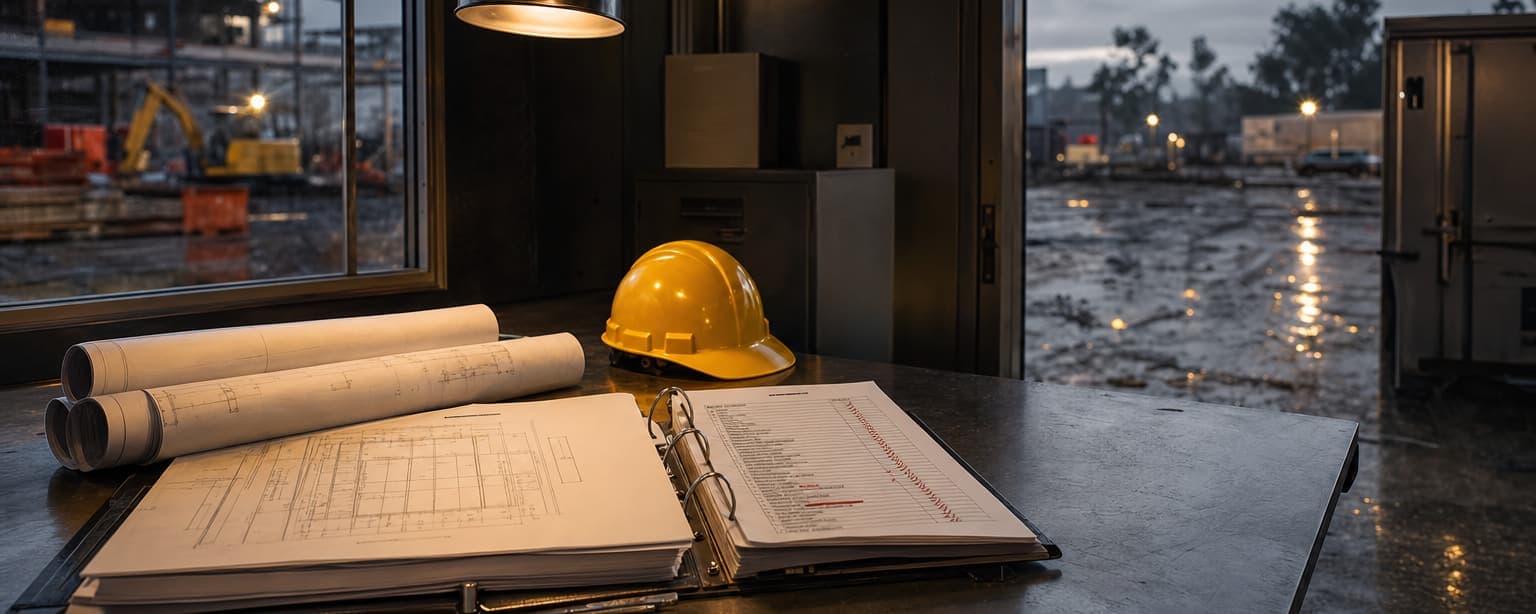
General liability pays for the damage. Not for the work being wrong.
Contractors E&O covers the cost of faulty work and professional mistakes: the claims a general liability policy is specifically written not to pay.
Tell us the situation.
One licensed human replies the same business day — not five agents, not an auto-responder. If the policy you have is already the right one, we will tell you.
We use this to quote and service your insurance, and we do not sell it or pass it to lead networks. Privacy policy.
Send us what you have. We’ll tell you if it’s right.
Your current policy paperwork, a renewal notice, or nothing at all. A licensed agent reads it and replies the same business day.
What contractors errors and omissions actually covers.
Faulty workmanship
The cost of putting your own defective work right.
Without it — General liability pays for the floor your leak ruined and not for the pipe you installed wrong, which is usually the part the customer is arguing about.
Design and specification errors
Claims arising from design-build work, engineered systems or a specification you supplied.
Without it — The moment you recommend rather than merely install, you have taken on a professional duty that general liability does not insure.
Rework and delay
The financial consequences of getting it wrong, where scheduled.
Without it — Tearing out and redoing a compliant-looking installation is a cost with no third-party damage attached to it, so nothing else responds.
Where contractors errors and omissions shows up.
- Glass Contractors & Glaziers
Specified glazing that fails to perform — thermal, structural or acoustic — is a professional claim rather than an accident.
- Carpentry & Framing Contractors
General liability pays for the damage your framing caused and nothing toward the framing itself being wrong.
- Hardscape & Retaining Walls
A wall that was engineered wrong, or built to the wrong specification, is a professional failure rather than an accident.
- Pressure & Soft Washing
Stripping a surface you were paid to clean — etched glass, stained stucco, damaged shingles — is a workmanship claim rather than an accident.
- Roofing Contractors
A specified system that fails, or the wrong assembly for the deck, is a workmanship claim general liability excludes.
- Electrical Contractors
Specifying or designing a system that fails to perform is a professional claim, and design-build work puts it in play on almost every job.
- Plumbing Contractors
A system that is installed correctly and specified wrongly still fails, and that failure is professional rather than accidental.
- HVAC Contractors
A system sized or specified incorrectly performs badly for years without ever breaking, and that is a professional claim rather than an accident.
- Painting Contractors
A coating specified for the wrong substrate fails as a system rather than as an accident, and the remediation is the whole elevation.
- Concrete Contractors
Concrete placed to the wrong specification cures perfectly and is still wrong, and that is a professional failure rather than an accident.
- Drywall & Interior Finish Contractors
An assembly built to the wrong fire or acoustic rating passes visual inspection and fails the one that matters.
- Masonry Contractors
A wall that moves, cracks or fails to carry what it was designed to carry is a structural failure rather than an accident.
- Flooring Contractors
Installing over a substrate that was never tested is a professional failure, and it is the argument after every moisture claim.
- Welding & Fabrication
A weld that fails under load is a structural failure, and whether it met the specified procedure is the whole claim.
- Handyman & Property Maintenance
Advice given about a building — what needs replacing, whether something is safe — is a professional statement whether or not it was invoiced as one.
- Staging & Rigging Companies
A rigging plot or a load calculation is engineering advice, and a plot that miscalculates a load is a professional failure rather than an accident.
What clients with contractors errors and omissions ask us.
Is this not what my general liability is for?
No, and the distinction is deliberate rather than accidental. General liability covers bodily injury and damage to other people’s property caused by your work. It excludes your work itself, the "your work" exclusion, because insurers will not guarantee the quality of what you sell. Contractors E&O is what covers the workmanship and the professional judgment behind it.
Who actually needs it?
Anyone who designs as well as builds, anyone installing engineered or specified systems, and anyone whose contract makes them responsible for a performance standard rather than just a scope. Irrigation and landscape design, mechanical and controls work and design-build contracting are the common ones.
Does a contract ever require it by name?
Increasingly yes, usually phrased as professional liability on design-build work. Where a contract requires professional liability from a trade contractor, this is generally the policy meant, and a general liability certificate will not satisfy it however good the limits look.
Commercial insurance is 96% of what we do — it is not a department here, it is the whole business. Not ready to talk? The guides answer the questions this page raises in more depth. Already insured with us and need a certificate or a policy change? Ask the service team rather than starting a quote — it is faster and it goes to the people whose job it is. We also write home and auto, which is usually cheaper alongside the business policy than apart from it.
Handed a lease, a vendor packet or a client contract with insurance requirements? Paste it into the COI Requirements Decoder to see what each one means for your business, or read what the requirements mean.