
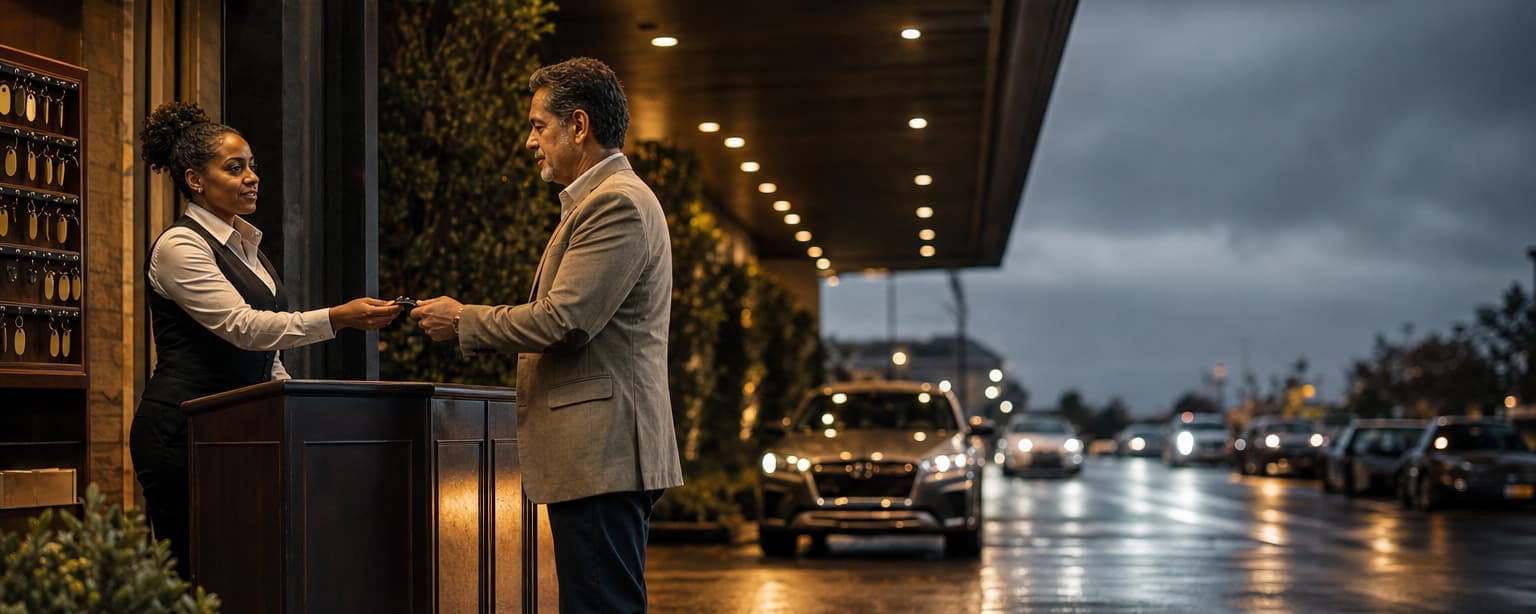
The moment the key changes hands, the car is your problem.
Whether you run a valet company under contract or a restaurant or hotel that parks cars with its own staff, the customer’s car is excluded from the liability policy you already have. Garagekeepers is what answers for it, and this page covers the rest of what a valet operation carries.
Tell us the situation.
One licensed human replies the same business day — not five agents, not an auto-responder. If the policy you have is already the right one, we will tell you.
We use this to quote and service your insurance, and we do not sell it or pass it to lead networks. Privacy policy.
Send us what you have. We’ll tell you if it’s right.
Your current policy paperwork, a renewal notice, or nothing at all. A licensed agent reads it and replies the same business day.
What valet parking businesses actually need.
Garagekeepers
Damage to, and theft of, a customer’s vehicle while it is in your care, from the key stand to the space and back. Written as legal liability, which pays when the damage was your fault, or as direct primary, which pays regardless.
Without it — General liability excludes property in your care, custody or control, and every car you park is exactly that. A dented door on a customer’s car is paid from your own account, and they expect it that evening.
Hired and non-owned auto
Liability for what your attendants do while driving a car you do not own, including the pedestrian in the lane and the car in the next space.
Without it — The customer’s own auto policy insures the customer. It was not written to defend your business for what your employee did behind the wheel, and their insurer will look for you.
General liability
A guest struck at the stand, a fall on the ramp, a cone in the wrong place, and the defense costs that arrive before anyone decides who was at fault.
Without it — The venue contract requires it before the first shift, and without it there is no contract.
Workers compensation
Attendants run, in traffic, at night, in whatever the weather is doing. The injury rate reflects it.
Without it — A valet hit in the lane with no comp policy is a lawsuit against the operator and, in most states, a penalty from the state on top.
Umbrella
The limit above the primary policies, which hotels, hospitals and event venues routinely name in the contract.
Without it — A single-vehicle injury involving a guest can pass a one million limit, and a venue that wrote five million into the agreement will hold you to it.
The claims we actually see.
Ordered by how often we see them, not by how dramatic they are. Each one names the coverage that answers it — and the policy people wrongly assume already does.
Most common
An attendant clipped a parked car bringing a guest’s vehicle around, and both owners want it fixed today.
Covered by Garagekeepers for the guest’s car, hired and non-owned auto for the other one
Two cars, two policies. The guest’s car was in your care and sits under garagekeepers. The other car was a third party’s property, damaged by your employee driving a vehicle you do not own, and answers to the auto policy. An operator carrying only general liability has neither.
Common
A car was stolen from the key stand, keys and all, while the attendant was retrieving another.
Covered by Garagekeepers, on a direct primary form
On a legal liability form the carrier can ask whether the theft was your fault before it pays. An unattended key board is an argument, and a guest without a car does not want to hear it. Direct primary pays and moves on.
Less common, severe
A guest was hit by a car in the valet lane and the lawyer’s letter names the restaurant and the valet company.
Covered by General liability, and the venue’s own liability with the operator’s certificate behind it
Both get named because both are there. The venue wants the operator’s policy to respond first, which is what the additional insured wording in the contract is for, and it only works if the certificate and the endorsement behind it were actually issued.
Common
A ticket that says “not responsible for damage or theft” and a guest who is not persuaded by it.
Covered by Garagekeepers
A disclaimer on the ticket is not what the underwriter priced and it is not what the guest will accept. It is argued about after the loss. The policy is what pays during it.
What the insurance company will ask about your valet parking business
We read the applications the markets use for businesses in this field and pulled out what they actually ask. Have these answers ready and a quote takes a day instead of a week, because nobody has to come back to you for the missing piece.
About the business
- What services do you provide (boarding, day care, grooming, training, or other)?
- How long have you been in business and at your current location?
- How many employees do you have?
- Do you sell any products under your own label?
How you operate
- How many pets do you have on site on an average day?
- How many kennels or compartments do you have?
- Are all pets monitored in common areas?
- Are all play yards and play areas fenced?
- If you transport animals, are they tethered or caged during transport?
Safety and controls
- Do you have functioning fire extinguishers on site?
- Do you have functioning smoke and heat detectors in all areas?
- For any building built before 1978, does it have aluminum wiring or knob and tube wiring?
Your history
- Have you had any property or liability losses in the past three years?
- Has your insurance coverage been canceled or non-renewed in the past three years?
Money and people
- What coverage limits do you want for pet liability (starting at $100,000 per incident)?
- What coverage limit do you want for pets themselves ($1,000 to $10,000)?
Have these ready
- Description of what your business does and how you operate
- Your loss history for the past three years (claims you or your current insurer know about)
- Information about anyone else with a financial interest in your business
You answer what you can; a licensed agent fills the rest with you.
What our valet parking clients ask us.
We are a restaurant and our own staff park the cars. Does our restaurant policy cover them?
Almost certainly not, and the exclusion is in the general liability form rather than in one carrier’s fine print. Liability policies exclude damage to property in your care, custody or control, and a guest’s car with your employee at the wheel is the textbook example. What answers is garagekeepers for the car itself and hired and non-owned auto for what the employee does while driving it, with the attendants rated as drivers. If you also own a shuttle or a house car, that goes on a commercial auto policy. None of this is expensive next to the first claim, and a restaurant that has run its own valet for years without it has simply not had the claim yet.
Doesn’t the customer’s own car insurance cover it?
The customer’s policy insures the customer, and their insurer will pay them and then come looking for you. That process is called subrogation and it is routine. So the guest’s policy does not remove your exposure; it changes who sends the letter. On top of that, many guests carry liability only, with no coverage on their own car, and for them the valet stand is the only place the money can come from. Garagekeepers exists because both of those things are true at once.
What is the difference between legal liability and direct primary garagekeepers?
Legal liability pays when the damage was your fault, so the carrier can investigate before it does. Direct primary pays for a covered loss to a car in your care whether you were negligent or not, and it is what most guests assume they are getting when they hand over the keys. A stolen car, a hailstorm on the overflow lot and a scratch nobody saw happen are all cleaner under direct primary. It costs more, and for a valet operation it is usually the right form, because the argument it avoids is with your own customer.
What do venues put in the valet contract?
General liability and garagekeepers at stated limits, the venue named as an additional insured on both, hired and non-owned auto, workers compensation, and often an umbrella above them. Hotels and hospitals tend to ask for the higher limits. Read the insurance section of the agreement before you price the job, because the limits and the endorsements are a cost of the contract, and a certificate that does not match the wording gets the operator sent home on the first night. We match the certificate to the contract and send it to the venue before the stand opens.
How much does valet parking insurance cost?
It is rated on the number of attendants and their driving records, the number of cars you move on a typical night, the venues and the states you work in, and whether the garagekeepers form is legal liability or direct primary. A single-restaurant stand with three drivers and a hotel contract with twenty are different risks and price that way, so we do not print a number here. What lowers the price is clean motor vehicle records, checked before hire and every year after, a written key-control procedure, and a claims history that shows you have had the stand for a while without incident.
We use a contract valet company. Are we covered?
You are covered by their policy only to the extent their certificate says so. Ask for a certificate naming your restaurant or hotel as an additional insured on both the general liability and the garagekeepers, and ask for the endorsement itself rather than the certificate alone, because the certificate is a summary and the endorsement is the coverage. Keep it current every year. If the operator lapses or goes out of business, the guest’s claim comes to the name on the building, and your own policy still excludes the car.
Do you write new valet companies?
Yes. A first-year operator is placeable when the application is honest about who is driving and where. What the underwriter wants is a driver list with motor vehicle records, the venue contracts or letters of intent, the hours and the traffic pattern, and the key-control procedure in writing. The first year carries the price of no history, and it improves after twelve clean months.
What does a valet parking insurance application ask for?
The applications for valet parking businesses ask about 4 things above all: what services do you provide (boarding, day care, grooming, training, or other); how many pets do you have on site on an average day; do you have functioning fire extinguishers on site; have you had any property or liability losses in the past three years. Have description of what your business does and how you operate and your loss history for the past three years (claims you or your current insurer know about) ready and a quote takes a day instead of a week.
Commercial insurance is 96% of what we do — it is not a department here, it is the whole business. Not ready to talk? The guides answer the questions this page raises in more depth. Already insured with us and need a certificate or a policy change? Ask the service team rather than starting a quote — it is faster and it goes to the people whose job it is. We also write home and auto, which is usually cheaper alongside the business policy than apart from it.
Handed a lease, a vendor packet or a client contract with insurance requirements? Paste it into the COI Requirements Decoder to see what each one means for your business, or read what the requirements mean.