
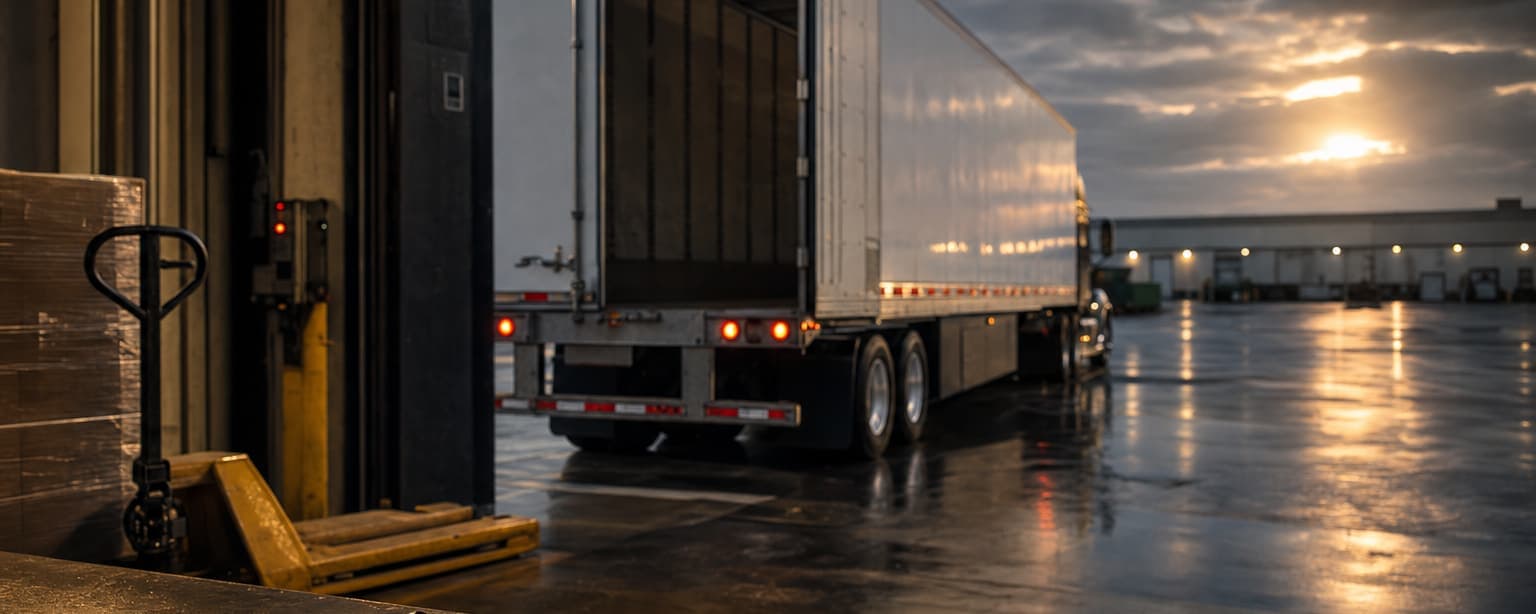
Everything that happens when the truck is not moving.
Truckers general liability covers a motor carrier for the operations around the vehicle -- yards, docks, loading and premises -- which the auto liability policy does not reach.
Tell us the situation.
One licensed human replies the same business day — not five agents, not an auto-responder. If the policy you have is already the right one, we will tell you.
We use this to quote and service your insurance, and we do not sell it or pass it to lead networks. Privacy policy.
Send us what you have. We’ll tell you if it’s right.
Your current policy paperwork, a renewal notice, or nothing at all. A licensed agent reads it and replies the same business day.
What truckers general liability actually covers.
Premises and operations
Injury or damage at your yard, shop or terminal, and at a customer site.
Without it — Somebody hurt in your yard has no coverage behind them, because the auto policy answers for the vehicle rather than the place.
Loading and unloading
The part of the job performed off the truck, where responsibility is most often disputed.
Without it — A dock incident falls between the auto policy and the cargo policy, and both point at the other one.
Completed operations
Claims arising after the work is finished, where you perform services beyond the haul.
Without it — A load secured wrongly that fails later is your claim and nothing in the auto policy contemplates it.
Contractual requirements
The general liability limit shippers and brokers name in their agreements.
Without it — A broker packet asking for general liability is not satisfied by an auto certificate, however large the limits.
Where truckers general liability shows up.
- Trucking
Truckers general liability is this coverage written around a motor carrier rather than a premises risk, and it is the name a shipper contract usually uses.
- Tanker & Hazmat
Yards, docks, loading and customer premises sit outside the auto policy entirely, and brokers ask for general liability by name.
- Refrigerated Freight
Yards, docks, loading and customer premises sit outside the auto policy entirely, and brokers ask for general liability by name.
- Livestock Hauling
Yards, docks, loading and customer premises sit outside the auto policy entirely, and brokers ask for general liability by name.
- Farm Truck
Loading at an elevator or a feedlot happens off the truck and outside the auto policy. If you haul for hire, the shipper's contract will ask for this by name.
- Regional & Intermediate Radius
Yards, docks, loading and customer premises sit outside the auto policy entirely, and brokers ask for general liability by name.
- Single Truck & Owner-Operator
Loading docks, yards and customer premises sit outside the auto policy entirely.
- Fleet
Yards, docks and customer premises sit outside the auto policy across the whole fleet, not one truck.
- Commercial truck
The exposure off the truck — at the dock, the yard, the customer’s premises — that the auto policy does not touch.
- UIIA & Intermodal
Terminals, ramps and yards are premises exposures the auto policy does not reach.

Lori Adams, TRS
Commercial Trucking Insurance Advisor
Twenty-five years in trucking insurance. Knows the filings, the radius rules and the carriers that will actually take the risk.
Transportation Risk Specialist (TRS)
What clients with truckers general liability ask us.
Is this different from ordinary general liability?
It is general liability written for a motor carrier, and the difference is in what it assumes you do. A standard commercial general liability form is built for a business with premises; a truckers form is built for one whose exposure is spread across yards, docks and customer sites, with an auto policy sitting alongside it. The two have to fit together, because the gap between them -- loading and unloading especially -- is where the arguments happen.
Do I need it if I already have auto liability?
Almost certainly. Auto liability answers for the operation of the vehicle. It does not answer for somebody slipping in your yard, damage you cause on a customer site, or an incident at a dock while the truck is stationary. Brokers and shippers also ask for general liability by name in their agreements, and an auto certificate does not satisfy that requirement.
Can it be bundled with my trucking liability?
Yes, and with many of the carriers we place trucking with it is written alongside the auto liability rather than bought separately. That is usually the better answer: one carrier, one renewal, and no argument between two insurers about which policy answers a loading dock claim.
What limit do brokers ask for?
One million per occurrence is the common floor and it is frequently specified in the broker-carrier agreement alongside the auto and cargo limits. Compliance platforms check it mechanically, so a certificate missing general liability entirely is a rejection rather than a conversation.
Commercial insurance is 96% of what we do — it is not a department here, it is the whole business. Not ready to talk? The guides answer the questions this page raises in more depth. Already insured with us and need a certificate or a policy change? Ask the service team rather than starting a quote — it is faster and it goes to the people whose job it is. We also write home and auto, which is usually cheaper alongside the business policy than apart from it.
Handed a lease, a vendor packet or a client contract with insurance requirements? Paste it into the COI Requirements Decoder to see what each one means for your business, or read what the requirements mean.